

After validation over an IPsec tunnel between Frankfurt and Singapore, QSI is now available in 20 Equinix locations across Europe, the Americas and Asia
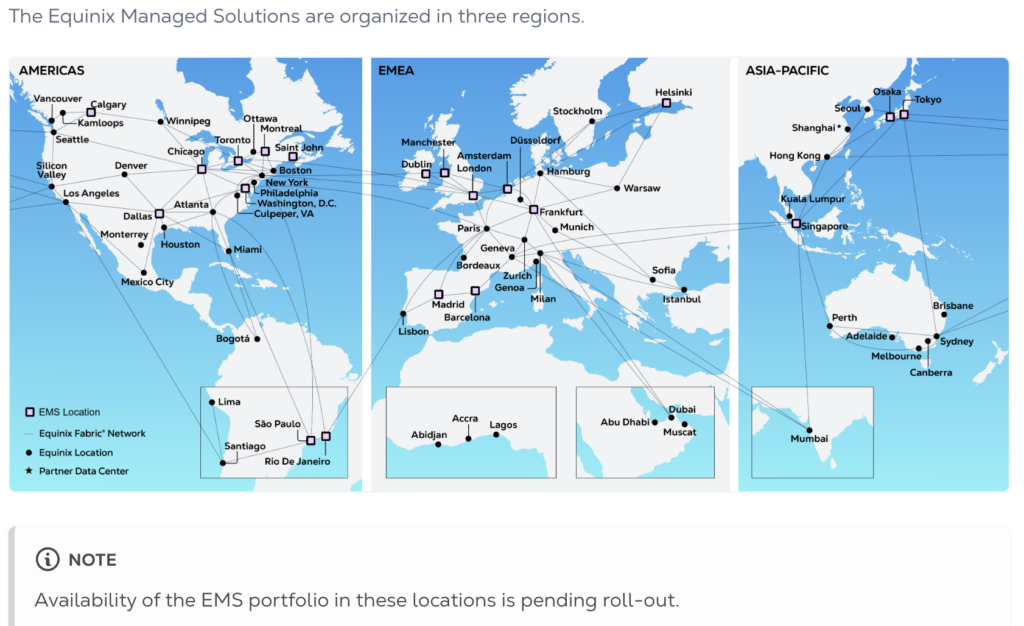
Sparkle, Italy’s leading international service provider, announced its Quantum Safe Interconnect (QSI) is commercially available at 20 Equinix International Business Exchange (IBX) data centre locations. They span Europe, the Americas and Asia where Equinix Managed Solutions (EMS) are offered (see graphic and note below).
The QSI was validated through a proof of concept over a secure Internet Protocol (IPsec) tunnel between Frankfurt and Singapore. It is available to enterprises, carriers and hyperscalers seeking quantum-safe protection for their cross-site VPNs, hybrid infrastructures and distributed multi-cloud environments.
QSI is a software-based overlay which can be deployed on existing network and security infrastructures. Sparkle says this is unlike approaches based on dedicated transmission paths, specialised hardware chains or rigid point-to-point architectures.
QSI can integrate with virtual firewalls, cloud environments and interconnection platforms, and can be delivered through Network-as-a-Service (NaaS) so organisations can secure traffic across regions without redesigning their networks. It is intended to enable rapid adoption, scalable multi-site deployments over long distances and a gradual transition to quantum-resilient connectivity.
Commercial availability
“The commercial availability of Quantum Safe Interconnect across Equinix locations marks a major milestone in Sparkle’s strategy to extend QSI into leading interconnection environments worldwide”, said Antonella Sanguineti, Head of Networking, Cloud, Security & Identity Solutions at Sparkle.
“QSI stands out for its ability to deliver quantum-safe protection in real operational contexts as a scalable software-based service. This achievement reflects a shared vision with Equinix to develop secure, interoperable and future-ready solutions across a global digital ecosystem.”
“Sparkle is innovating in the integration of next-generation security directly into the environments where dense ecosystems of customers build and scale their digital infrastructure at Equinix,” said Joe Crawford, Vice President, Equinix Managed Solutions. “They have demonstrated an approach that can be integrated into real world IPsec, data center and interconnection environments, helping customers strengthen cyber resilience across globally distributed infrastructures.”
Sparkle says it will continue to industrialize and expand the solution across the broader Equinix ecosystem, including Equinix Fabric, accelerating the adoption of quantum-resilient connectivity worldwide.