


Professor Harald Haas famously coined the term LiFi and takes a reassuringly long view of comms tech and all the pieces that need to come together around it to reach its full potential
Professor Harald Haas is Van Eck Professor of Engineering at the University of Cambridge and Co-Director of the Federated Telecoms Hubs (FTH). FTH coordinates one of the world’s largest telecoms research consortia, spanning 35 UK universities. It is organised in four streams, as shown below.
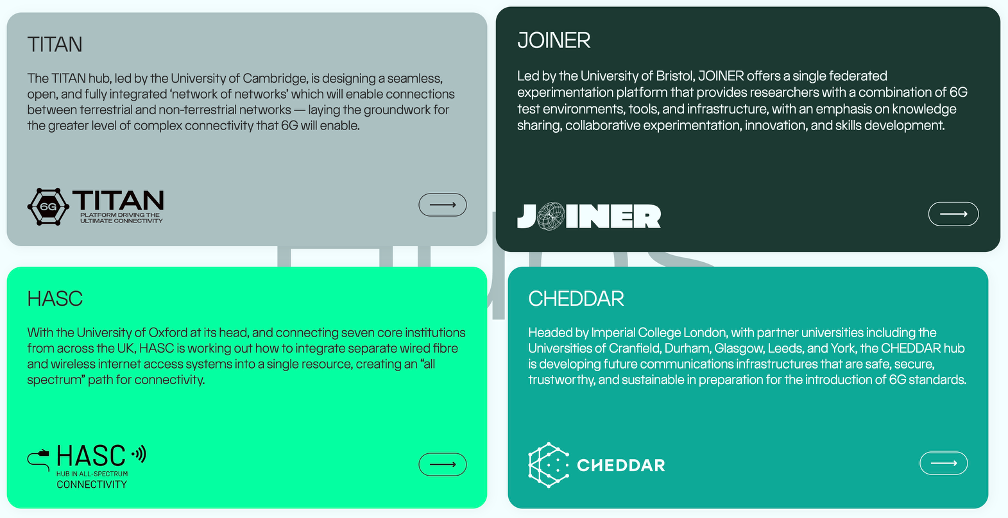
Source: https://federated-telecoms-hubs.com/#initiatives
This is a lightly edited account of the editor’s recent conversation with Professor Harald Haas (pictured).

What’s the outlook for 6G?
“Looking at the trajectory of comms technologies, Professor Harald Haas observes, “We know that 6G is primarily a marketing term, right?” He notes the continuous improvements encapsulated in standardisation, such as by 3GPP so that “Certain releases are linked to a particular standard a particular generation”.
In his view, “Continuous innovation in AI – large language models and agentic AI – are key developments. They may be a core element of 6G but others come into it – such as non-terrestrial networks – then there is a core architecture of future networks and network structures. The push now is more towards software-based innovations that will form the core of 6G”.
Surely that was the plan with 5G Standalone?
Professor Haas concedes this but adds, “Coverage is a main driver for 6G, connecting the unconnected is will be a differentiator as well. That’s why satellite communications, drone communication and aerial platform hubs will be coming to the fore will be the defining element of 6G.
“Satellite was introduced to 3GPP’s Release 17. Different technologies are not coming as a step function into the game. They start in one generation and carry over into another generation, where they really materialise. We had three different directions within the 5G market, broadband, low-latency communications and machine-type comms. 5G moved forward primarily in one area, higher data rates. Low latency is becoming more important now as more autonomous systems come the fore, like autonomous cars and robots, drones and autonomy in general.”
And IoT?
“We’ve talked about it for many years but it is gradually coming. It’s a continuum and continues to be a continuum.
Is AI going to help telecoms move up the value chain beyond connectivity – cloud, softwarisation and 5G failed to do that so far? Now we’re talking physical AI and intelligent infrastructure…depending on who’s in the chair?
“It remains to be seen: AI is becoming embedded in networks; intent-driven networks are a real deviation from rule-based, deterministic network management. Slicing came in with 5G and SDN was maybe one of the greatest things that came with it. Next the network itself becomes completely programmable and with that you have different layers, starting with AI on the physical layer.
Interference, inference and AI
“Look at multi-antenna systems, where you need to steer the beams and route the traffic. Interference in RF communications is important, given the spectrum-sharing approach which is becoming more common – and the UK is a pioneer.
“Then there are NTNs for which spectrum still needs to be decided, but may also involve spectrum-sharing between NTNs and terrestrial networks. There’s a lot of intelligence needed to do that, which leads onto predicting traffic and using telemetry to see where the traffic flows are. For example, you must optimise traffic flow if you want a low latency connection across the globe, which needs AI.
“AI is also needed in network functions: if you bring compute into the network and various other sorts of open RAN-type functionalities, you need AI. A lot of data that comes in; then the questions are, obviously, ‘Is that data normalised? Is that data trustworthy? Is that data through bias?’
“We need to validate AI models before we come to inference, executing on a model, and making sure the network behaves in the same way in every country you’re operating to validate and test networks. That’s a huge challenge.
“When it comes to inference, you probably need less computing power, but to distribute inference, which can introduce delays. When a network moves from a managed pipe to a really intelligent network that self-organises data flow based on the intent, based on what the service requires, on availability and on security requirements, that’s a whole lot of different approaches.”
Agents can destabilise a network
“If you have different AI agents in the network, how do you make sure they are stable and the network is not becoming unstable due to various agents talking to each other and wrongly reinforcing a negative feedback or positive feedback loop? There’s a number of research challenges, and in future, major, major changes in the way networks are structured and operated – from the physical layer all the way to service layers and applications.
And we’re back to autonomy…
You can also say that’s already there. We had it with SDN. We had it with slicing programmable networks, but I think we will probably get more of that agile network that allows intelligent self-healing, self-organising and self-configuring capabilities, obviously often driven by autonomy – self-driving and autonomous systems, Machines and humans, are currently the endpoint of a network and the originator for network data traffic, but more humanoid robots will come into our lives – drones, cars, whatever.
“There’s different requirements that come with operating autonomous systems securely, safely and trustworthily. So yeah, there’s transitions in network because the network needs to respond to these requirements.”
So about 6G? From tech-driven to…?
“I’m not telling you here is this big new thing – the new shiny cloud is coming and it’s labelled 6G. It’s getting the things we already know to work better, to be more commercial, and serving the real end users’ needs. That maybe is another learning from the discussions about 5G, where it’s all technology driven.
“I come from the cellular environment. I started my career in 1995 at Siemens Semiconductors, building the first mobile chip set for helping to build a mobile chip set for mobile phones. And I’ve been following all the generations since, it’s all been tech driven. But now I think the wheels have turned a little bit, and it’s more application driven, about use cases; you see the tone changing. At MWC, you see a lot of drones and robots there – devices making use of networks in a positive and a way that otherwise is not possible.”
The anatomy of an autonomous system…
“In a paper I wrote, I tried to compare the human to an autonomous system – we have a brain and a nervous system. We have actuators – arms, legs and so on – and sensors. This is what we are replicating now and telecoms will be the integration of sensing, communication, compute and actuation – these are the four functions – and control, which is autonomous.
“These systems control each other with the help of communication – that is not about some dumb pipe. It’s about how you connect cloud, your fork device in the best possible way with the rest of the core – and sensors, which are really tiny and widely spread so you get no delays. That is a nervous system – not a pipe – it adapts. It’s part of that vision of creating an autonomous system that does something very useful.
So purpose defines the uptake
“6G delivers better and more reliable communication, but the future hinges on the fact that communication networks are there for purposes which defines the uptake – and different verticals have different innovation cycles. The automotive industry is working on new cars and electric cars. They’re coming slowly. Self-driving cars are coming in very, very slowly, in cycles of 10 years and more.
“Connectivity is a part of it and defines autonomous driving within verticals’ innovation cycles, which in turn determine when things in a network are needed, with a specific requirement for a specific application, and applications vary.
“It’s the same with agriculture: autonomous harvesting devices are coming, but they arrive in a certain innovation cycle – networks need to be ready for when the application is there.
“The same is true with the IoT. You need the internet devices – lamps in your homes connected intelligently to an internal lighting system. It takes a certain innovation and adoption cycle until that becomes mainstream. Once mainstream status is achieved, the underpinning networks must manage the home systems in a low-latency way.”
Uplink versus the downlink status quo
“People want to watch YouTube, upload to YouTube. The imbalance between uplink and downlink suddenly changed dramatically – now we need more uplink capacity. It came about through demand. We need to create demands in our verticals. In my own research I look at the needs of verticals. What is the innovation that will drive them into the next phase? Then defining what the network needs to do to be ready.”
Comms need to be on the defensive – dual-use
Another area Professor Haas sees as of rapidly rising interest is what is required of networks for defence? “Sadly we live in a world of big vulnerabilities. There’s a lot of demand for innovation in contested environments for spectrum – to ensure you are secure on the physical layer. Not only that, to make it so your signal cannot be detected, nor where you transmit from. Challenges from the defence domain will define networks. And we see more dual use. We see, for example, 5G moving into the context of NATO Defence and you will see that growing around 6G
“We want to avoid warfare underwater but we need to see what’s going on. We need to be connected. You need remotely operated vehicles – autonomous systems working underwater that are connected at Gigabit speeds for high resolution cameras. It will need bespoke technologies that work in that demanding environment best.
“It comes back to my analogy of a human body. You need to define your nervous system based on your senses and brain processing the way that is needed in a particular context. We haven’t touched upon the energy efficiency, but that is another big driver.”
Energy efficiency is a huge issue
He continues, “If energy efficiency is goal: you have agents within a network talking to each other in the core, at the edge and in transport. They have continuous communications with each other – how much traffic do they generate? They generate data, the data generates models, and the models must be trained and regularly updated. You might create a self-blocking network, congested by agents’ traffic.
“That’s what I meant earlier, when I said we need to make sure it’s stable, that things that are completed in stable states. Avoiding huge energy consumption is another big challenge.”
Should automation and AI be backwardly compatible – which is what we usually do with tech in telecoms – because that kills innovation?
“Stone dead,” the professor agrees, “because you’re being compatible with something that happened 25 years ago. It’s why standardisation documents are thousands and thousands of pages long – to be backwardly compatible with lots of legacy things.” He’s more interested in fixing current issues.
Seeing the light: what does LiFi do for 5G?
“One of the biggest problems with fixed wireless access (FWA) is to get the 5G signals indoors because the signal suffers 20Db or more loss. If you’re already at the edge of a network, of a cell, then that’s a lot of loss. You need to look at UK pioneers who are solving that problem,” Professor Haas says.
He founded pureLiFi which has a product called Lightbridge. It takes the RF signal from outside and uses a light channel to send it through the window to a detector inside the house, then spreads the 5G signals indoors.
You can double and sometimes triple the capacity indoors with 5G signals, according to Professor Haas, as shown at Mobile World Congress 2026. Fixed wireless operators are conducting trials. He says, “So coming back to the original question, better reliability, better coverage, better signal for phones. There’s still some work to be done, and there are still companies out there that solve some of these technical challenges that will lead to better networks and maybe in 6G coming to its true fruition.”

