
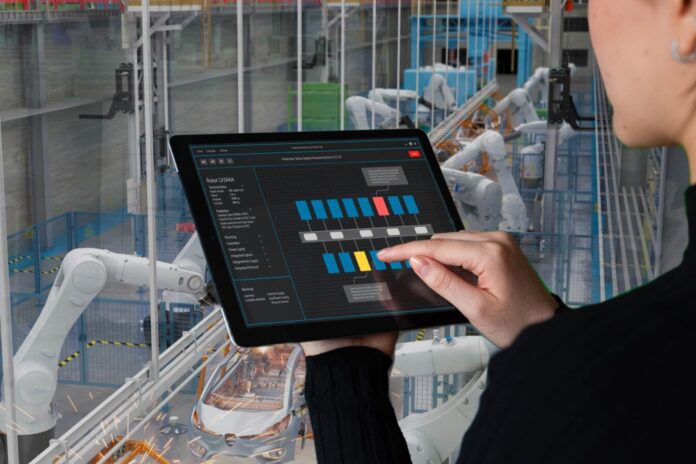
Partners in this public-private research are investigating 6G for industrial applications and to develop close integration of network and IT with the applications
A new research project, VICTOR6G, started work in January 2026. It will run for three years with a total budget of €5.4 million. Some €4.3 million is publicly funded by the German Federal Ministry of Research, Technology and Space (BMFTR) as part of the Bringing 6G into Application programme. This is intended to further the technological sovereignty of Germany and Europe.
VICTOR6G aims to create value for industry and accelerate the introduction of new 6G technologies. Hence industrial partners and research institutions are working together to develop real-time virtualisation solutions for industrial 6G applications.
Their goal is to design an integrated solution of wired and wireless networks that can reliably operate applications such as robots controlled from the local cloud or inspection drones in the “Industrial Metaverse”. Editor’s note: Metaverse is closely tied to what used to be Facebook, this might not be the best label.
Evelyn Mora puts it rather better. She founded VLGE and was cited in this recent Forbes article explaining that the next iteration of the metaverse will be focused on “world models” — a new approach to AI that relies on 3D representations of real environments and the behaviors that happen inside them.
Ericsson is the lead partner, working with SEW-EURODRIVE, Adaept Engineering, IKADO, Fraunhofer IPT, RWTH Aachen University, TU Dortmund University, TU Dresden University and, as associated partner, Airbus. They bring together expertise from telecoms, mechanical engineering and IT.
They will research these core components:
- Digital twins – the interaction of applications and communication networks for precise virtual representation in real-time
- Flexible frequency use – to explore the dynamic use of different frequency bands and for the first time focus on the centimeter band between 7 GHz and 15 GHz, which is expected to be partially available for mobile applications from 2030
- Extending time sensitive networking (TSN) into the wireless domain – so far it has only featured in fixed infrastructure.
Robots controlled from the local cloud and inspection drones that offload their computations to the cloud are examples of such industrial applications. All the solutions under consideration must prove their performance in simulations, laboratory tests and in real environments at the industry partners as well as at the 5G Industry Campus Europe operated by Fraunhofer IPT. Thus, partner-specific IT infrastructure is used, ensuring integration and scalability of developed solutions.
The focus is to optimise technical key performance indicators, such as latency and throughput, but also to determine the economic benefits using so-called key value indicators (KVIs): how can digitisation reduce costs or unlock new revenue streams?