
This new report from Mobile Europe includes insights from China Mobile International, Proximus Global, Telefónica Tech, Verizon Business and Vodafone Business, plus Deutsche Bahn
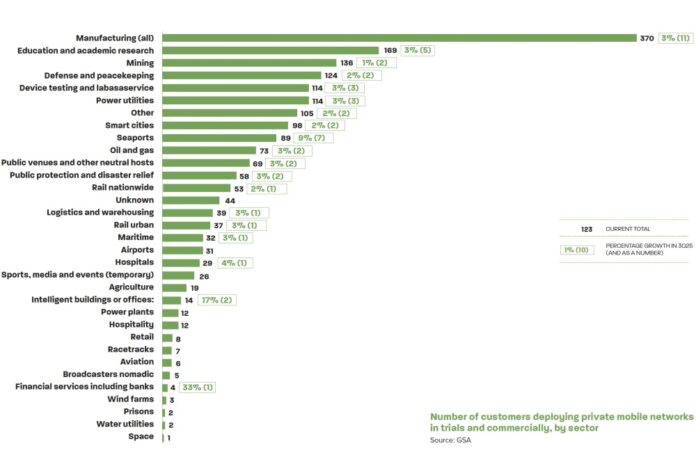
In 2019 a Harvard University market-sizing exercise, commissioned by Nokia, calculated that there were 14.58 million potential venues for private LTE and, later, private 5G. The reality, as of December 2025, is that there are fewer than 2,000 private mobile network customer references worldwide, according to the Global mobile Suppliers Association (GSA).
Care is needed with such numbers: private 5G (P5G) is diverse and the many variables account for different assessments of market size, value and so on. In manufacturing, for example, P5G is typically a highly localised deployment focusing on ultra-reliable connectivity within a single facility.
Autonomous drones making deliveries need to be constantly connected across a metropolitan area. In both cases – and all others – security is paramount.

Many niches
Until recently, many analysts viewed private P5G as a niche market, although this is changing. “I think maybe a better way to describe it is that it’s multiple niches,” says Joe Madden, Founder and Lead Analyst at Mobile Experts, a US-based research and consulting firm. “When we talk about the private 5G market, we have to talk about each vertical market separately.”
Mobile Experts tracks 13 different vertical markets, and Madden considers each to be unique. P5G may remain niche in some of these verticals, adoption is accelerating in others.
The telco business case
The ecosystem of P5G players is evolving, too. Early on, telcos expected to lead the market for P5G and believed it would be big source of new revenue but it soon became clear that telcos lacked the expertise.
Network equipment providers like Ericsson and Nokia seized the chance to provide full-service solutions, but the market has proved challenging for them too. Nokia accounts for about half the world’s private networks, but in November 2025, revealed that its private network business had lost €100 million ($115 million) on revenues of €900 million ($1.04 billion) in the previous year.
The numbers don’t add up
Sebastian Barros, MD of Circles and industry commentator, sums up the problem in this post [subscription needed for the whole article]: “for infrastructure that protects tens of millions in industrial value [see graph on next page], telecom connectivity captures almost nothing. Private networks clearly work. Telecom business models do not.”
This report, Solving the profit puzzle of P5G, looks at the market for P5G services and how its progressing with insights from operators including China Mobile International, Proximus Global, Telefónica Tech, Verizon Business and Vodafone Business, plus Deutsche Bahn. Moving up the value chain as a platform provider with accountability is the key: simply providing infrastructure is not a sustainable business model.