

Partner content: Demand for high-speed connectivity, cloud-native services and seamless customer experiences is booming – automation must span all operational levels to deliver
As automation becomes increasingly important, putting effort into how you can scale and succeed with your automation projects is essential. As a company working with automation projects of different scales and complexity for more than 20 years, Ductus sees the key to accelerating successful deployments is to build a solid foundation for sustainable, scalable automation projects.
This article looks at how we do that and how you can leverage AI to assist both automation and implementation, as well as the challenges it presents.
The challenges of an automation project
Service provider networks [GE2] are becoming increasingly complex and dynamic, with demand for high-speed connectivity, cloud-native services, and seamless customer experiences growing rapidly. To meet evolving demands, automation must span all operational levels: customer business, service and resource management.
While end-to-end automation remains the ultimate vision, the path to it is incremental, building from foundational network automation toward a seamlessly intelligent, fully automated ecosystem.
While the goal is clear – zero-touch, zero-wait, and zero-trouble networks – progress remains slow. According to TM Forum’s benchmark study, many CSPs aspire to reach high levels of automation by 2030, yet most are still in early stages of adoption, facing significant challenges such as:
- Legacy infrastructure that wasn’t designed for automation.
- Siloed operational models, making it difficult to integrate automation across domains.
- Lack of real-time data insights, limiting the effectiveness of AI-driven decision-making.
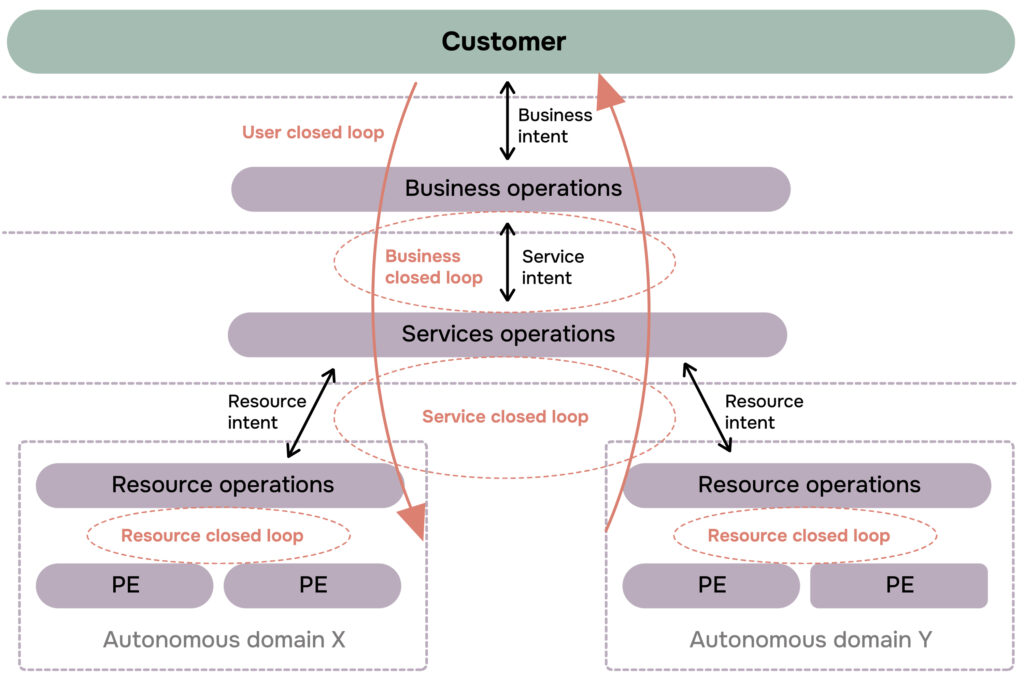
To overcome these challenges, CSPs must shift from isolated automation efforts to an integrated, intent-driven approach. The figure below illustrates the role of intent-based closed-loop management in achieving these goals.
Observability-driven approach
Closed-loop operations are essential for modern automation, but that is not all. A modern automation needs to aim at being:
- Event-driven
- State-aware
- Policy-based
- Closed-loop.
This essentially leads to observability being a driver of operation rather than a dashboard presenting current results. The key idea being observability-driven operations, meaning that the system reacts to insights rather than having a human evaluating, assessing and reacting to alerts or other system events. AI can be a powerful ally to do this, but there is a need to tread carefully.
Looking at what a closed-loop automation actually means with AI at the core, the observability-driven operations will require real-time data evaluation, correlation across layers, decision logic and of course automated execution. AI-driven operations are perfect for these types of predictive operations instead of reactive operations.
In essence, AI-driven operations can be at the core of self-healing networking when you have an observability-driven operation using AI. Data collection and analysis is an essential part of this approach, as well as validating results to make sure your system is acting on correct and proven information.
Research shows that this type of proactive detection is on the rise. Probably due to troubleshooting being the true cost center of network operations (Source: EMA Network Megatrends Report), and incident response being at the very top of the list (36,9%) of tools to automate to improve operational efficiency, followed by auto-discovery and monitoring of devices (35%).
AI can additionally assist in this approach as well, building evaluation and validation of risks and decision-making into your system to make sure that your system is acting on correct information and in the way you want it to act. Essentially, gatekeeping of AI by using AI.
Recommended approach to scalable automation
The TM Forum research underscores that while fully autonomous networks remain a long-term aspiration, CSPs’ focus on automation and intent-based closed-loop systems is critical to their long-term survival. Ductus concludes that any steps toward increased network automation – no matter how incremental – will provide a solid foundation for future advancements.
We recommend the following phased approach for scalable automation:
- Build a strong automation foundation – establish automated and orchestrated service delivery with open APIs, ensuring they are secure. Ensure interoperability and prioritize cross-domain orchestration.
- Data collection and analysis – collect, clean, and analyze network data. It is of essence to have a collection strategy in place to avoid ending up with a huge load of data with no or limited use. Take learning from Carl Andersons Data-Driven Organization from 2015 where he stresses that the data need to be at least Relevant, Accurate and Complete, but also Coherent, Timely Accessible as well as Consistent and Defined. Finally, ensure that the data is secured since it probably will contain personal data and/or business-critical information.
- Closed-loop pperations – utilize data insights from the cleaned data to update and optimize services through open APIs in a closed-loop manner. Use AI if applicable, but far from all closed loop operations have to be AI-driven.
- Scale automation across layers – start at the resource level for specific network domains, gradually moving upward to higher operational levels. Take an incremental approach.
By following these steps, CSPs can align their current operations with long-term goals, paving the way toward autonomous networks. However, when it is time to put these recommendations into action, it is imperative that you succeed with your automation. So how does one do it?
AI-infused implementation to better scale and maintain
In 2024, network automation was in third place of the highest priority networking technology initiatives (EMA Network Megatrends Report 2024), just behind network security and hybrid cloud/multi-cloud networking. At the same time, only 18% of automation projects fully succeed (Network & Infrastructure Automation Tools Landscape – 2026). Why is that and how can it be avoided?
Through years of implementing successful network automation projects, Ductus ha[JC5] ve seen firsthand what makes automation initiatives succeed, and where they fail. This experience has allowed us to identify six core software development principles that help service providers build reliable, scalable, and future-proof automation solutions.
These principles are:
- Setup a software organization including process, roles, methodology and tools to enable adaptability, efficiency, and collaboration.
- Have a QA strategy and live by it. Building quality into your solutions to ensure high quality and maintainability.
- Engage stakeholders early to align goals and expectations.
- Choose the right components for the job, looking at which reference architecture to use for Network Automation and/or Process Automation.
- Don’t try to do everything yourself. Look at available tools and methods to save time and cost. Use partners to complement your competence and to accelerate implementation.
- Test early and often and automate it. Add tests continuously and use valid test data.
With AI entering the scene, none of these principles have changed. Experience and expertise will continue to take the lead. In fact, we see that it is more important than ever to lay a foundation of well-defined use cases and a well-grounded architecture in order to fuel the quality of delivery with the assistance of AI.
The challenge now lies in managing risk, managing solution lifecycle and having quality gates that comply with AI processes (for example, when using agentic AI for deployment pipelines and decision-making).
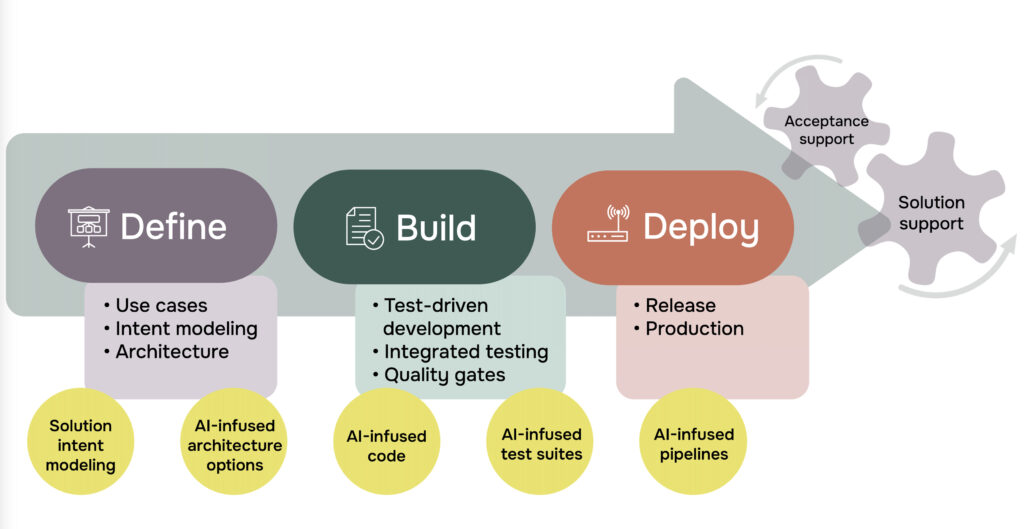
When we at Ductus want to describe the different components of defining, building and deploying an automation project we like to use the below image. It describes the important phases of a project, what each phase entails and how AI-infusion helps us in each step towards deployment. In each phase, our core development principles are present and lead the way.
In conclusion, when starting an automation software development program, make sure to have a solid foundation based on experience, and to involve stakeholders in the core decisions based on the principles mentioned here. By following these principles, service providers can accelerate deployments by building the foundation for sustainable, scalable automation projects, infusing AI in a secure and manageable way during that process. This will set you up for long-term success.