


Monetising the infrastructure remains the most serious challenge faced by those building and selling fibre broadband, although the FTTH/B take-up rate has reached 54.4%
Fibre-to-the-home/building (FTTH/B) networks now pass about 295 million homes in EU39* countries, that is, 79.3% of all homes, according to the 2026 FTTH/B Market Panorama. The Panorama is published annually by the FTTH Council Europe with the research undertaken and collated by iDate for the year ending in September 2025.
Monetising the infrastructure is the most serious challenge faced by those building out fibre broadband, although the FTTH/B take-up rate has reached 54.4%, up by 2 points over the previous year studied. Also, subscriber rates increased by 13%, outstripping the growth in the coverage, to reach around 160 million. This includes the 65% of rural households that have been passed, as outlined in the the FTTH/B in Rural Areas report.
In absolute numbers, the UK added the highest number of subscribers during the year in question, with 3.6 million, then France (+2.65 million), Spain (+2.08 million), Turkey (+1.39 million) and Italy (+1.21 million). Greece had the strongest new subscriber growth in percentage terms, with a 46.14% increase, then the UK (45.39%), Croatia (45.15%), Belgium (+33.46%) and Cyprus (+30.28%).

At the presentation of the results, Roland Montagne, Principal Analyst for Broadband and FTTx at IDATE, pointed out there there are 86 million homes passed in the EU27+UK that do not subscribe to fibre services. This equates to about 45% of home passed not taking up subscriptions, with adoption rates in Italy, Germany, the UK (38% take-up) and Poland being the lowest.
Recent research from Point Topic, on a period with considerable overlap with that of the FTTH reports, found Switzerland and Czech Republic are “bucking the trend”. They have higher take-up rates, albeit from a low base, than many larger countries where incumbents squeezed as much as they could for as long as they could from copper infrastructure.
On a more optimistic note, to the FTTH Council Europe’s 2025-2031 market forecast (see graphs below), FTTH/B networks could reach about 353 million premises EU39 by 2031 and have more than 251 million fibre subscribers expected by that time.
There are various factors that could help make that come true, based on extensive research undertaken on behalf of the Council. They include closing down the copper local loop, so that VDSL is no longer available. See the FTTH Council Europe’s report on progress in closing down copper published earlier this year: Copper Switch-Off Tracker, developed with Cullen International.
Germany, Europe’s biggest economy, always stands out as the laggard in the FTTH country reports regarding fibre penetration rates, but remember Germany has a huge cable network: Vodafone is the largest operator, serving over 13 million households. It is in the process of upgrading to DOCSIS 4.0 and FTTB with mid-2026 as its target to improve speeds and replace aging coax.
Another tactic operators elsewhere are using is offering fibre services at low prices to encourage subscribers to switch – Montagne gave the Pure Fibre deal from France’s Bouygues Telecom in France and Digi Spain’s Fibra Smart plan as examples.
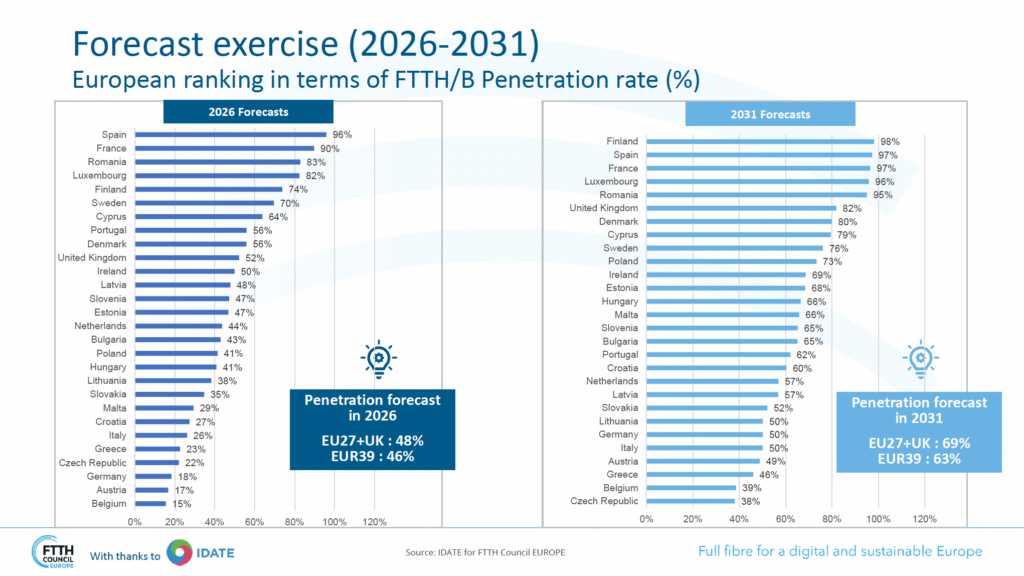
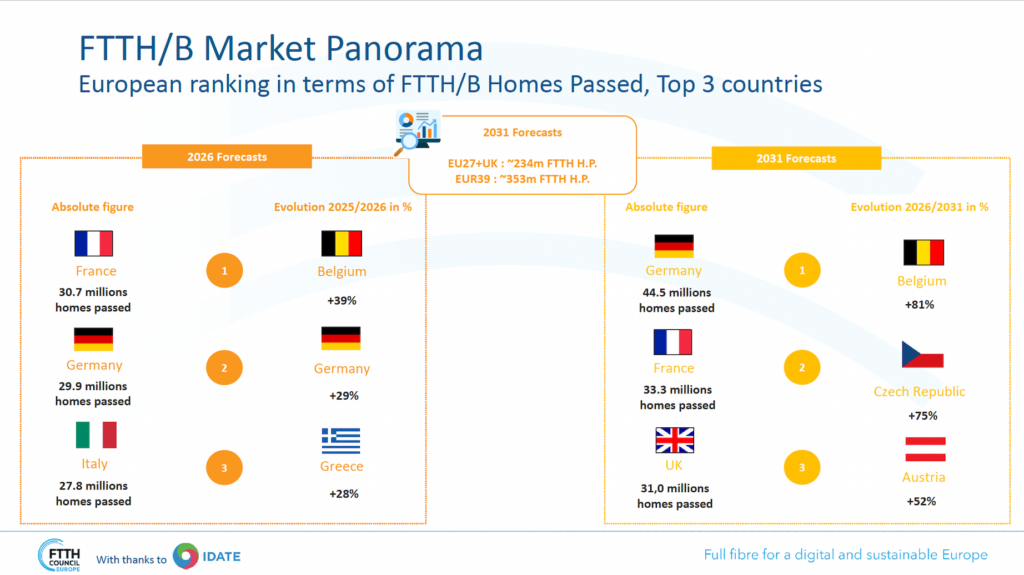
The graph below shows expected shifts in penetration in the top three, with surges from Germany and the in the earlier part of the period covered by the prediction, with Belgium, Czechia and Austria making the greatest proportionate progress across the time span.
Francesco Nonno, President of the FTTH Council Europe, commented, “Europe has achieved remarkable progress in fibre deployment, but sustaining investment at this scale requires a stable and forward‑looking policy environment. As policymakers shape the next phase of Europe’s digital framework, initiatives such as the Digital Networks Act and the future Cybersecurity Act will be instrumental in ensuring the financial stability and regulatory certainty needed to support long-term
infrastructure investment.”
The FTTH Council Europe also published a Global Ranking report, again conducted by iDate – see graph below. Interestingly and not by coincidence, Norway and Spain have completed their copper switch-off.
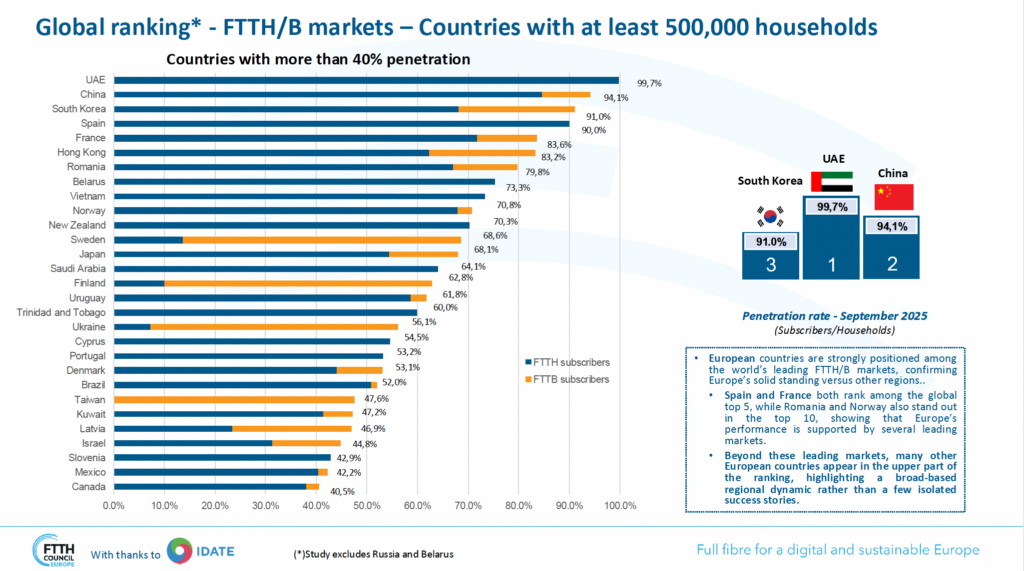
* The EU39 countries are: the 27 EU members + UK, plus Iceland, Norway, Switzerland, Serbia, North Macedonia, Turkey and Israel, and the Commonwealth of Independent States (CIS) or Eastern Partnership countries – Belarus, Moldova, Russia and Ukraine.

