

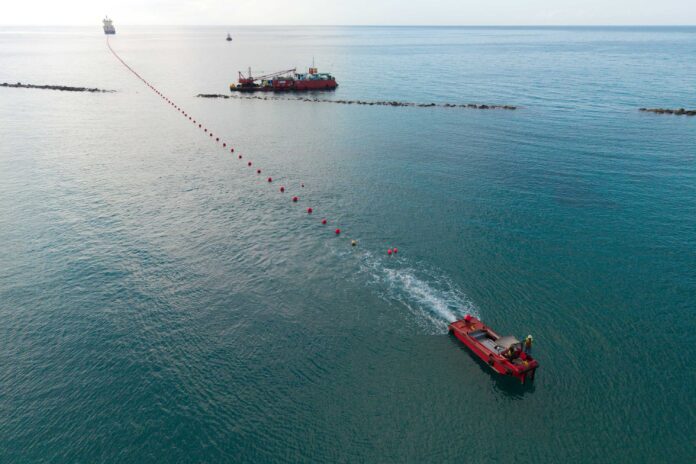
TIM Group’s international arm expands its reach across the eastern Mediterranean with a new landing at Cyta’s Yeroskipos station in Cyprus
Sparkle and Cyta have announced the arrival of the BlueMed submarine cable in Cyprus, marking another milestone for the system that connects Italy with several Mediterranean countries and extends as far as Jordan and India. The landing at Cyta’s Yeroskipos station strengthens both companies’ positions in a region that is seeing growing investment in renewing the subsea infrastructure.
BlueMed forms part of the wider Blue & Raman Submarine Cable Systems, built in partnership with Google and other operators, stretching from Genoa and Marseille through the eastern Mediterranean to Mumbai. The system comprises four fibre pairs with an initial design capacity exceeding 25 Tbps per pair, providing high-speed, low-latency and scalable connectivity across Europe, the Middle East and Africa.
With the new branch, Sparkle secures a strategic presence in Cyprus, while Cyta gains direct access to the BlueMed network, improving connectivity between Cyprus, Greece and Western and Central Europe. “This is a new important stage for BlueMed, a project that embodies our commitment to innovation and collaboration, linking Europe with Africa and the Middle East through a state-of-the-art infrastructure,” said Enrico Bagnasco, CEO of Sparkle. “Today we are also particularly glad to celebrate this milestone with our long-standing partner Cyta, confirming our shared commitment to strengthening connectivity in the Mediterranean basin.”

Cyta chief technology officer George Malikides said the connection would “further enhance the Cyprus digital ecosystem and reinforce the island’s position as a key digital hub in the Eastern Mediterranean,” while chief commercial officer George Metzakis described it as “a pivotal step forward in our ongoing mission to strengthen the island’s international connectivity.”
The project has received funding from the European Commission’s Connecting Europe Facility (CEF), highlighting its strategic importance for Europe’s digital resilience and regional connectivity goals.
Medusa moving
While Sparkle strengthens its eastern Mediterranean footprint, rival activity is picking up elsewhere. The EU-backed Medusa cable system reached Marseille in late 2024 and, more recently in October 2025, signed a landing deal with Syria, adding to a series of routes that will connect Southern Europe and North Africa.
The Medusa system, led by Barcelona-based AFR-IX Telecom, is backed by the EU’s Global Gateway initiative. The 8,700 km system will connect 12 countries across North Africa and Southern Europe, creating a new digital corridor between the Atlantic and the eastern Mediterranean. The agreement with Syria marks the country’s first international subsea cable landing.
Beyond the Med
Some operators are bypassing the Mediterranean altogether. Vodafone Group and Vodafone Ukraine have unveiled the Kardesa submarine cable system, a €100 million project linking Bulgaria, Georgia, Turkey and Ukraine through the Black Sea.
Managed by Xtera, Kardesa will deliver over 500 Tbps of capacity with its first landing in Bulgaria in 2027. The system aims to create a new digital corridor between Europe and Asia, increasing route diversity and network resilience as global demand for bandwidth continues to accelerate.

