


New report from the operator says connectivity should be treated as a strategic priority – not a commodity – as times become ever less certain
Secure connectivity is critical for Europe’s defence and resilience and should be treated as a strategic priority, says a new report from Vodafone. Its publications is just ahead of the World Economic Forum at Davos, Switzerland, which kicks off on Monday, at which digital infraststructure, tech and AI especially will be key topics.
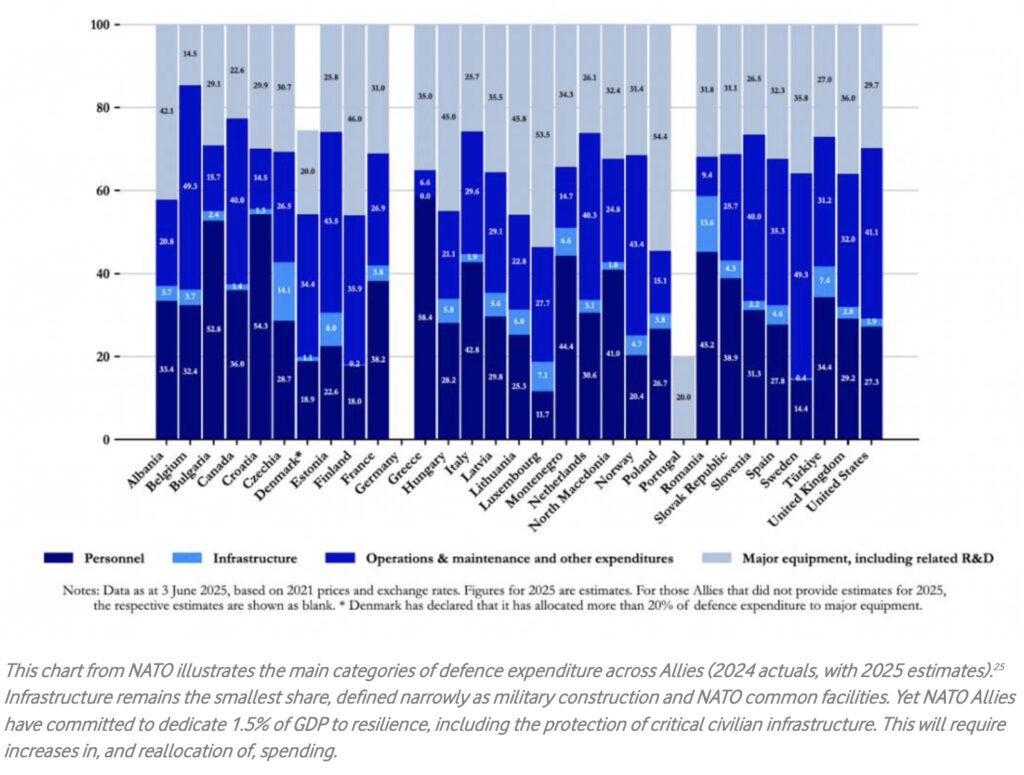
Certainly the graph below should give us all pause for thought, taken from the report. It shows the main categories of defence spending in 2024 (actual) and 2025 (estimated).
Europe’s digital backbone: why secure connectivity is now a core pillar of defence sets out how Europe’s security is inseparable from secure connectivity, and why Europe must accelerate investment and drive “pro-innovation policies”. As we all know, there is little in Western lives – and much of the rest of the world – that is not underpinned by telecoms, directly or indirectly.

Yet, as the report warns, politicians often see connectivity as a commodity rather than a core pillar of European defence and resilience. Critical connectivity investments are delayed or underfunded, and coordination for crises remains ad hoc – responsibilities are fragmented across civil and military authorities.
Treated as a low cost utlity
Joakim Reiter, Vodafone Group Chief Corporate & External Affairs Officer said, “…if Europe continues to treat connectivity as a basic, low-cost utility, it will expose citizens, democratic institutions, and allies to escalating risks.
“Addressing these challenges requires a pro-investment, pro-innovation framework, underpinned by coherent and consistent policy. Europe has a choice – it can prioritise connectivity as central to its security, and in doing so strengthen one of its most important lines of defence against modern warfare.”
Dr Antonios Nestoras, Founder and Director of the European Policy Innovation Council (EPIC), added, “Without secure critical infrastructure, Europe will face a persistent strategic deficit. Hence, our security policies must face up to risks to our subsea and on-land networks from hybrid threats, as well as the effects of concentration of network power in a few foreign companies.”
Lessons from the war in Ukraine
The war in Ukraine shows that military action can severely test connectivity and when it holds, it can dramatically strengthen a country’s ability to resist. The conflict proves digital networks are strategic assets, not only supporting security but also countering hybrid and electronic warfare.
To elevate the role of telecoms in safeguarding Europe’s prosperity and security, Vodafone sets out five policy recommendations:
• Recognise secure connectivity as a strategic security asset, and reflect this in national security strategies, EU and NATO planning, and defence capabilities.
• Establish permanent, trusted mechanisms for collaboration between governments, operators, and allies to coordinate crisis response, share intelligence, protect subsea, satellite and cyber systems, and strengthen cross-border resilience at the pan-European level.
• Close investment gaps in critical digital infrastructure where markets alone do not deliver the resilience and redundancy Europe needs. The continent must use targeted incentives and harmonised policies that strengthen network protection, including via the upcoming Digital Networks Act.
• Pursue strategic openness by partnering with trusted allies, such as the UK, to co-develop critical technologies and align standards that reinforce Europe’s security and technological sovereignty.
• Invest in digital inclusion and literacy to help citizens recognise disinformation and sustain trust in democratic institutions, reinforcing Europe’s societal resilience.
Vodafone states this approach will enable Europe to use its dense and robust networks for strategic gain, deterring adversaries, supporting allies and protecting the safety and prosperity of its citizens.
The report is available here.

