

Declared bidders for the Cayman Islands’ next submarine cable have outlining sharply different network strategies
The Cayman Islands Government’s move to procure a new submarine fibre-optic cable is crystallising into a contest between rival international consortia with contrasting views on how the territory should be positioned within regional and global connectivity markets.
The project, launched via a Notice of Opportunity (NOO) by the Ministry of Planning, Lands, Agriculture, Housing & Infrastructure (PLAHI), is backed by a one-off government subsidy and is intended to improve resilience, capacity and long-term security of international communications.
According to the Cayman Compass, at least two prospective bidders have now publicly declared for the project, an unusually transparent development at this early stage of a subsea cable procurement. The publication has also divulged the members of the competing consortia, bringing into focus a strategic debate that goes beyond the delivery of a single cable.

One declared bidder is a consortium led by Ecuador-based wholesale operator Telconet LatAm, working alongside SALT Wireless and locally registered Cayman Cable Co. The group has framed its proposal as an extension of Telconet’s wider subsea footprint, positioning the Cayman Islands as a potential node within a broader Caribbean and South American network.
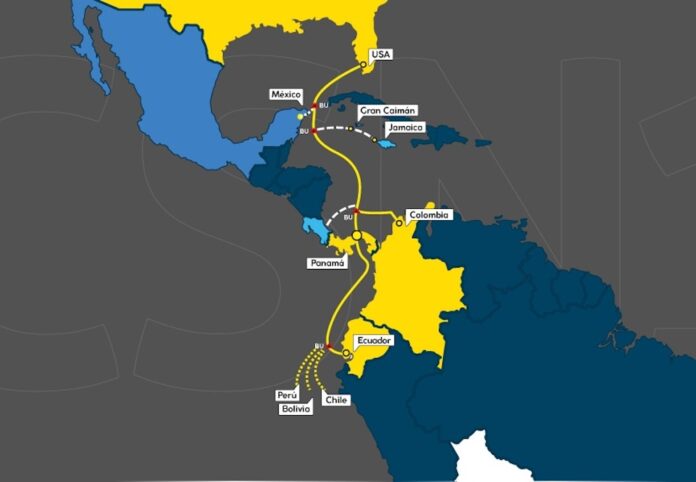
Telconet is currently developing its CSN-1 submarine cable system, which links Florida with Panama, Colombia and Ecuador. The consortium’s Cayman proposal would utilise that wider architecture through a branching unit, offering the islands access to multiple onward routes and landing points rather than a single point-to-point connection. For wholesale-focused operators, this model promises route diversity, lower latency to Latin American markets and greater flexibility in international traffic management.
SALT Wireless, which operates regional connectivity infrastructure, has publicly supported that approach, arguing that the Cayman Islands could benefit from being embedded in a larger regional ecosystem rather than relying on a standalone resilience cable. From an operator strategy perspective, the consortium is effectively proposing to monetise the Cayman landing as part of a wider wholesale platform, aligning national connectivity objectives with regional traffic flows.
Local resilience
A rival bidder, however, has questioned that strategy. Cayman Compass reports that a second consortium, which favours a more contained system design focused on direct redundancy and operational simplicity for the Cayman Islands market itself. Liberty Networks has been linked to the rival bidder through its existing subsea footprint in the region. Liberty Networks operates an extensive fibre network across the Caribbean and Latin America, including multiple submarine cable systems and landing points that already provide connectivity into the Cayman Islands.
The second group has reportedly raised concerns about the complexity and risk of tying national connectivity too closely to a broader regional network, particularly where capacity, governance and long-term control could be influenced by external demand.
The divergence highlights a familiar tension in subsea procurement: whether small but strategically located markets should prioritise sovereign resilience through dedicated infrastructure, or seek to maximise value by integrating into larger international systems.
The Cayman Islands Government has stressed that it does not intend to operate the cable itself. Through the NOO process, it is seeking an experienced international wholesale operator with the technical and financial capacity to deliver and run the system, supported by a one-time grant subsidy reflecting the project’s national significance. Qualified bidders will progress to a Request for Proposals stage, where technical designs, commercial models and governance structures will be assessed.
The proposed project includes a new international cable landing in Grand Cayman, with an option to add an inter-island link between Grand Cayman and Cayman Brac. Resilience remains a central policy driver, given exposure to hurricanes and the growing dependence of financial services and public administration on uninterrupted international connectivity.

