

Telecoms infrastructure, not just of the mobile variety, and the importance of its efficiency is a big theme – new FTTH Council research tracks fibre’s ascendancy over copper in Europe
John Stankey, AT&T’s Chairman and CEO put it well in his ‘fireside chat’ opener at MWC. You can watch the opening keynotes on demand here, Stankey’s session starts one hour and seven minutes in.
The bit I really liked (I recommend you watch all the keynotes) from Stankey was that he sees telecoms as “I never thought about our industry and our business as being fixed and mobile. I’ve often thought about it being dense fibre networks with different access technologies hanging off of the fibre”.
He added, “From a customer’s perspective, there’s one internet. They don’t want to buy it multiple times. They’d like one relationship, they’d like to get on the internet and use it. And if you’re going to meet that expectation with a customer, you’re going to have to have dense fibre infrastructure and be really good at running multiple access technologies off that fibre infrastructure. So I think that’s kind of the next play, at least in the United States. We’re seeing very, very robust intermodal competition.

“When we start talking about doing things like integrating satellite, who’s going to be the best at taking hybrid networks, bringing them together, and actually bringing them as one to the customer? Under one simple plan, they can ultimately buy and understand what they’re getting, consistent, ubiquitous connectivity with reliability and trust. Whoever does that the best, ultimately, will probably do well on the markets.
“And…if you build a higher performing network, and you can do it at the lowest marginal cost, usually things work out pretty well for you in telecommunications.”
Copper has an uneven pattern
According to this article on the International Center for Law and Economics’ website, industry analysis estimates that all-fibre networks cost about $91 less per home annually in the US than copper-based DSL networks, and AT&T reports fibre costs roughly 35% less per subscriber to maintain.
AT&T estimates its shift from copper to fibre saved 340,000 megawatt-hours of electricity in 2024: a Ramboll report found fibre at least 100 times more energy-efficient than copper during operation because copper systems need continuous power and cooling for central-office [exchange] equipment.
The article states that federal and state rules require operators to maintain copper networks, even where few customers remain. Which leads me to a new report published by the FTTH Council Europe, the second edition of the Copper Switch-Off Tracker, developed with Cullen International.
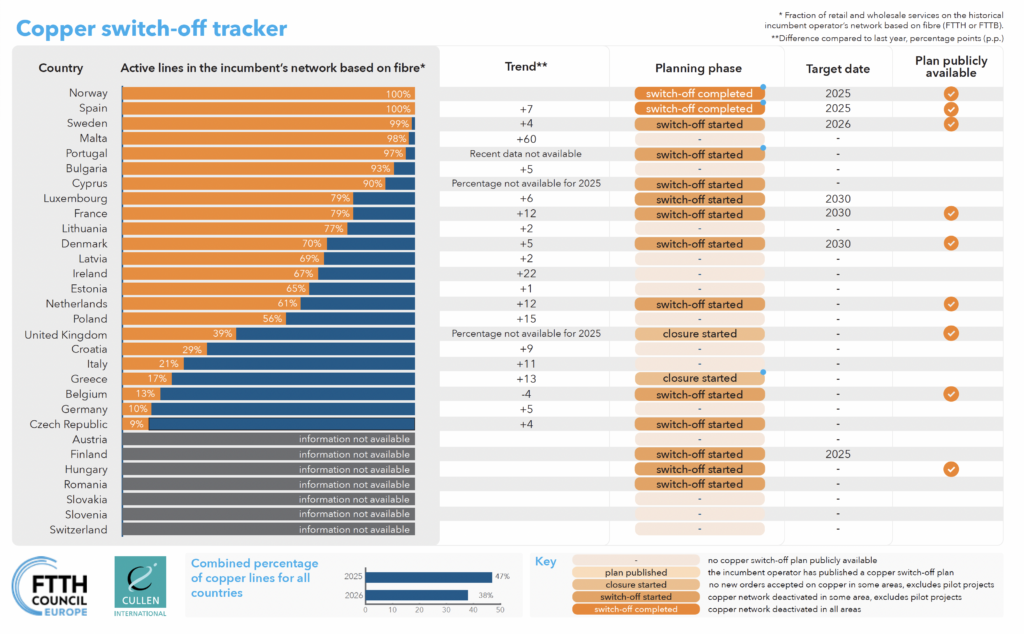
The study monitors the deactivation of copper networks across 27 EU Member States, the UK, Norway and Switzerland. This edition highlights developments observed during 2025. It confirms that no national regulatory authority has set a binding deadline for copper switch-off in any of the countries reviewed.
The research found that the transition away from copper is advancing overall, but progress is uneven (see graphic below). Norway and Spain have completed the copper switch-off, with incumbent operators fully deactivating their legacy copper networks. In Greece, the incumbent operator has stopped activating new copper lines in certain areas – a step towards decommissioning.
Incumbents are not the whole picture
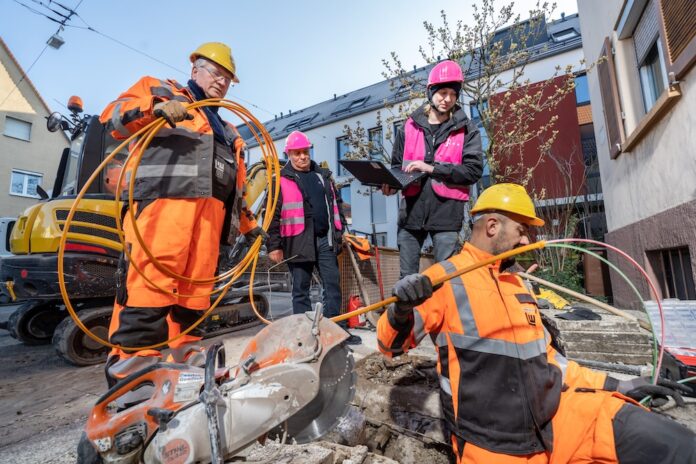
Within incumbent operators’ networks, the share of fibre in total active access lines increased on average from 53% to 62% across the countries analysed. Note this does NOT reflect the national FTTH penetration rate, which also depends on altnet providers. Also in countries such as Germany and the Czechia, incumbent operators still rely heavily on copper networks (picture show Deutsche Telekom workers deploying fibre).
In several markets – including Denmark, France, Luxembourg and Sweden – incumbent operators have announced voluntary target dates to complete the switch-off process.
The report notes in some places there is little transparency around planning. In nine countries, copper switch-off plans are publicly available, while in others, including Portugal, such plans are not publicly disclosed. In Ireland, discussions between the national regulatory authority and the incumbent operator are at an advanced stage, but no formal plan has yet been published.
Regulation is not helping
Under the current regulatory framework, national regulatory authorities in Europe cannot oblige operators to switch off their copper networks nor impose mandatory timelines. However, the proposed Digital Networks Act (DNA), if adopted, would help reshape the regulatory framework and could accelerate copper switch-off plans in some countries, by providing greater flexibility and incentives for operators to migrate fully to fibre-based networks.
The Copper Switch-Off Tracker offers policymakers, regulators and market stakeholders a comparative overview of copper switch-off strategies, fibre migration progress and regulatory conditions across Europe, providing a clear snapshot of where the transition from copper to fibre stands today. Advert over.

