

Partner content: WIM Technologies has spent years building and deploying automation for the increasingly complex RAN, which shaped the evolution of its Unison platform
The Radio Access Network (RAN) has never been more complex. With multi-vendor deployments spanning 2G through 5G, the rise of Open RAN, and networks carrying billions of daily interactions, the burden on operations teams has grown far beyond what manual processes, or even the first wave of automation tools, were ever designed to handle.
At WIM Technologies, we’ve spent years building and deploying RAN automation at the sharp end of this challenge. What we’ve learned along the way has shaped the next evolution of our Unison platform.
Where It Started: Automation That Works in the Real World

Unison began as a centralised RAN automation platform, built to act as a single source of truth across multi-vendor, multi-technology networks. The core idea was simple: operators shouldn’t need separate tools for configuration management, C-SON, performance monitoring, and deployment. And they certainly shouldn’t be doing any of it manually at scale.
Across multiple large-scale deployments, Unison has demonstrated carrier-grade scalability, auditing hundreds of millions of RAN configuration parameters and reducing configuration drift against radio design baselines from over 10% to below 1%. The platform performs continuous, policy-driven optimisation across multi-vendor, multi-technology environments, supports complex RAN sharing scenarios, and delivers quantifiable reductions in total cost of ownership relative to alternative software solutions.
These deployments proved something important: real-world RAN automation must be vendor-agnostic, policy-driven, and capable of running with minimal human intervention. Unison was built to meet all three.
The SMO Layer: Automation Meets Hybrid RAN
As the industry shifts toward O-RAN and disaggregated architectures, Unison has evolved to meet this new reality.
The Unison SMO (Service Management and Orchestration) platform extends its automation foundation into an O-RAN-aligned architecture, supporting O1 and A1 interfaces alongside a built-in Non-Real-Time RIC for rApp hosting and lifecycle management.
Crucially, Unison is a hybrid SMO. It allows operators to manage both traditional and Open RAN environments within a single platform. Configuration, performance, and fault management for legacy networks sit alongside O-RAN functions, with conflict management and a unified messaging layer ensuring seamless coordination.
The platform also exposes REST APIs and SDK environments, enabling operators and third-party developers to build and deploy automation logic directly within Unison. Policy-driven automation, scripting, Python-based development, and prebuilt applications can all coexist, allowing teams to scale automation at their own pace.
Unison AI: Intelligence Built on Operational Reality
The latest chapter in the Unison story is Unison AI and, unlike many AI concepts in telecom, this capability is already live in production environments.
Unison AI is a conversational assistant embedded directly within the platform. By combining Retrieval-Augmented Generation (RAG) with C# code execution, it provides engineers and operations teams with a natural language interface into live network data.
Users can query underperforming cells, parameter inconsistencies, or KPI trends, and receive precise, context-aware responses grounded in real network conditions.
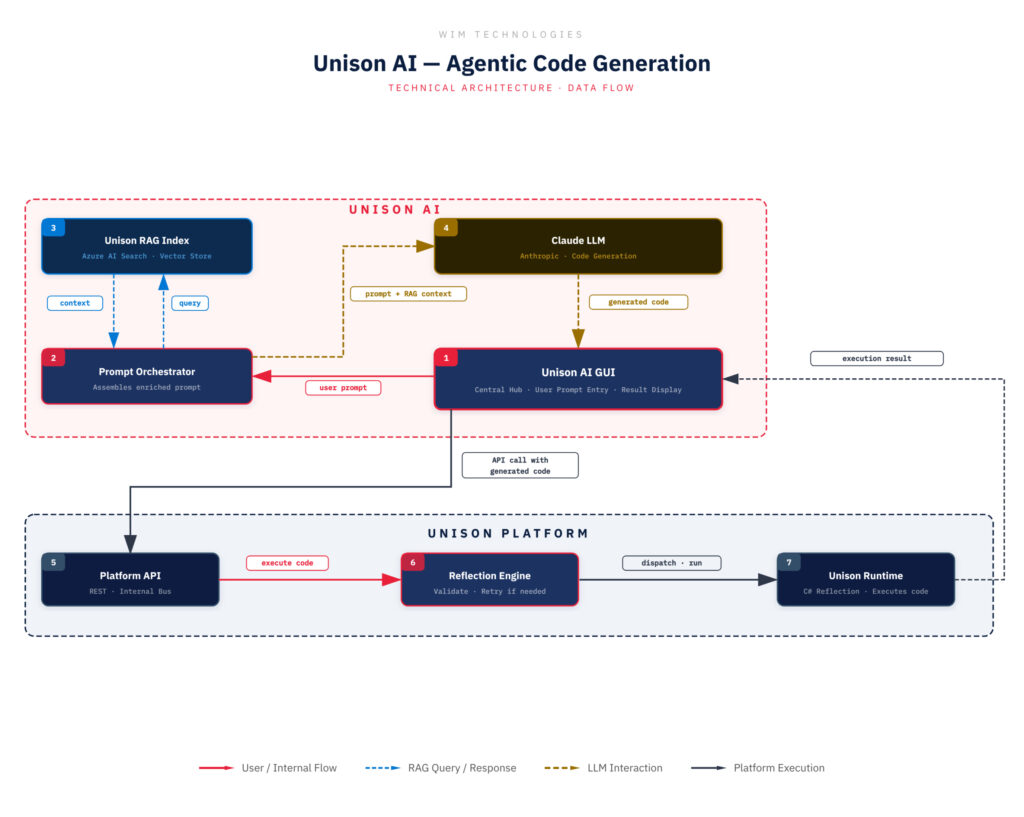
Beyond conversation, Unison AI introduces a KPI Parameter Optimiser powered by deep learning. This system forecasts network performance and recommends parameter adjustments at a granular, cell-by-cell level.
The process is iterative and intelligent:
- A user selects a cell and target KPI
- The system analyses current parameters
- It proposes adjustments
- It forecasts the impact
- It refines continuously until the target outcome is achieved
This is closed-loop optimisation in practice, not theory.
The Road Ahead
The trajectory is clear. Unison began in the operational trenches of day-to-day RAN management and has evolved into a platform capable of orchestrating intelligent, automated networks at scale.
With its SMO and Non-RT RIC architecture, WIM Technologies is aligned with the next generation of network management standards. With Unison AI, intelligence is no longer an add-on but a core part of how engineers interact with their networks.
For operators facing the growing complexity of multi-vendor environments, Open RAN transition, and increasing operational pressure, the question is no longer whether to automate.
It’s whether your automation platform is ready to evolve with you.
Unison is.

WIM Technologies is an exhibitor at FutureNet World 2026. For operators navigating hybrid networks, this unified approach isn’t optional. It’s essential.
About the author
Anshul Malhotra is CEO of WIM Technologies.