

MTN Consulting: in 1Q 2011 telcos globally employed nearly 4x more than the webscale sector but since 4Q 2025, hyperscalers’ headcount is 3.5% higher. What’s going on?
With global telecom revenues flat, the industry’s strongest players are shifting from unrealistic growth targets to aggressive cost control. Central to that shift are automation, autonomous networks, and, more recently, AI. MTN Consulting’s Telecom AI & Automation (TAIA) module examines this transition.
The telco workforce has been shrinking for years due to layoffs, retirement and attrition, while the employee profile is also changing. Telcos increasingly value skills in software, cloud, AI and quantum computing.
Operators have long automated incrementally, but many now frame their strategy explicitly around AI as AI has become a major theme in the telco C-suite. Verizon said on its 4Q25 earnings call that it aims to be the industry’s “most efficient telecom company” [an ambition shared by the Vodafone Group, see this FutureNet World article] and an AI-first company deploying AI at scale.

At Orange, Chief AI Officer Steve Jarrett said the company is still at the crawling stage of managing AI systems at scale, while CEO Christel Heydemann predicts that by 2030, nearly two-thirds of network traffic could be AI-related.
Despite this rhetoric, telcos still need to make better use of their existing workforce. Training and upskilling remain essential. Swisscom’s CEO said on its recent 4Q25 earnings call that the company is “constantly upskilling” to improve employee performance as digital and AI transformation accelerates.
Other examples include:
Vodafone Spain – in May 2026, it said it had trained more than 2,300 employees in AI and cybersecurity through 22,000 hours of instruction, including masterclasses on AI and automation tools.
China Unicom (Chongqing) – in December 2025, it said it had built an “AI talent army” around “Research-Maintenance-Operations” integration, training staff in AI applications and “digital employees.”
Telus (Canada)– the company is rolling out an “AI co-pilot” for retention calls, saying it is meant to augment staff with real-time information despite employee concerns about job security.
VNPT – in late 2025, the Vietnamese state-run operator launched specialised AI training through VNPT Academy and VNPT AI, focused on enterprise solutions and workforce upskilling.
Success now depends on balancing retraining with selective hiring to meet digital-first needs.
The layoff paradox
Large layoff announcements often grab headlines. Verizon’s late-2025 plan to cut 15% of its workforce remains the biggest recent example. Over the past year, other major cuts came from AT&T, BCE, T-Mobile US, and Charter/Cox in the Americas; BT, Telefonica, and Vodafone in Europe; and Telstra in Asia-Pacific.
Operators often justify cuts as necessary for competitiveness and profit. BCE, for example, said its November 2025 plan to cut 700 jobs would help deliver C$1.5 billion (US$1.1B) in savings by 2028. But our data shows no direct link between headcount reductions and margin expansion, even with a multi-quarter lag, whether measured by EBIT or EBITDA.
This matters for telecom CFOs and labour unions alike: headcount cuts do not reliably raise EBIT margins. Savings on labour are often offset by higher costs elsewhere, especially depreciation and amortisation.
A telco that cuts staff by 20% while maintaining heavy capex should not expect a consistent EBIT benefit. Some operators, including KPN, Telenor and Deutsche Telekom, did improve EBIT while reducing headcount, but those gains also reflected asset restructuring or revenue stabilisation. The cuts alone were not the cause.
Analysts should stop accepting claims that layoffs are needed to protect margins without clear evidence afterward.
By contrast, MTN Consulting’s TAIA research suggests that financially strong telcos, those with high EBIT margins and high EBIT per employee, reinvest in workforce upskilling across automation, autonomous networks and AI.
Indiscriminate cuts can erode morale, institutional knowledge, service quality, and brand equity, hurting long-term profitability. Telcos that rush to cut staff in response to AI may also create talent gaps that increase cybersecurity risk, churn, and lost innovation.
Key findings: 4Q25 analysis: the following insights are based on MTN Consulting’s quarterly review through to the end of December 2025.
Employment and labour costs
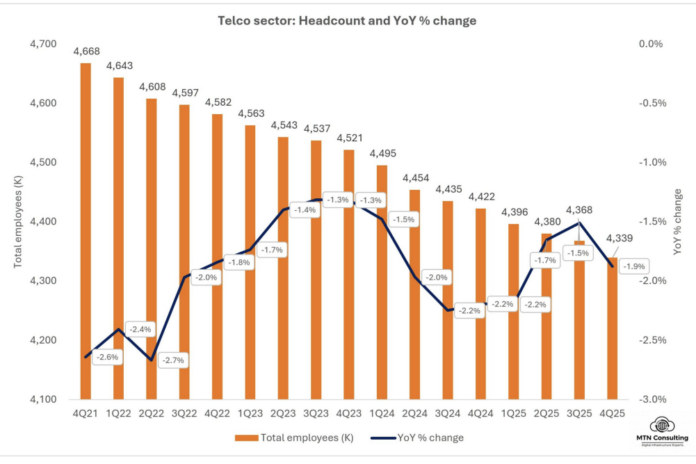
Total headcount: The sector employed 4.339 million people in 4Q25, a 1.9% year-over-year decline (roughly 82,900 positions). This aligns with long-term trends of steady contraction. On a quarter-over-quarter basis, headcount has fallen steadily for 8 years, with only one interruption: after a dramatic dip in 1Q20 when COVID hit, employment levels rose slightly in 2Q20.
Global labour costs: Annualised labour costs were $263.2 billion in 4Q25. To put this in perspective, this compares to $295.7 billion in capex and $340.4 billion in depreciation opex for the same period. Some telcos spend much more on labour costs than capital, including Telus (labour costs 2.3 times capex in 2025), Chunghwa and stc (both 1.8x), KT (1.6x), and NTT (1.4x).
Cost efficiency: As a percentage of opex (excluding D&A), labour costs were 21.6% in 4Q25, down a bit from 21.8% in 3Q25 or 21.9% in 4Q24. Many telcos spend well over 30% of opex (ex-D&A) on the workforce, though, such as Swisscom (36%), Turk Telekom (35%), Telecom Argentina (34%), BT (32%), and Orange (31%).
Revenues mapped to costs: Another view is to map revenue to its primary uses. In 4Q25, annualised telco revenues broke down as follows: 14.2% to labour costs; 18.4% to depreciation and amortisation; 51.7% to all other opex; and 15.6% “leftover” as operating profit (EBIT). The EBIT portion is the second highest since the 3Q14 period, when EBIT/revenues was 16.8%; the highest since 3Q14 was the 3Q25 result of 16.1%.
Top workforce movers (4Q24–4Q25) – the cutters
Biggest 1-year declines: The largest headcount drops in number of employees between 4Q 2024 and 4Q 2025 were at Telefonica (down 18.7K employees), Verizon (-9.7K), AT&T (-8.0K), BT (-7.7K), and Etisalat (-5.0K). These are all large national operators with strategic programmes aimed at streamlining operations. Automation has been a central part of headcount cuts at these and similar companies for many years; AI is only an after-thought. Some even may call it a convenient excuse.
Of the five top decliners, BT and Verizon have been most explicit in claiming that AI is a (or the) primary driver in motivating workforce cuts. BT’s current CEO Allison Kirby, who is already planning 55K job cuts by 2030, has said that this plan does “not reflect the full potential of AI”, and that “depending on what we learn from AI…there may be an opportunity to be even smaller by the end of the decade.”
Verizon’s CEO Dan Schulman has been vocal about ambitious job cutting plans since taking his post late last year. Now he is making big claims about the benefits of AI in company operations, pointing to energy savings and better network troubleshooting. However, most telcos cutting headcount have been shrinking for many years, or have other reasons such as weak revenue growth or low margins which explain the cutting better than do early AI deployments.
Biggest gainers
Biggest 1-year gains: The largest headcount increases between 4Q 2024 and 4Q 2025 were at China Mobile (+5.9K, AI/data center expansion), Telus (+4.7K, growth at non-telecom divisions, Digital and Health), Swisscom (+3.4K, acquisition of Vodafone Italia), NTT (+3.2K, AI/hyperscale expansion), and Digi Communications (+2.4K, growth in Spain & Italy, new launch in Portugal).
When headcount growth occurs, the causes are usually acquisition or consolidation, short-term network rollout needs related to 5G or FTTH, and occasionally expansion into new market areas. Quite a few telcos are investing in AI and data centres, or diversifying away from telecom in other ways; China Mobile, Telus, and NTT are examples.
Biggest percentage changes in employment since 4Q 2024
These often result from spinoffs, asset sales, and M&A activity. Swisscom, for instance, grew headcount by 17% between 4Q 2024 and 4Q 2025 due to acquisition of Vodafone Italia. Digi grew headcount by 10% in 2025 due to expansion within Spain and Italy, and its newly launched greenfield mobile network operations in Portugal.
Turkcell’s headcount rose by 9.3% in 2025 due to both a ramp-up in 5G and expansion in cloud and data centre areas. The biggest percentage declines from 4Q 2024 to 4Q 2025 were at TDS Telecom (-40.5%, sale of affiliated wireless business to T-Mobile), CK Hutchison (-25.9%, Three UK and Vodafone merger), and Spark New Zealand (-20.2%).
Spark’s case is unusual, as the company reported poor results for the year ended June 2025, triggering a move to more outsourcing via Infosys and Nokia.
Profitability and performance
Labour costs/opex: Telcos spending the most on workforce, measured by labour costs as a percentage of opex (ex-D&A), include: BSNL (45%), Telus (43%), Rostelecom (43%), Bezeq (37%), and Grupo Televisa (37%). Those spending the least include Softbank (6%), Taiwan Mobile (8%), Airtel (9%), Zain KSA (9%), and True Corp of Thailand (9%).
Companies with low labour costs tend to have high external costs, such as interconnection, roaming, facility leasing or outsourced sales and marketing to partners or franchises. Those with high labour costs often have complicated histories as incumbent providers, high pension costs, high unionisation rates, and may own substantial infrastructure leased to others. Some also conduct their own R&D and design, such as Chunghwa, BT, Orange, and NTT.
Labour cost per employee: The global average rose to $60.2K in 4Q25, up from $51.4K 6 years prior in 4Q19. This growth is largely driven by rising salaries in emerging markets. For instance, China Mobile’s average per-employee cost rose from $30.4K to $47.1K in that period. Labour costs per head are also rising in the US; for AT&T, as an example, its average employee cost $115.K in 2019 but that grew to $183.1K in 2025.
EBIT per employee: This KPI is on a strong upward trajectory, growing from $51.1K in 4Q19 to $66.1K in 4Q25. On average, telco employees are generating 29% more profit per person than they were six years ago.
The hyperscale crossover
In 1Q11, the telco sector employed nearly four times as many people as the webscale sector. After years of rapid hyperscale growth and telco consolidation, the two sectors reached parity in 2Q24. As of 4Q25, hyperscale headcount is now 3.5% higher than that of the global telco sector.
Telcos tend to hire lots of people in two groups: network/IT engineers, and sales & customer support staff. Telcos will continue to need people in these areas for many years to come, but the needs are declining. Geographic and scale efficiencies, automation, autonomous networking, and now AI all are allowing the telco workforce to do more with less. AI may facilitate some of these changes, but it is not the main driver. Telcos have been using automation to do more with less (staff) since well before the first Lucent 5ESS digital switch was deployed in 1982 in Seneca, Illinois.
By contrast, hyperscalers continue to branch out and have more diverse hiring needs. They do hire plenty of software engineers, but that’s not all. Some hire lots of logistics and fulfillment staff; some hire retail specialists. All key hyperscalers spend heavily on R&D, and in a number of different areas: robotics, drones, aerospace, quantum computing, gaming. Nowadays there is high demand in areas like chip and DC infrastructure design, cloud platform development, AI model training, etc.
At the same time, the hyperscalers have always aspired to downsize their workforce when possible. That’s why, for instance, Amazon has been investing in robotics since its 2012 acquisition of Kiva. Now there is more of a push to downsize, for two reasons. First, hyperscalers are spending so much on capex, that they need to cut operational expenses. Second, they need to show that they can “take their own medicine”.
After all, they are all pushing the world to adopt AI as fast as possible, and they need to show that this approach can work. Meta’s big May 2026 layoff announcement is an example. There is a chance that Meta’s aggressive layoff strategy will be as successful as its rebranding to Meta in 2021.
Contact me, Matt Walker, Chief Analyst, MTN Consulting, via matt@mtn-c.com

