

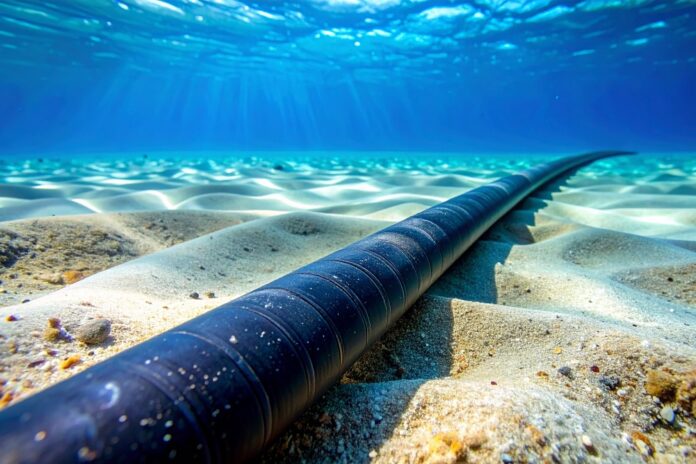
The aim is to expand route diversity and improve the resilience of international and regional connectivity across West and Central Africa after a series of multi-country outages
CSquared Group, the pan-African wholesale infrastructure company, announced it has added capacity on the 2Africa West submarine cable system to its own subsea system off West Africa. The aim is to expand route diversity and improve the resilience of international connectivity across West and Central Africa.
The 2Africa infrastructure is the world’s longest open access subsea cable system and the first to connect East and West Africa in a continuous system, and to link Africa to the Middle East, South Asia and Europe, according to Engineering at Meta. The core infrastructure was completed in November 2025 with an initial reach of 33 countries.
West Africa’s international connectivity is concentrated across a small number of coastal cable landing stations, including Accra, Lagos and Abidjan, meaning a single infrastructure disruption often affects multiple networks simultaneously. There have been three examples of this in the last 28 months.

In March 2024, subsea cable damage near Côte d’Ivoire, caused by a seabed landslide, contributed to widespread service disruption across multiple countries in the region. Then in June 2026, cuts to subsea systems near Cote d’Ivoire impacted several countries. And again in June 2026, MTN Ghana confirmed that undersea cable cuts off the coast of Abidjan in Côte d’Ivoire are disrupting internet connectivity and data services across Ghana and several other countries in the sub-region.
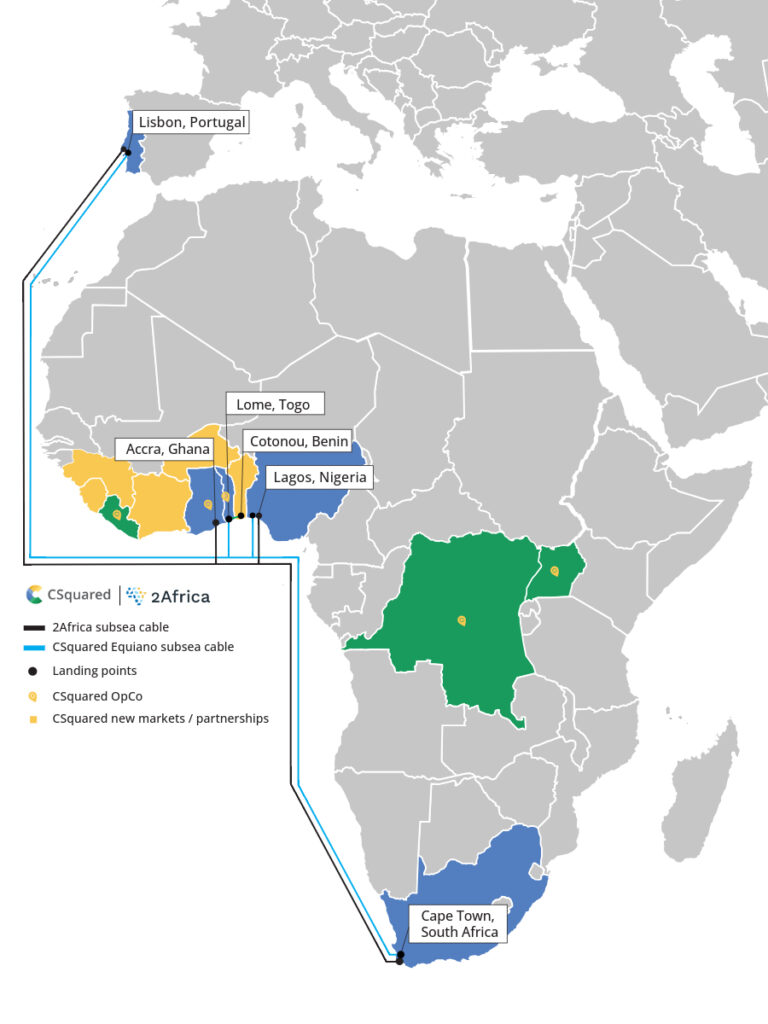
Source – CSquared and 2Africa West Map
International routing paths
CSquared’s new capacity on 2Africa West introduces an independent subsea route to its existing international architecture, which includes the Equiano system landing in Nigeria, Togo and neighbouring countries (Ghana, Benin, and Burkina Faso) via terrestrial backbone networks.
By combining multiple subsea systems with CSquared’s terrestrial backbone, operators gain access to physically diverse international routes with automated traffic rerouting across the network. This architecture enables continued service availability in the event of disruption on any single subsea system or landing point.
CSquared’s fibre backbone connects international cable landing points to inland markets across Burkina Faso, Mali, Guinea, Sierra Leone and Liberia.
Samuel Owusu Yeboah, CTO of CSquared Group, said, “Digital services, cloud platforms and mobile networks depend on resilient international connectivity. By combining multiple subsea systems with CSquared’s terrestrial backbone, we enable customers to build more robust and fault-tolerant network architectures that support uninterrupted service delivery.”

