

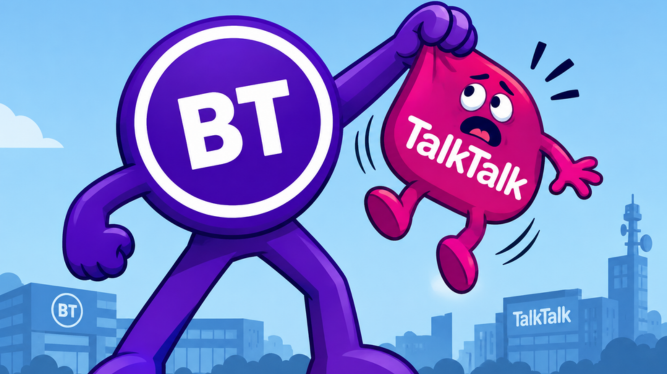
BT’s £400 million takeover of TalkTalk is already facing pushback from one of its biggest competitors, bringing fresh scrutiny to a deal that could significantly change the UK broadband market.
Virgin Media O2 (VMO2) CEO Lutz Schüler has urged the UK government to reconsider the takeover, warning that letting BT acquire the struggling broadband provider could harm competition.
BT swooped in on TalkTalk after it fell into administration, taking control of its consumer business and wholesale division, PlatformX Communications.

The criticism highlights both the scale of what BT is taking on – and what it stands to gain. The deal gives BT greater scale but also hands it a business that has been losing customers, struggling financially and battling a poor reputation for customer service.
So how does BT fix TalkTalk – and does the brand even have a long-term future?
Fix the customer experience first
BT’s most immediate job is to improve the experience for TalkTalk customers and give them fewer reasons to leave.
Omidia, Research Director, Service Provider Strategy & Regulation, Dario Talmesio, says: “As a starting point, BT could address some of the technical and customer-related issues that have plagued TalkTalk.
“The company has consistently ranked among the most complained-about providers in the UK broadband market. The vicious cycle of customer losses, financial shortcomings, and service quality degradation leading to further attrition can be halted by BT’s stronger and more scaled-up operations.”
BT has the size and resources to tackle some of those problems. Better customer support, faster fault resolution and a more reliable service could help slow down the flow of customers leaving TalkTalk.
However, there is a danger in moving too quickly. Trying to migrate customers or cut costs before sorting out the underlying service problems could make matters worse.
Integration could be the real test
Bringing TalkTalk into BT will also be a major integration job, and history suggests telecoms companies do not always get these things right.
Industry commentator and Mobile Europe Contributing Editor, Annie Turner warns against it because although, the deal makes sense on paper, it will not work smoothly in practice.
“Rationale is no guarantee of successful execution. Telcos have a long history of poor integration post-acquisition, one of the reasons their operating costs remain too high, and customer experience still sucks,” she says.
BT has turned to former Openreach CEO Clive Selley CBE to lead the stabilisation and integration planning. He knows BT and the UK telecoms landscape well, but Turner believes this could be a rather different challenge.
“He might find this a very different kettle of fish to building out infrastructure you control, to your own specification,” she adds.
There is more to the deal than TalkTalk’s retail broadband customers, too. PlatformX could be an important part of the equation.
Turner describes PlatformX as the UK’s largest independent wholesale telecoms service platform and says it “should complement Openreach, BT’s semi-detached wholesale division”.
From that perspective, the deal gives BT an opportunity to strengthen both its retail and wholesale positions.
Turner also describes it as a “hard-headed £400 million commercial deal” that takes out what was once one of BT’s biggest rivals and strengthens the former monopoly’s position in the UK.
What happens to the TalkTalk brand?
Once the immediate problems have been dealt with, BT faces another difficult question: does it actually need TalkTalk as a brand?
BT already has Plusnet for customers looking for cheaper broadband. Keeping TalkTalk alongside it could leave the group with two brands chasing much the same audience.
Talmesio continues: “In the longer term, BT has several strategic options: it could position TalkTalk as a tactical brand targeting price-conscious customers, or it could gradually absorb and upsell the higher-value segment of TalkTalk’s customer base while managing the exit of unprofitable accounts.
“However, one significant challenge is that BT already operates a value brand (Plusnet), raising questions about whether it needs to run two discount brands simultaneously.
“This is particularly relevant given that many telcos are currently rationalising their multi-brand portfolios and rediscovering the value of their flagship national brand.”
Keeping both TalkTalk and Plusnet might make sense in the short term, particularly if BT wants to avoid a disruptive customer migration. Longer term, though, it becomes harder to see where both brands fit.
Could Plusnet absorb TalkTalk?
One answer would be to gradually move TalkTalk customers across to Plusnet and retire the TalkTalk name.
CCS Insight Director of Consumer and Connectivity, Kester Mann, sees that as one possible route.
He says: “For BT, the deal strengthens its position in the entry part of the broadband market, which it is already addressing through the Plusnet brand.
“A potential scenario could be for Plusnet to absorb TalkTalk customers and for the TalkTalk brand to be retired, paving the way for BT to cross-sell broadband and mobile services from EE.”
That could give BT a relatively simple brand structure. Plusnet could continue to compete for more price-conscious households, while customers willing to spend more could potentially be moved towards EE and additional services.
Avoiding an expensive distraction
BT also needs to make sure that fixing TalkTalk does not create new problems elsewhere in the group. Mann warns that the deal “could prove both a complex technical integration and an unwelcome distraction to BT’s renewed efforts to position as a trusted, secure and reliable provider.”
Improving customer service and stabilising the customer base should come before any rush to migrate people onto different brands or squeeze out savings.
“By contrast to broadband, BT has chosen not to be drawn into the cut-throat value segment of the mobile market, where MVNOs are quickly taking share through very low pricing,” Mann concludes.
For BT, then, reviving TalkTalk may not necessarily mean preserving it in its current form. The immediate job is to stabilise the business and improve the customer experience.
After that, BT can decide which customers, assets and brands have a place in the wider group – and whether the TalkTalk name is one of them.
IN RELATED NEWS

