


The growing complexity of networks and customers’ demands for cloud-like experiences mean telcos must go beyond identifying problems to automate the actions to resolve them
Network complexity is increasing substantially as operators adopt cloud-native architectures and deploy 5G Standalone (5G SA), edge-computing and Internet of Things (IoT) networks. It is no longer possible to manage manually the volume, velocity and variety of changes required in software-based networks. For example, the number of interconnected devices is exploding, generating massive volumes of data along with an expectation that networks will operate with near-zero latency.
Cricket scores
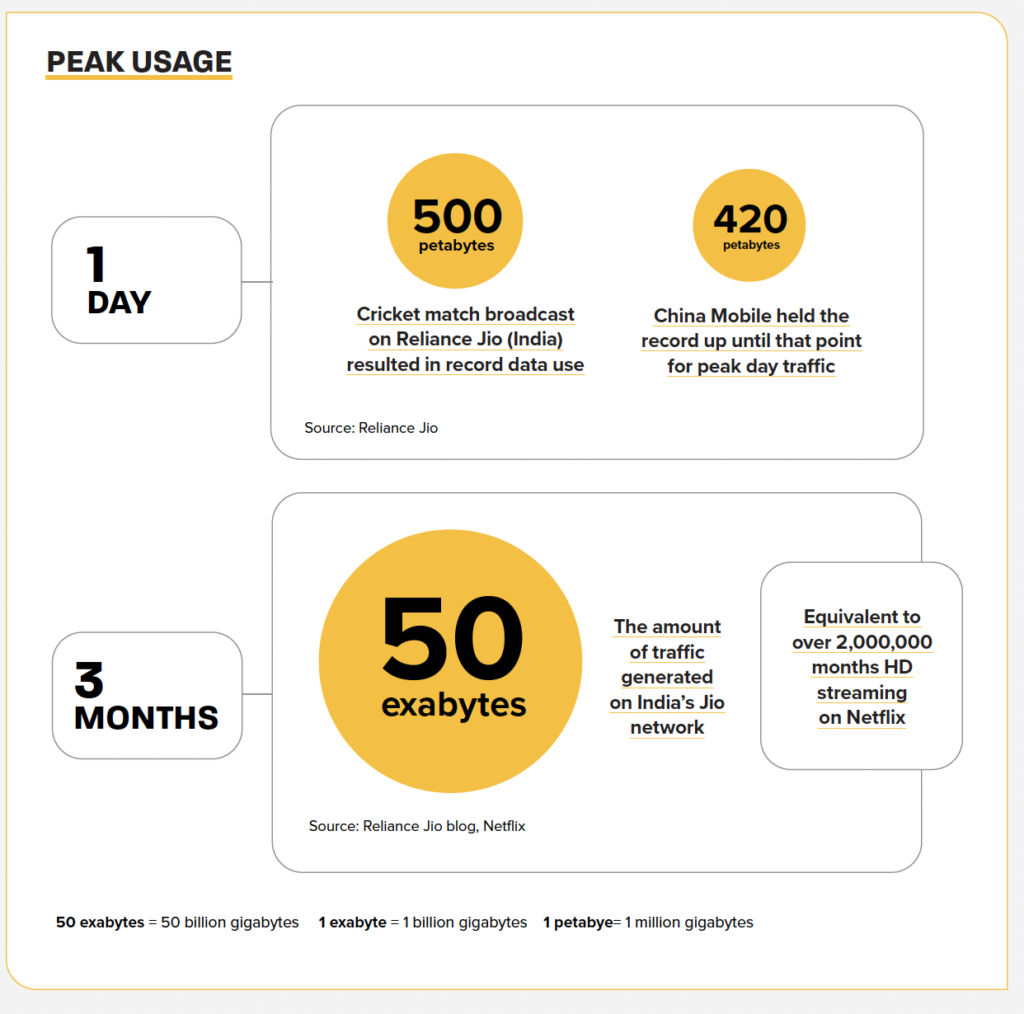
Consider India’s Reliance Jio, which measured the amount of data it generated in a recent three-month period at around 50 exabytes. To put that in perspective, Netflix streams HD video at about 3 GB per hour. Reaching 50 exabytes would mean streaming HD video for more than 1.6 billion hours. Jio’s huge data surge was due in part to an ICC championship cricket match that resulted in 500 petabytes of data in a single day. According to Jio, this beat the previous record held by its global rival China Mobile, which handled 420 petabytes on its peak day.
Source: Network assurance – action insights with automation, published by Mobile Europe, September 2025
5G network slicing adds even more complications. Each slice is essentially a virtual network tailored for a specific use case and must be managed independently to ensure performance, reliability and security. This is why multi-slice, multi-use case deployments at scale are still rare.
“Understanding the root cause of an issue is vital, but increasingly challenging due to the number of signalling interactions and nodes involved in todays networks,” says Matjaž Kranjc, Telecom Network Specialist, Telekom Slovenije. “We are, therefore, investing in smart and effective tools to ‘tame’ this complexity and shield it from our users. Our goal is simple: the technology in the background should work invisibly, while the user experience becomes better, faster and more secure.”
It’s about customers
Customers’ expectations are evolving, too. Enterprise users and consumers expect CSPs to provide dynamic, cloud-like experiences that enable them to buy and consume telecom services in the same straightforward, immediate way they can dial cloud capacity and services up and down to meet their needs.
At the same time, they want the same level of reliability and QoS they are accustomed to when working with telcos. Any delay in resolving network issues can lead to violations of service level agreements (SLAs) and ultimately to dissatisfaction and churn.
Automated insights might detect a degradation in service quality, but unless the system can act on that insight – by rerouting traffic, restarting a service or allocating additional resources, for example – customers’ experience suffers.
Swisscom is prioritising customer experience as part of its AI and cloud transformation, according to Mark Düsener, the company’s CTIO. He said during a panel at TW-Ignite 2025, “The best thing is to take a customer perspective first. So, the most important feature of a cell is reliability: Whatever service they consume, it shall be reliable”.
Swisscom aims to measure improvements in customer service and experience daily, according to Düsener. “That is ever more demanding, since the complexity is rising dramatically,” he said, noting that within just two years of Swisscom’s introduction of 5G in 2019, the company had doubled the number of elements in the radio access network (RAN).
This represented “an exponential growth in complexity because all of the neighbourhood relationships increased exponentially,” Düsener explained. “And doing that with the same team – optimising the same network with the same amount of people – needs more support that is beyond, let’s say, manual work.”
Automation’s opex savings
Operational efficiency is another driver of automated action as CSPs are under constant pressure to cut costs while maintaining or improving service quality. Automating processes like order fulfilment, orchestration and assurance improves efficiency by reducing the need for manual intervention and minimising human error. Indeed, autonomous (self-configuring, self-healing and self-optimising) networks are the end goal for most operators.
Getting there means implementing closed-loop automation, where insights feed directly into automated decision-making and execution of processes.
Assurance has an “elevated role in the autonomous networks story”, according to Christoforos Sarantopoulos, Senior Analyst for Service Provider Networks at Omdia. “It is no longer a standalone function that’s just an afterthought. It’s something that needs to go hand in hand with orchestration systems to have a closed-loop operation,” he says.
We discuss autonomous networks more throughout but first next we look at why end-to-end observability is important.
This is an excerpt from our report on Network assurance. Download the report free by clicking the banner below.