

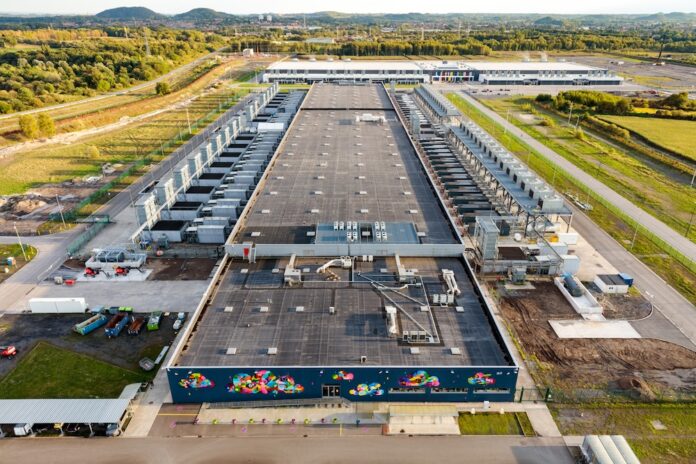
The hyperscaler wants to spend €5 billion in Belgium but its Feluy data centre project cannot currently connect to the high-voltage grid
While the much-vaunted AI sector thrives on hype and vibe, Europe’s energy sector is ruled by physics. Google is facing this challenge in Belgium’s Wallonia region where its data centre project in Feluy cannot currently connect to the high-voltage grid. For a company that recently announced that it wants to invest €5 billion in Belgium this means it is needing to scramble for a workaround as L’Echo reports [subscription required].
Google recently obtained a permit for the data centre, which is on a plot of around 36 hectares located in the Feluy-Écaussinnes industrial zone. The site does not currently have access to the high-voltage electricity network, which is becoming saturated. “Currently, only medium voltage is available, but an upgrade by Elia is planned in the medium term. The objective is for the centre to be operational in 2029,” said the Walloon Minister of the Economy Pierre-Yves Jeholet, when questioned in Parliament this week. Elia is the electricity transmission system operator.
In the absence of immediate access to Elia’s high-voltage network for the Feluy centre, a temporary solution has been found with Ores, the local distribution system operator, according to there report. “We are going to connect Google to medium voltage (25 MVA) on a temporary basis. This connection will be disconnected once there is availability at Elia,” confirmed Annabel Vanbever, a spokesperson for Ores.
Defining constraint
The Belgian Digital Infrastructure Association’s 2025 report highlighted its data centre operator survey which singled out power and permitting dominating concerns. Respondents identified grid access and permitting timelines as the main inhibitors to expansion, far outweighing cost or demand issues. Colocation and hyperscale capacity will exceed 260 MW IT power by year-end 2026, split into 105 MW for the colocation sector and 158 for hyperscale data centres. Investment momentum remains high, led by Google’s €5 billion programme in Wallonia.
The compound annual growth rate of colocation data centre IT power is 21.5% between 2024 and 2031, with an expected capacity of 344 MW in 2031.
According to the report, Power availability has become the “defining constraint” for future expansion. Grid operator Elia is introducing flexible connection models and staged energisation schemes to reconcile industrial, residential, and digital demand. This is prompting closer cooperation between operators, utilities, and policymakers. On-site generation and battery energy storage systems (BESS) are emerging as practical complements to enhance reliability and grid stability.
Grid capacity and, especially, allocation/lead times are the single biggest throttle on market growth. Even where total generation appears adequate on paper, the ability to secure timely, firm connections at the right locations is uncertain, which, in turn, delays site selection, financing, and customer commitments.
Respondents repeatedly framed power as the pinch point that determines what can be built, where, and when, ahead of any other factor (real estate, talent, even demand). As one put it: “The energy exists… allocation is the challenge.” The practical implication is that successful projects start with a power strategy – early reservation, flexibility options, and credible grid roadmaps – rather than with buildings.
The group concludes that as grid operator Elia warns of limited spare capacity in some industrial zones, flexible-connection models and staged energisation schemes are becoming essential. “With the construction phase giving way to activation, power allocation now determines timing. Collaboration with Elia on flexible connection schemes, energy storage, and demand response integration will determine how quickly new capacity comes online. Grid readiness – not real estate – has become the strategic bottleneck of the Belgian data-centre economy.