

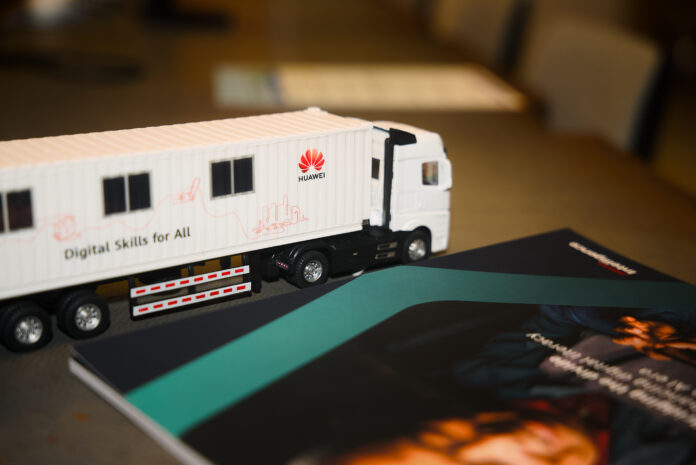
Huawei has unveiled plans to bring its DigiTruck mobile classroom scheme to several cities in the Île-de-France region this autumn.
In a bid to help people in underserved communities build the digital skills they need, the programme will target those customers with practical digital skills training, which could be used for work, education and everyday life.
The move comes as Europe faces a growing need to improve digital skills among people who may have access to smartphones, computers and broadband but lack the confidence or knowledge to make full use of them.
“Today, the digital divide is no longer simply a question of access to the Internet or to a computer,” Flavie Deprez, CEO of Konexio, said. “Above all, it is a question of skills and autonomy.”
DigiTruck is part of the technology giant’s Skills on Wheels initiative, which uses solar-powered mobile classrooms to provide hardware, connectivity and training to support underserved communities with digital skills.
Since it launched in 2019, Skills on Wheels projects have trained more than 130,000 people across 21 countries.
The programme has focused particularly on groups at risk of digital exclusion, including people living in rural and remote areas, older people, women and girls and children and teachers in underserved and underprivileged communities.
The move comes as research from GSMA Intelligence, titled “Bridging the Divide: Enhancing Digital Literacy in the AI Era,” found that 38% of people remain offline despite being covered by mobile broadband.
It also warned that without investment in basic digital education, rapid AI adoption could deepen existing inequalities, even in areas where broadband infrastructure is already available.
The new DigiTruck programme in France will put this approach into practice, bringing training directly to communities across the region. Despite being highly connected, the region still has communities that do not benefit equally from digital technology.
People on lower incomes or those with limited digital experience can still face barriers when accessing online services, education and employment opportunities.

Deprez also highlighted that digital exclusion is not confined to older people. According to INSEE, almost one in five people aged 16 to 29 still has a low overall level of digital skills.
“Being born into the digital age therefore does not automatically mean knowing how to use digital technology effectively,” she said.
She added that mobile format is designed to reach people who might not otherwise attend formal training, stating: “If some people don’t come to digital, then digital must come to them.
Huawei Executive Editor-in-Chief, Gavin Allen, added: “Mobile classrooms have demonstrated immense value in helping underserved populations break through physical and psychological barriers to technology.
“We will continue working alongside local governments and industry partners to drive digital literacy, ensuring that no one is left behind as we transition into the AI economy.”
Meanwhile, the GSMA Intelligence report also added that closing the global digital capability gap could add around $3.5 trillion to global GDP by 2030, with more than 90% of those gains flowing to low- and middle-income countries.
Instead, the report calls on governments, telecom operators and technology companies to make digital and AI literacy a bigger part of education and skills training.
GSMA Intelligence, Head of Research and Consultancy, Tim Hatt, said: “Digital literacy can no longer be defined by static thresholds.
“Connectivity alone is insufficient – capabilities, system design and trust must evolve together. To capture this multi-trillion-dollar opportunity, stakeholders must integrate layered AI literacy directly into daily livelihoods through trusted community channels.”
Huawei’s DigiTruck programme in France will be one example of how this kind of training can reach people who need it. By bringing a mobile classroom into local communities, the programme will give people the chance to develop practical digital skills and feel more confident using technology in their everyday lives.

 in partnership with Insight Enterprises and the Metropolitan Airports Commission (MAC).)