


Publication outlines how mobile operators can adopt AI-based operating models for increasingly autonomous network operations
The Next Generation Mobile Networks Alliance (NGMN) has published guidance outlining how mobile operators can evolve their cloud-native network operations towards agentic AI-based and increasingly autonomous operating models. The publication, Cloud Native Next Chapter – Agentic AI-based Operating Models provides a framework for mobile operators to help operators navigate the necessary technology, processes, skills and organisational culture.
The new publication builds on NGMN’s Cloud Native Manifesto and cloud-native frameworks such as the Cloud Native Computing Foundation’s (CNCF’s) Cloud Native Maturity Model (CNMM), to introduce a structured approach to integrate Agentic AI-based capabilities into operations.
It defines five progressive AI adoption levels and maps them to the CNCF Cloud Native Maturity Model (CNMM) stages, enabling operators to assess their readiness and required next steps to gradually evolve towards more intelligent and autonomous network operations.

“As Agentic AI-based technologies evolve rapidly, NGMN provides operators practical guidance on how to lever them on the transition to Agentic AI-based network operations, in a responsible and scalable way,” said Anita Döhler, CEO of the NGMN Alliance (pictured). “By outlining 5 specific stages, this publication provides a roadmap for mobile network operators to evolve their cloud-native platforms towards Agentic AI-enabled operating models, whilst setting clear objectives and measuring business outcomes.”
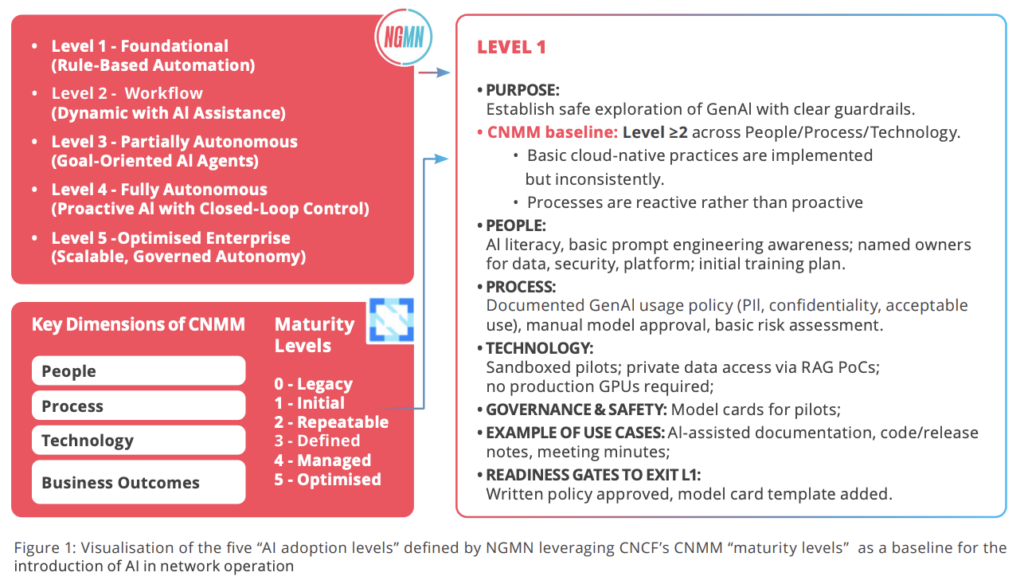
The document provides guidance on what is required across technology, people, skills and organisational culture for each AI adoption level. It stresses the importance of defining clear transformation targets and measuring business outcomes as operators progress.
Laurent Leboucher, Chairman of the NGMN Alliance Board and Orange Group CTO and EVP Networks, notes, “Agentic AI has the potential to fundamentally change how telecom networks are operated, but only if telecom operators build on the right foundations.
“AI adoption doesn’t happen in isolation; it depends on cloud-native maturity and a clear path to integrate autonomy without sacrificing reliability or control. That’s exactly what NGMN’s framework delivers: practical guidance to help operators embrace AI-driven operations with confidence.”
Cloud maturity
The publication highlights how cloud-native maturity forms the foundation for AI-driven operations: early stages focus on controlled experimentation and AI-assisted workflows; more advanced stages enable increasingly autonomous network management through closed-loop automation and intelligent orchestration. By aligning cloud-native maturity with AI readiness, operators can adopt AI technologies in a phased and responsible manner while balancing innovation with operational stability.
“Cloud-native adoption provides the essential foundation for integrating advanced AI into telecom operations,” said Bernard Bureau, NGMN Board Member and VP Wireless Technology & Services at TELUS. “By mapping cloud-native maturity levels to AI adoption stages, NGMN offers operators a practical framework to gradually introduce AI-enabled automation — from early experimentation to increasingly autonomous network operations.”
The publication also emphasises that the transition towards AI-driven operating models is not solely a technological shift. Successful adoption requires organisational transformation across people, processes and culture, including new skillsets, responsible AI governance and redesigned operational workflows. AI-enabled tools can support tasks such as network troubleshooting, capacity planning, and predictive operations, enabling more efficient and resilient network management.
Download the full publication Cloud Native Next Chapter – Agentic AI-based Operating Models.

