

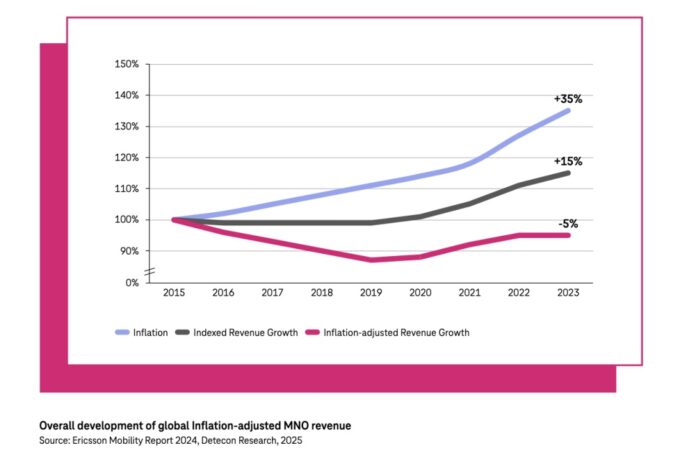
Telecoms is evolving from a single connectivity-led system into a more polarised landscape, in which operators follow increasingly different economic logics
The telecoms industry is entering its most consequential transition in decades. What is often described as another wave of modernisation is in fact a structural stress test: the sector is evolving from a single connectivity-led system into a more polarised landscape, in which operators follow increasingly different economic logics.
Connectivity remains essential for cloud adoption, digital lifestyles and AI-enabled economies, but selling gigabytes no longer secures long-term value creation (for example, see graph above, source State of the Industry analysis).
Network assets still require massive investment, particularly in fibre and 5G, while competitive pressure continues to push prices down. As the traditional connectivity utility model hits its structural limit, value is migrating towards software-driven platforms, automated operations and AI-enabled digital services.

Detecon’s State of the Industry analysis of more than 100 global operators suggests that this re-sorting is already underway. While most were still clustered around the Connectivity Leader model in 2020, the centre of gravity is expected to weaken towards 2030 as operators move into more distinct strategic archetypes.
Five strategic archetypes
Archetype discipline increasingly separates successful operators from those that fall behind: the ability to translate specific assets into a single, coherent economic model.
Two of the archetypes remain anchored in the physical layer of the industry. Connectivity Leaders create value through industrial excellence in the retail core, monetising scale and compressing unit costs across mobile and fibre. Infrastructure Pureplays operate one layer below, extracting value from towers, fibre and backbone assets through neutral-host and wholesale models tied to tenancy and utilisation. In both, AI primarily strengthens efficiency – supporting predictive maintenance, traffic and energy optimisation, as well as network planning.
Two further archetypes shift the value logic beyond connectivity as the product. TechCos move upward, repositioning connectivity as a distribution layer for software-like businesses such as cloud, data centres and AI-enabled B2B solutions. Here, AI can become part of the revenue logic, extending beyond efficiency into AI-enabled B2B offerings and platform services.
Digital Disruptors move sideways, competing on structural cost through lean greenfield architectures, narrow propositions and digital-only distribution. They apply AI tactically in onboarding and service automation.
The fifth archetype – AI Native – is categorically different. It treats AI as the operating system of the business itself, embedded end-to-end, with value created through autonomous, self-optimising networks and the direct monetisation of intelligence. By 2030, this archetype will remain rare, but it defines the structural frontier towards which the leading edge of the industry is moving.
Three structural constraints
Choosing an archetype does not make it achievable. Three structural constraints define the strategic positions an operator can realistically occupy.
The first is structural scale and cash generation capacity and depends on whether the core business produces enough investment to fund a move beyond connectivity. Platform and AI ambitions require long build-out cycles. Operators without reliable surplus cash from the core fall back into episodic experimentation. Where the core business does not fund the future, the future does not scale.
Secondly, operators need enterprise access and ecosystem relevance – they determine if beyond-core growth can translate into revenue once it is funded. Adjacencies rarely scale through consumer demand alone; they require access to enterprise and public-sector customers, and a credible role within broader digital ecosystems. Without this demand, new ventures accumulate complexity rather than revenue.
The third constraint is the ability to separate the organisation to serve the new business and discipline in execution – in other words, being able to turn capital and market access into a viable new business. New ventures operate on different governance, incentive and speed logics than the connectivity core. Where that separation is missing, the core absorbs and neutralises change.
Taken together, these constraints explain why so many transformations stall in hybrid positions. Decisive leadership must commit capital, align the organisation and apply execution discipline to the archetype that is structurally within reach.
Strategic clarity is the deciding factor
Strategic clarity will become a performance lever in the next phase of telco transformation. Operators that keep multiple strategic paths open will carry rising capital requirements, organisational complexity and diluted investment priorities at the same time. As value creation shifts beyond pure connectivity, ambiguity turns into a structural disadvantage.
By 2030, operators that define their archetype early will be able to build around it with greater consistency. Those that hesitate will allow market pressure, capital constraints and competitive dynamics to narrow their options for them.
For European operators, the strategic question is therefore no longer whether to move beyond connectivity, but which role they can credibly own in the next telco era.
About the author
Dr Alexander Mathieu is a Partner at Detecon, an independent company within the Deutsche Telekom Group. He is responsible for strategy, corporate development and transformation within the telecoms practice. Dr Mathieu advises clients on corporate strategy and corporate development as well as transformation within the telco and technology domain.

He combines an understanding of technological developments with business model drivers to create value. He has more than 20 years’ professional experience in the telecoms sector in both corporate and strategy consulting. Before joining Detecon, Dr Mathieu led the corporate strategy department for Nokia and served in the telco practice of a global tier 1 strategy consultancy.

