

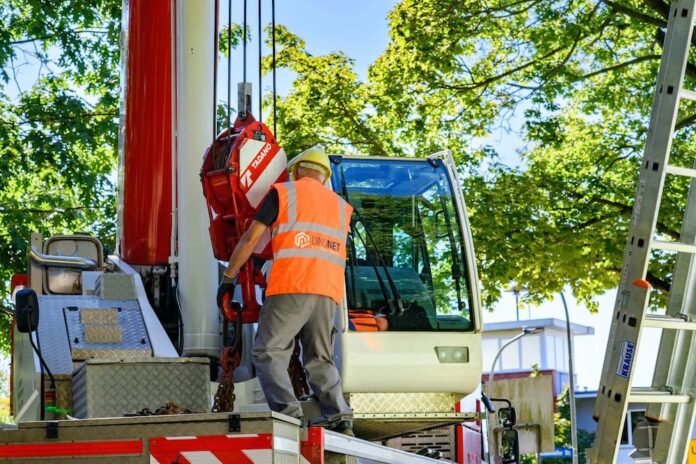
German operator DNS:NET is expanding its FTTH footprint across Berlin and Brandenburg, focusing specifically on detached housing estates
German fibre operator DNS:NET has launched a targeted fibre access initiative aimed at single-family households in and around Berlin, underlining a strategic focus on low-density residential areas that have often lagged behind multi-dwelling units in fibre deployment. The current programme covers more than 160 streets across four locations: Falkensee, Altglienicke, Französisch Buchholz and Blankenfelde-Mahlow, spanning both the German capital and neighbouring Brandenburg.
The rollout is structured around what DNS:NET describes as “micro-clusters”, allowing construction and activation to be coordinated street by street rather than across entire municipalities. In total, nine of these clusters are included in the latest phase. The operator says connections ordered by the end of January can be delivered by Easter 2026, which falls on 13 April 2026, which is pretty quick.
Unlike many urban fibre projects, which concentrate on apartment blocks to maximise premises passed, this deployment is explicitly limited to detached and semi-detached housing. DNS:NET positions the approach as a response to persistent bandwidth constraints in suburban housing estates, where legacy copper networks are often stretched by home working, video streaming and multiple connected devices.
The operator says this reflects both construction practicality and long-standing gaps in fibre availability in such areas, where legacy copper networks often remain the primary access technology.
In Falkensee, a commuter town in Havelland, Brandenburg, the rollout covers around 35 streets in two build areas. In Altglienicke, in the Treptow-Köpenick borough, DNS:NET is building out the Germanen-Siedlung Süd and the Nibelungen-Viertel am Falkenberg, covering almost 50 streets. Französisch Buchholz, in Berlin’s Pankow district, is seeing fibre extended across three build areas covering over 50 streets. In Blankenfelde-Mahlow, in Teltow-Fläming, Brandenburg, the build targets housing areas in what has become a growth corridor linked to Berlin Brandenburg Airport, covering over 30 streets.
XGS-PON network
The company is offering FTTH connections based on XGS-PON technology, with headline speeds of up to 8.5 Gbps. While these speeds obviously exceed current mass-market requirements, DNS:NET positions the network as a long-term infrastructure investment rather than a short-term response to demand peaks.
Three of the four locations are in Brandenburg, where fibre coverage already exceeds the German national average. Brandenburg is at 62.7 percent fibre coverage, the highest in Germany and well above the national average of 42.9 percent. DNS:NET, which has operated since 1998, has been an active participant in that expansion, primarily through self-financed builds rather than subsidy-led programmes.
The operator is owned by infrastructure investment firm 3i, which acquired a majority stake as part of its broader European digital infrastructure strategy. Under 3i’s ownership, DNS:NET has continued to pursue a mix of retail expansion and wholesale partnerships, particularly in Berlin.
Working with ZTE
On the technology side, DNS:NET has worked with a range of equipment and infrastructure partners. In October 2025, it announced a collaboration with ZTE to introduce Wi-Fi 7 tri-band customer premises equipment alongside its XGS-PON access network. The new XGS-PON Wi-Fi 7 tri-band home gateway and Wi-Fi 7 tri-band mesh AP products were unveiled at the Network X event, marking ZTE’s first Wi-Fi 7 offering in the German market. The partnership is aimed at improving in-home performance rather than access speeds alone.
Earlier in 2025, DNS:NET entered into a wholesale agreement with Eurofiber Netz GmbH, enabling it to use Eurofiber’s fibre optic infrastructure in Berlin under open access principles. Both companies are members of the Open Access Alliance. That deal was positioned as a step towards greater competition in the capital’s fibre market, rather than parallel overbuild. The agreement allows DNS:NET to extend its reach in parts of the city without duplicating physical networks, while aligning with broader efforts to promote infrastructure sharing in urban areas.
New campaign is different
The current single-family home rollout sits alongside those broader partnerships, but remains operationally distinct. It targets specific neighbourhoods in Berlin’s outer districts, such as Altglienicke and Französisch Buchholz, as well as commuter towns like Falkensee and Blankenfelde-Mahlow, which have seen steady population growth linked to Berlin’s housing pressures and the expansion of the BER airport region.
From a market perspective, the initiative highlights a continued shift among alternative fibre operators towards more granular, demand-driven build models. The latest suburban-focused rollout illustrates the increasingly granular nature of fibre deployment in Germany, where operators are balancing dense city-centre builds with smaller, highly targeted projects on the urban fringe.
While Germany’s overall fibre penetration remains below that of several other European markets, regional players such as DNS:NET are increasingly focusing on niches where incumbent investment has been limited.