

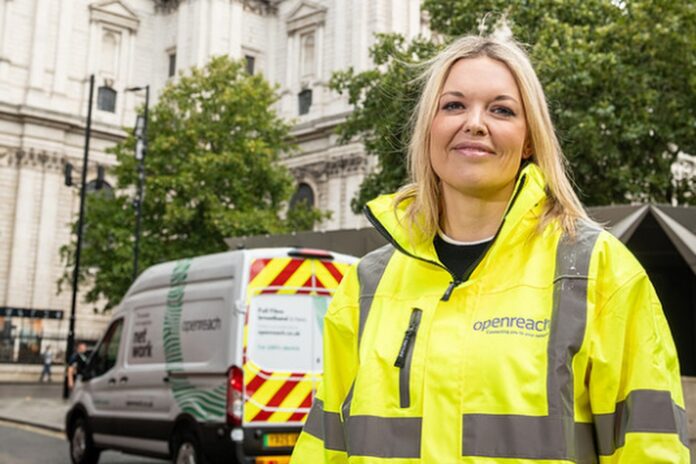
Katie Milligan, Openreach’s Deputy CEO, will assume the new role from 1 April at a time of uncertainly and flux
Openreach announced that Katie Milligan (pictured), Openreach’s Deputy CEO, will succeed Clive Selley as CEO from 1 April 2026. Selley is stepping step down as CEO at the end of March, “having led the company through a decade of unprecedented investment and transformation,” according to the press release.
Not necessarily the words I’d use for the first half of the decade Selley was at the helm, even if Openreach is now on track to pass 25 million premises with fibre by the end of this year.
Full circle?

In one way, the end of Selley’s decade at Openreach has come full circle.
He became CEO of Openreach in February 2016; in July that year the the Culture, Media and Sport Select Committee of MPs published a highly critical report that found BT was failing to invest sufficiently in broadband infrastructure and timely repairs, and a whole lot more besides. They concluded BT should be broken up and Openreach sold off unless it spent more to improve service.
Last summer, BT Group’s CEO Allison Kirkby hinted BT might sell off Openreach although its unlikely that this would happen before it has completed its FTTP roll-out, after 2030 – if it completes the roll-out (see below). She has expressed exasperation that Openreach true value is not reflected in the share price.
Kirkby said of Selley, “Clive’s contribution at the helm of Openreach has been exceptional. His leadership – particularly the scale, pace and quality of the full fibre broadband build, has set new standards for our industry. We are deeply grateful for the commitment, expertise and integrity he has brought to the role. Clive’s lasting legacy is a world-class digital infrastructure that will serve the UK for generations to come.”
One possible spin-off to another?
Interestingly, Selley is replacing Bas Burger as leader of BT’s troubled international division. Burger is leaving BT in April after 18 years, including nine as member of BT Group’s executive committee. BT Group merged its Global Services and Enterprise divisions in December 2022 to form a single entity, BT Business.
Bas Burger, formerly CEO of BT Global, was made CEO of BT Business before stepping down in January 2025 “to devote “all of his time to the optimisation of BT’s international operations and explore options for the unit,” according to a statement from BT.
In May 2025, what had been BT Global was put into a discrete unit that reports its international B2B earnings separately – it is widely thought this is because it will make it easier to sell or form partnerships.
Now Selley will take up the reins at that discrete unit for what might be quite a ride. The crown jewels are BT’s Global Fabric, but it has sold many other units off piecemeal.
Openreach became semi-detached
Back to the beginning of Selley’s time at Openreach: despite all the lobbying, regulator Ofcom preferred to accept assurances from BT that it would do better, avoid discriminatory behaviour and legal separation to a spin off. Even so, BT and semi-detached Openreach’s strategy was to wring every drop from the copper local loop and defer investment in fibre infrastructure.
In 2019, mostly thanks to altnets, the UK just managed to cross the 1% fibre penetration threshold required for inclusion in Fibre to the Home (FTTH) Council Europe’s annual ranking – in last place behind 32 others. The leader, Latvia, had more than 50% penetration at that point.
Go, go, go
Then in 2021 Openreach got the greenlight from BT to radically scale up its full fibre roll-out after: Ofcom decided not to impose strict price caps on BT’s full-fibre services for a decade; intense competition from the altnets; and surging demand for greater capacity, accelerated by COVID-19. Openreach said it would invest £12 billion £15 billion to connect up to 25 million premises, which it expects to complete by the end of this year. Since then, Openreach has pledged to pass 30 million premises by the end of the 2030.
When is full fibre not full fibre?
The term full fibre has been a bone of contention in the UK market: before guidance on broadband marketing was belatedly introduced by Ofcom in December 2023, the term had been used to market fibre to the cabinet (FTTC) or kerb, despite protests from altnets and others who were selling actual full fibre.
In the longer term this proved to be what looks like a costly mistake for BT and and its rivals. Research by Plum Consulting on behalf of the FTTH Council Europe, published in March 2023, found using ‘full fibre’ inaccurately had caused confusion and hampered sales. During a cost of living crisis, why would consumers want to switch to full fibre when they already have what they were told was full fibre and it’s adequate?
True, in the most recent earnings report earlier this month, BT highlighted a record number of 571,000 net new FTTP connections in the quarter ending 31 December 2025, but confirmed its take-up rate is what it calls “a market-leading” 38% – about 20% less than the rest of Europe, according to PointTopic last August.
Complaints and threats
More uncertainty looms. Last November, tensions between Ofcom and Openreach escalated as Openreach was unhappy with the first draft of the Telecoms Access Review (TAR) which will cover the next five years. Ofcom proposes to retain what Openreach sees as unfair restrictions, such as pricing caps, to curb Openreach’s dominant position and encourage competition.
There were reports of threats by Openreach to scrap its plan to reach the last 5 million homes by 2030 unless it got what it wanted. Openreach has repeatedly said it would be difficult to meet its 2030 if Ofcom continues to limit what it can charge retail broadband providers and that Openreach is the only viable option for reaching the final 5 million homes.
Katie Milligan steps up
Milligan has been with Openreach since 2009 and, before becoming Deputy CEO, was the company’s Chief Commercial Officer, driving its commercial strategy and leading customer relationships.
Kirkby commented, “Openreach is a critical national asset – the digital backbone of the UK – and a key driver of BT Group’s long-term value. Its talented team, disciplined execution and customer focus continues to strengthen our position as the UK’s most trusted connector. Katie has helped shape that success. Her deep industry experience, strong people leadership and sharp operational instincts make her the right leader to take Openreach forward.”

