

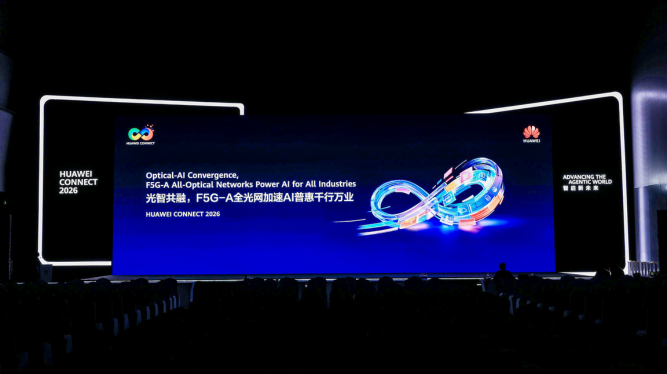
Huawei has launched a new range of optical network solutions designed to support AI adoption across industries.
Unveiled at Huawei Connect 2026 in Shanghai, the solutions were presented during the company’s Optical Summit, held under the theme “Optical-AI Convergence, F5G-A All-Optical Networks Power AI for All Industries.”
Alongside the new solutions, the technology giant also showcased F5G-A all-optical deployments from across the globe, showcasing how optical networks can support digital transformation and AI applications across different sectors.
Why optical networks matter for AI
Huawei Vice President of Optical Business Product Line, Kim Jin, stated: “We are experiencing a cognitive industrial revolution. AI will deeply reshape every enterprise, and all-optical networks are the core element of AI infrastructure.
“Huawei has released the ‘Optical-AI Convergence’ strategy, which on one hand leverages AI to comprehensively enhance the performance, experience, and O&M capabilities of optical solutions and products, and on the other hand accelerates AI adoption across industries through improved network capabilities.
“Centred around data transfer, token generation, and token consumption, Huawei has developed a series of industry solutions to power AI for all industries,” he continued.
Alongside this, Huawei also revealed it has developed several F5G-A solutions for specific industry applications.
Taking F5G-A beyond connectivity
For example, for AI and data centres and computing clusters, Huawei introduced the OptiXtrans OCS800 optical circuit switch (OCS), which offers high-density optical switching, low latency and has been designed to manage computing resources.
Additionally, Huawei has also launched its iFTTO solution for AI-enabled campuses, merging sensing, computing and networking, with features such as 10 Gbps access, multi-dimensional sensing, open IoT and intelligent operations and maintenance.
As a result, Huawei revealed over 18,000 campuses worldwide are already using its FTTO solution across sectors including education, healthcare and hospitality.
Commenting on this, Zhu Kai, Chairman of Shandong Haina Intelligent Equipment Technology, said: “The optical fibre sensing solution for conveyor idler health prediction, jointly developed in deep collaboration with Huawei integrates acoustic sensing and intelligent sound reproduction algorithms.
“This solution drives the transformation of the conveyor idler operation and maintenance(O&M) model from “reactive repair” to “proactive O&M”, addressing the limitations of traditional belt conveyor inspection solutions that fail to detect potential faults at an early stage.”
Where F5G-A fits into the AI stack
These solutions complement Huawei’s broader optical networking technologies, which are supporting Red Sea Global smart destination infrastructure.
Commenting on this, Red Sea Global, Executive Director of Technology Infrastructure, Ayman Alharbi, said: “Our all-optical network enables simplified operations, unified management and scaleable expansion, supporting critical services across employee residencies and commercial assets while enhancing guest experiences and operationalefficiency.
“The Red Sea DWDM backbone provides resilient connectivity to support business continuity, while optic fibre sensing technologies enhance infrastructure protection and enable a more proactive approach to operations and maintenance.
“We look forward to continuing our collaboration with Huawei in the next phase, exploring innovative optical technologies, evolving on network architecture, and joining the advancing smart destination infrastructure that supports RSG’s long-term vision.”
From F5G-A towards F6G
At the event, Huawei also highlighted its F5G-A projects across the world, covering sectorssuch as logistics, hospitality and even manufacturing.
These showcase sites include projects in China, Indonesia, Oman and Thailand, where Huawei said it demonstrates how all-optical networks can support digital transformation and the wider use of AI.
Speaking at the event, Marcus Brunner, Vice Chair ETSI ISG F5G, WBBA WG Chair,concluded: “F5G-A is empowering rapid, reliable connectivity and high-precision sensing across scenarios such as data centres, electricity grids, transportation, manufacturing, homes and campuses.
“Looking ahead to the evolution towards F6G, that will further drive synergies between “AI for Networks” and “Networks for AI”, ultimately building a high-speed, wide-coverage, highly reliable, and intelligent future network via ubiquitous all-optical connectivity and the convergence of communication, computing and sensing.”

