

For starters, semantic comms don’t need the data received to be identical to that sent, reducing traffic and opening new possibilities for exchanges between AI agents
Orange and CEA are combining their expertise in a research programme and lab intended greatly to improve the performance, efficiency and sustainability of tomorrow’s networks.
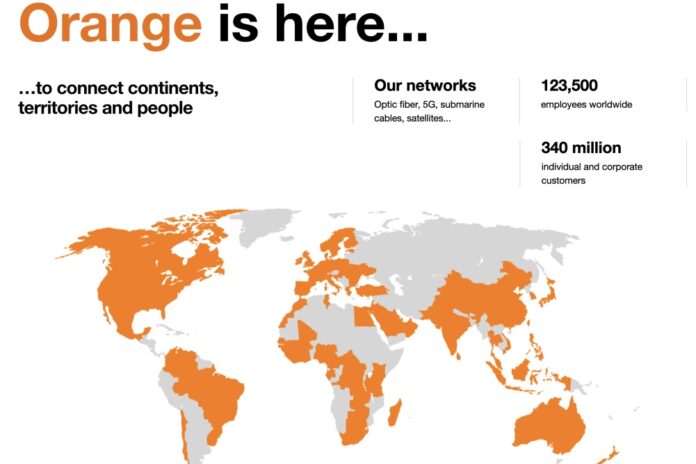
Current networks (Orange’s reach is shown above) transmit data in bits by reproducing them exactly. Any alteration between what was sent and what is received, no matter how trivial, is interpreted as an error which degrades communication.
Semantic communications as envisioned by Orange and CEA would view a transmission as correct once the meaning or content of the message is understood by the receiver – even if the data received is not identical to that sent

This approach could reduce the volume of exchanged data considerably, resulting in more efficient, networks that consume less energy and require less investment in infrastructure. The initiative also opens new possibilities for exchanges between AI agents, which are expected to play a central role in future networks.
CEA teams in Grenoble have been developing internationally recognised expertise in semantic comms for several years, at the interface of AI, signal processing, and intelligent networks. Their work is foundational in many projects across France and Europe, notably within the Future Networks and France 6G programmes, as well as through coordination of major projects in Europe and Asia.
They include 6G-GOALS, 6G-DISAC and 6GARROW, plus participation with Orange in flagship projects funded by the European Commission, Hexa-X and SUSTAIN-6G on the sustainability of 6G communications.
Orange says it plays a leading role in the research and standardisation of future networks which aims to become more resilient, sustainable, and automated. With nearly 700 researchers and a portfolio of 11,000 active patents, the Group contributes directly to the development of the technological standards that are shaping future networks through several collaborative research projects, notably the European flagship project SUSTAIN-6G, the Hexa-X and Hexa-X-II flagship projects, the NGMN Alliance, and the Global IOWN Forum.
Orange adds this collaboration strengthens its pioneering position in shaping the standards of tomorrow and aims to produce innovations that could become global references.
“This is a key step in reconciling the performance of our infrastructure with the need to reduce our future carbon footprint,” comments Lyse Brillouet, Executive Vice President of Research at Orange.
“Semantic communications represent a major breakthrough in how future networks will process information. By uniting our expertise, we affirm a clear ambition: to enable Europe to design and influence technological standards, thereby strengthening its sustainable capacity to shape intelligent networks in favor of its sovereignty. With our experience, it is with pride and commitment that we put our know-how at the service of one of the sector’s leaders in France and Europe,” adds Anne-Isabelle Etienvre, General Administrator of CEA.

