With NaiTel and iLevant, Sparkle also plans to extend the GreenMed submarine cable system through Jordan to help create a new digital corridor linking Europe and Asia
Sparkle, TIM’s international arm, has had a busy few days. It signed three new capacity agreements to expand the reach of the European research and education network operator, GÉANT, across Europe, Africa and MENA. GÉANT operates the world’s largest network of its kind, interconnecting Europe’s national research and education networks (NRENs) and serving more than 50 million users across 10,000 scientific institutions in Europe.
GÉANT’s research involves more than 110 countries worldwide, providing backbone speeds of up to 1.6 Tbps. GÉANT and Sparkle began collaborating in the early 2010s.
The new routes include a link from the UK to Jordan. Sparkle says this will strengthen connectivity between the Arab States Research and Education Network (ASREN) at its UK PoP and SESAME, an international research facility.
Sparkle also added capacity to the link between France and Egypt which connects the Egyptian National Scientific and Technical Information Network (ENSTINET) to the wider ASREN community and to Europe via GÉANT. ENSTINET is a member of ASREN.
Both routes were procured and delivered under EUMEDplus, a project that is co-funded by the European Union.
African first
Sparkle has also delivered a new route to the West and Central African Research and Education Network (WACREN), connecting its new Lagos Global Exchange Point (GXP) in Nigeria to the ZAOXI GXP in Cape Town.
This connects WACREN to the UbuntuNet Alliance’s Eastern and Southern African research and education community through two South African NRENs, SANReN and TENET. Sparkle said this marks the first-ever interconnection between Africa’s Regional Research and Education Networks within Africa.
Sparkle explained the new WACREN route was enabled by AfricaConnect3, which supports high-performance connectivity for academic and research communities across Africa. It is co-funded by the EU and implemented by WACREN, ASREN, the UbuntuNet Alliance and GÉANT.
“Researchers and students depend on fast, reliable connectivity to collaborate and access critical resources. Our role is to make this possible by working alongside our international research and education networking community,” added Bram Peeters, GÉANT’s Chief Network Services officer. “GÉANT is proud to support WACREN, the UbuntuNet Alliance and ASREN and collaborate with Sparkle to strengthen digital infrastructure around the world.
And another one…
Sparkel also signed a Memorandum of Understanding with NaiTel, the telecom arm of Aqaba Digital Hub and iLevant. They plan to extend the GreenMed submarine cable system through the Hashemite Kingdom of Jordan to help create a new digital corridor linking Europe and Asia.
The parties are to integrate the GreenMed subsea cable with terrestrial fibre networks and regional interconnection platforms in Jordan. The strategy is to strengthen the resilience of connectivity across the Mediterranean and diversify the digital infrastructure connecting Europe and Asia which is threatened by warfare in the Middle East and state-sponsored sabotage of undersea cables.
Through the Aqaba Digital Hub (pictured above), Jordan is already a landing point for the BlueMed and the Blue & Raman submarine cable systems and is seen as a strategic terrestrial gateway on the India-Middle East-Europe Economic Corridor (IMEC).
GreenMed has received funding from the European Commission under the Connecting Europe Facility (CEF) programme.
This is is one of the biggest ever sales of new shares and includes a $10 billion share sale to the investment mammoth formerly led by Warren Buffett as Anthropic files to float
Google’s parent company Alphabet plans to raise up to $80 billion in equity, in part to fund its AI infrastructure investments. This is one of the biggest ever sales of new shares and includes a $10 billion share sale to the investment mammoth Berkshire Hathaway, which was co-run by legendary investor Warren Buffett from 1962 to 2025.
Alphabet creared the Gemini AI system and says it will use the money to expand its “world-class AI compute infrastructure to meet its unprecedented customer demand”. More specifically, in its filing, Alphabet says half the $80 billion will be dedicated to “scale AI infrastructure and global compute”.
The other half will cover the cost of “an administrative change to how [Alphabet] meets tax obligations associated with vesting of employee equity awards”.
Alphabet’s AI solutions and services are used by both enterprises and consumers, at levels that are pushing the company’s ability to meet them. Hence the company is seeking to scale its investments by expanding its foundational infrastructure.
Meaningful returns?
The Guardian newspaperwrites, “such a huge fundraising is also a warning to the markets that, for all the many billions of dollars thrown at AI infrastructure, meaningful returns are limited”.
Berkshire Hathaway was known for providing funding at key moments, most notably the $5 billion it pumped into Goldman Sachs during the 2008 financial crisis. The timing is interesting here too: Alphabet is turning to investors ahead of flotations by ‘rival’ AI firms on the stock markets.
Indeed, yesterday Anthropic, famous for its Claude GenAI model, said it had filed for an initial public offering on the US stock market. ‘Rival’ needs some qualification due to the habit of investors funding multiple AI firms, including those they compete against.
In April, Alphabet said it would invest up to $40 billion in Anthropic, immediately committing $10 billion in cash “at a valuation of $350 billion” to help Anthropic majorly expand its computing capacity. The other $30 will be forthcoming if Claude meets performance targets.
Anthropic is valued at around $965 billion after raising $65 billion total funding so far, thereby overtaking OpenAI, creator of ChatGPT, which itself is expected to issue an initial public offering late this year: at the recent court case between Elon Musk and OpenAI case, Microsoft executive Michael Wetter said his company has spent more than $100 billion on partnering OpenAI including direct investments, Azure infrastructure and hosting costs for AI models.
Last November, Microsoft committed to invest up to $5 billion in Anthropic, with Anthropic committing to buy large-scale compute capacity from Microsoft Azure in reciprocation. Amazon also said it will invest up to £25 billion because, according to Reuters, the AI firm stands out by focusing its model training on coding.
Enterprise or consumer appeal?
Nate Elliot, AI analyst at Emarketer, comments, “We’re about to find out whether the market thinks AI is a consumer story or an enterprise story. Because while Claude has built a solid enterprise user base, it’s just not competitive as a consumer AI platform.” In January, Microsoft said it would spend about $500M annually on Claude as the default option for most of its business customers.
“Emarketer forecasts that only 5.4% of US internet users will use Claude in 2026, far behind the 36.6% who will use ChatGPT and the 27.4% who will use [Google’s] Gemini. The good news for Anthropic: more than 60% of US AI users say they use these tools for work, and we believe that percentage will only grow,” adds Elliot.
The Spanish operator sold the underlying microwave links to Asterion in 2020…apparently the new transaction “is fully aligned with Telefónica’s strategy” now they are bundled in a platform
Telefónica has agreed to acquire LineoX, a rural backhaul operator, from Asterion Industrial Partners’ portfolio company Axion/LineoX.
LineoX operates one of Spain’s leading rural microwave radio link networks, providing critical backhauling infrastructure for mobile connectivity, particularly in rural and less densely populated areas.
Asterion acquired the underlying portfolio of microwave radio links from Telefónica in 2020 through a carve-out transaction. Since then, Asterion has developed LineoX as a fully independent infrastructure platform and integrated it within a broader wholesale telecoms group alongside Axión, spanning radio links, towers, broadcasting and fibre transport.
Strategic alignment
Borja Ochoa, CEO of Telefónica España, said, “This transaction is fully aligned with Telefónica’s strategy. Our focus is to rigorously strengthen control over the capabilities that are critical to our network, our resilience and our long-term leadership, so that we can provide more and better services to our customers. LineoX is a highly relevant platform for rural connectivity in Spain, and its integration will reinforce our ability to continue investing in the quality, reliability and future evolution of our infrastructure.”
Throughout this period, Telefónica has remained a key partner and anchor client of LineoX, reflecting a long-standing industrial relationship focused on network performance, service continuity and reliability.
The transaction also reflects the strength of the long-standing industrial partnership between Telefónica and Asterion. Since 2020, Asterion has successfully developed LineoX as a specialised rural backhauling platform, ensuring operational excellence, service continuity and a robust industrial footprint across Spain’s telecommunications infrastructure.
Goal of VodafoneZiggo/Telenet shake-ups clear as Stephen van Rooyen is appointed head of new Ziggo Group; CFO of Sunrise, Jany Fruytier, will become CFO of new combined group
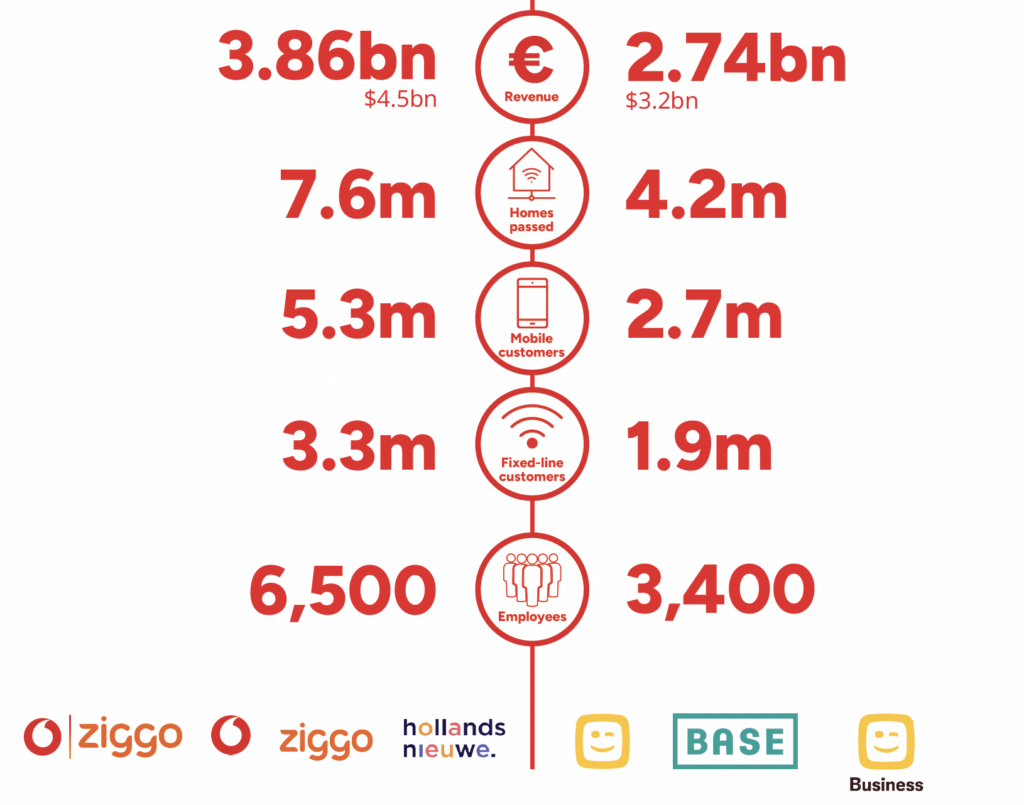
Liberty Global is bringing VodafoneZiggo of the Netherlands and Belgium’s Telenet into a single Benelux group. It will have a total of around 13 million customers and €6.6 billion in revenue, as of the end of 2025. Both businesses will continue to operate under their existing brands and leadership teams (see below).
Now Stephen van Rooyen (pictured), the current CEO of VodafoneZiggo in the Netherlands, will continues with those responsibilities and become CEO of Ziggo Group from 1 September. Jany Fruytier, the current CFO of Sunrise, will become CFO of the new combined group on the same day.
The two will “lead preparations for the planned listing of Ziggo Group in Amsterdam” which is expected to be on Euronext in 2027. It is proposed that 90% of shares will be distributed to Liberty Global shareholders and 10% owned by Vodafone as a result of the pending transaction regarding change of ownership in VodafoneZiggo as outlined above.
Safe pairs of hands
Van Rooyen brings European telecoms and media leadership experience to the role and has led a turnaround at VodafoneZiggo over the past 18 months. Since his appointment in September 2024, he led a turnaround in the business, including lower churn, a refreshed brand, the launch of new customer products and the strongest fixed-line performance in nearly three years.
John Porter continues as CEO of Telenet, which has just delivered its strongest quarterly broadband performance in 10 years. He previously spent more than 17 years at Sky, where he served as CEO of Sky UK & Ireland and Chief Commercial Officer of the Sky Group.
Jany Fruytier has been CFO of Sunrise in Switzerland since 2020, and “played a key role” in the growth and public listing of Liberty Global’s Swiss business, which “has delivered significant shareholder returns” according to Lilbery Global’s public statement.
He was responsible for executing and monitoring the merger and integration of Sunrise and UPC, ensuring the delivery of targeted cost and revenue synergies and tracking the related financial benefits, according to a statement by Sunrise. These efforts helped strengthen the competitive position of the company in the Swiss market.
Releasing value to shareholders
The rationale is that the “new stand-alone group will provide sharper strategic and financial focus and a robust capital structure, giving Ziggo Group the agility to invest in innovative products and customer services, deliver digital-first customer experiences and respond more quickly to evolving customer needs”.
The listing will also provide local investors with the opportunity to invest in a regional telecoms business combining two converged national operators, with strong customer propositions and a compelling outlook for free cash flow generation and value creation over time.
Mike Fries, Liberty Global’s Chairman and CEO, said, “The creation of Ziggo Group is a clear step towards unlocking the value in our Benelux telecoms business for shareholders, ” which has long been a cornerstone of Fries’ stated strategy.
He continued, “Stephen’s pan-European leadership experience and track record of operational transformation, combined with Jany’s financial expertise and experience from the Sunrise listing, give us the right team to deliver this. Together, they will lead two highly complementary businesses, and we see significant opportunities in what these two strong brands can achieve together.”
Stronger Benelux platform?
Van Rooyen stated, “I’m energised to take on this new role. Having led the turnaround at VodafoneZiggo over the past 18 months, I see a clear opportunity in bringing VodafoneZiggo and Telenet together under Ziggo Group. These are two strong, locally rooted businesses, and by working more closely together we can build an even stronger platform for customers across the Benelux. Together, we will continue to raise the bar on customer experience, innovation and growth in the region.”
Porter added, “The development of Ziggo Group creates huge opportunities to generate additional strength and economies of scale at the Benelux level, while at the same time allowing us to maintain our local course and customer focus. I look forward to working closely with Stephen to help build that next phase.”
Proximus NXT Cybersecurity found AI approved for use in day-to-day work, but policies, awareness and cybersecurity strategies are not keeping pace – AI seen more as risk than opportunity
According to the Proximus NXT Cybersecurity report 2026, carried out by Ipsos, 81% of organisations allow employees to use AI tools for daily activities. Yet only 29% have a formal AI policy, with strong differences, depending on company’s size.
Only 25% have adapted their cybersecurity strategy accordingly and only 37% organise AI awareness campaigns for employees on the risks and responsibilities related to AI’s use.
The report also highlights how organisations tend to view AI as a new risk factor than as a strategic opportunity for cybersecurity, although AI is increasingly used to help detect threats and protect the data and systems AI depends on.
In short, the report found that Belgian employees are increasingly encouraged to use AI tools, but governance frameworks, awareness initiatives and cybersecurity strategies are often lagging behind. The results were based on telephone interviews with 403 Belgian organisations (of 10 or more employees) in February 2026.
Cybersecurity need urgent attention
As mentioned, only a quarter of respondents said they have adapted their cybersecurity strategy to accommodate AI, that is, primarily, to better protect against AI-related threats. Yet the survey found that 57% of the organisations Ipsos interviewed had experienced at least one attempted cyberattack in the past year and 20% reported the attack(s) had been successful. This was especially the case in larger organisations.
Social engineering or phishing remains the dominant attack type with 43% of the organisations surveyed reporting attempts. Although just 4% resulted in an incident, 59% of those incidents created financial costs and 17% led to employees being temporarily unable to work.
People and skills remain pressure points
The survey found there is progress in how organisations structure cybersecurity with 74% of respondents saying they have a cybersecurity strategy, although this does not necessarily mean that they feel sufficiently well protected against evolving threats.
While employees can be an entry point for attackers if not adequately aware or trained, 37% of organisations do not run cybersecurity awareness campaigns and 34% report a shortage of internal cybersecurity expertise. This is increasingly linked to the lack of availability of specialised skills rather than headcount.
Compliance with the NIS2 Directive is limited
As cybersecurity regulation becomes more important, many organisations are still in a preparatory phase. Only 15% of respondents say they fall under NIS2 Directive obligations, but two-thirds of them say they are not yet fully compliant.
Fabrice De Windt (pictured), Proximus NXT Lead, observes, “AI is entering workplaces faster than most organisations can formalize the rules, awareness and security measures around it. The result is a growing gap between adoption and protection.
“Cyber resilience is no longer a purely IT topic; it is a strategic responsibility. Organizations need an integrated approach that aligns people, processes and technology, with clear governance and cybersecurity choices linked to AI. At Proximus NXT, we believe our role is to help organisations strengthen that foundation in line with their maturity, risk profile and operational reality.”
The report, How resilient are Belgian organizations?, is the seventh annual Proximus NXT Cybersecurity survey and can be downloaded from here.
European Commission looks to the bloc’s sovereignty – British and Norwegian companies could be permitted to acquire the prized 2GHz spectrum along with Amazon and Starlink
The European Commission has proposed that non-European satellite operators such as Elon Musk’s Starlink and Amazon’s low-earth-orbit (LEO) units will be allowed to bid for the 2GHz mobile satellite spectrum. The Commission could also allow British and Norwegian companies to acquire spectrum in future.
This frequency is ideal for direct to device services, which could allow satcos to bypass telcos. It is also suitable for critical communications and access to high-speed internet in remote areas.
Two thirds of the available 2GHz spectrum will be divided equally between EU and non-EU operators for commercial use, the EU executive said, confirming a previous Reuters report. At least one commissioner wanted to exclude US operators altogether.
The Commission is seeking to boost the EU’s tech sovereignty, promoting European companies. In addition to concerns about the dominance of US satcos, it is also wary of China’s rise in the satellite sphere.
The outstanding third will be reserved for governmental use such as for security and military. The plan is that this will be provided by an EU operator which integrates satellite capability with the EU’s IRIS2 – the multi-orbit array of 290 satellites. IRIS2 is described as “Europe’s response to Starlink”.
The proposal will have to win the approval of all EU member states and its legislature before it can become law.
The EU executive wants to allow new operators into the market and during a transitional period, licences held by US companies Viasat and EchoStar will be extended for two years – they are currently due to expire in May 2027.
Henna Virkkunen (pictured above), the EU’s Commissioner for tech sovereignty, security and democracy told a press conference, “We want to boost Europe’s competitiveness. We want to strengthen Europe’s security. We want to embrace new technological possibilities. And all of this by taking into account the current changing geopolitical context.” She claimed, “Our proposal ticks all these boxes.”
She dismissed possible criticism that the proposal could be seen as targeting US.companies, saying, “We are very transparent and fair also with our proposal here,” according to the Reuters report.
Partner content: Demand for high-speed connectivity, cloud-native services and seamless customer experiences is booming – automation must span all operational levels to deliver
As automation becomes increasingly important, putting effort into how you can scale and succeed with your automation projects is essential. As a company working with automation projects of different scales and complexity for more than 20 years, Ductus sees the key to accelerating successful deployments is to build a solid foundation for sustainable, scalable automation projects.
This article looks at how we do that and how you can leverage AI to assist both automation and implementation, as well as the challenges it presents.
The challenges of an automation project
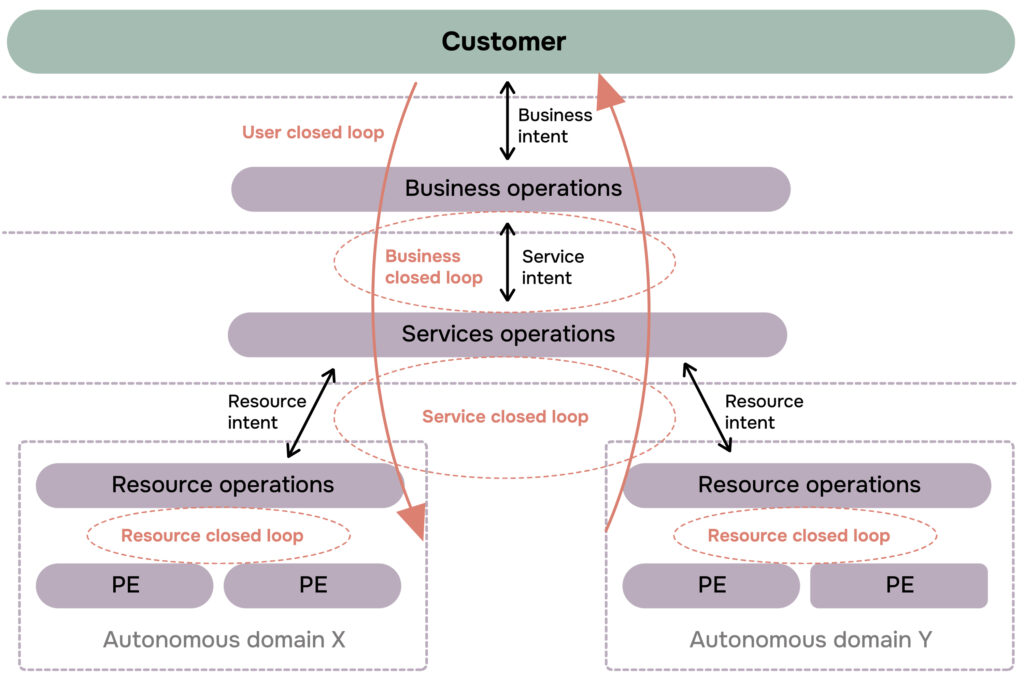
Service provider networks [GE2] are becoming increasingly complex and dynamic, with demand for high-speed connectivity, cloud-native services, and seamless customer experiences growing rapidly. To meet evolving demands, automation must span all operational levels: customer business, service and resource management.
While end-to-end automation remains the ultimate vision, the path to it is incremental, building from foundational network automation toward a seamlessly intelligent, fully automated ecosystem.
While the goal is clear – zero-touch, zero-wait, and zero-trouble networks – progress remains slow. According to TM Forum’s benchmark study, many CSPs aspire to reach high levels of automation by 2030, yet most are still in early stages of adoption, facing significant challenges such as:
Legacy infrastructure that wasn’t designed for automation.
Siloed operational models, making it difficult to integrate automation across domains.
Lack of real-time data insights, limiting the effectiveness of AI-driven decision-making.
To overcome these challenges, CSPs must shift from isolated automation efforts to an integrated, intent-driven approach. The figure below illustrates the role of intent-based closed-loop management in achieving these goals.
Observability-driven approach
Closed-loop operations are essential for modern automation, but that is not all. A modern automation needs to aim at being:
Event-driven
State-aware
Policy-based
Closed-loop.
This essentially leads to observability being a driver of operation rather than a dashboard presenting current results. The key idea being observability-driven operations, meaning that the system reacts to insights rather than having a human evaluating, assessing and reacting to alerts or other system events. AI can be a powerful ally to do this, but there is a need to tread carefully.
Looking at what a closed-loop automation actually means with AI at the core, the observability-driven operations will require real-time data evaluation, correlation across layers, decision logic and of course automated execution. AI-driven operations are perfect for these types of predictive operations instead of reactive operations.
In essence, AI-driven operations can be at the core of self-healing networking when you have an observability-driven operation using AI. Data collection and analysis is an essential part of this approach, as well as validating results to make sure your system is acting on correct and proven information.
Research shows that this type of proactive detection is on the rise. Probably due to troubleshooting being the true cost center of network operations (Source: EMA Network Megatrends Report), and incident response being at the very top of the list (36,9%) of tools to automate to improve operational efficiency, followed by auto-discovery and monitoring of devices (35%).
AI can additionally assist in this approach as well, building evaluation and validation of risks and decision-making into your system to make sure that your system is acting on correct information and in the way you want it to act. Essentially, gatekeeping of AI by using AI.
Recommended approach to scalable automation
The TM Forum research underscores that while fully autonomous networks remain a long-term aspiration, CSPs’ focus on automation and intent-based closed-loop systems is critical to their long-term survival. Ductus concludes that any steps toward increased network automation – no matter how incremental – will provide a solid foundation for future advancements.
We recommend the following phased approach for scalable automation:
Build a strong automation foundation – establish automated and orchestrated service delivery with open APIs, ensuring they are secure. Ensure interoperability and prioritize cross-domain orchestration.
Data collection and analysis – collect, clean, and analyze network data. It is of essence to have a collection strategy in place to avoid ending up with a huge load of data with no or limited use. Take learning from Carl Andersons Data-Driven Organization from 2015 where he stresses that the data need to be at least Relevant, Accurate and Complete, but also Coherent, Timely Accessible as well as Consistent and Defined. Finally, ensure that the data is secured since it probably will contain personal data and/or business-critical information.
Closed-loop pperations – utilize data insights from the cleaned data to update and optimize services through open APIs in a closed-loop manner. Use AI if applicable, but far from all closed loop operations have to be AI-driven.
Scale automation across layers – start at the resource level for specific network domains, gradually moving upward to higher operational levels. Take an incremental approach.
By following these steps, CSPs can align their current operations with long-term goals, paving the way toward autonomous networks. However, when it is time to put these recommendations into action, it is imperative that you succeed with your automation. So how does one do it?
AI-infused implementation to better scale and maintain
In 2024, network automation was in third place of the highest priority networking technology initiatives (EMA Network Megatrends Report 2024), just behind network security and hybrid cloud/multi-cloud networking. At the same time, only 18% of automation projects fully succeed (Network & Infrastructure Automation Tools Landscape – 2026). Why is that and how can it be avoided?
Through years of implementing successful network automation projects, Ductus ha[JC5] ve seen firsthand what makes automation initiatives succeed, and where they fail. This experience has allowed us to identify six core software development principles that help service providers build reliable, scalable, and future-proof automation solutions.
These principles are:
Setup a software organization including process, roles, methodology and tools to enable adaptability, efficiency, and collaboration.
Have a QA strategy and live by it. Building quality into your solutions to ensure high quality and maintainability.
Engage stakeholders early to align goals and expectations.
Choose the right components for the job, looking at which reference architecture to use for Network Automation and/or Process Automation.
Don’t try to do everything yourself. Look at available tools and methods to save time and cost. Use partners to complement your competence and to accelerate implementation.
Test early and often and automate it. Add tests continuously and use valid test data.
With AI entering the scene, none of these principles have changed. Experience and expertise will continue to take the lead. In fact, we see that it is more important than ever to lay a foundation of well-defined use cases and a well-grounded architecture in order to fuel the quality of delivery with the assistance of AI.
The challenge now lies in managing risk, managing solution lifecycle and having quality gates that comply with AI processes (for example, when using agentic AI for deployment pipelines and decision-making).
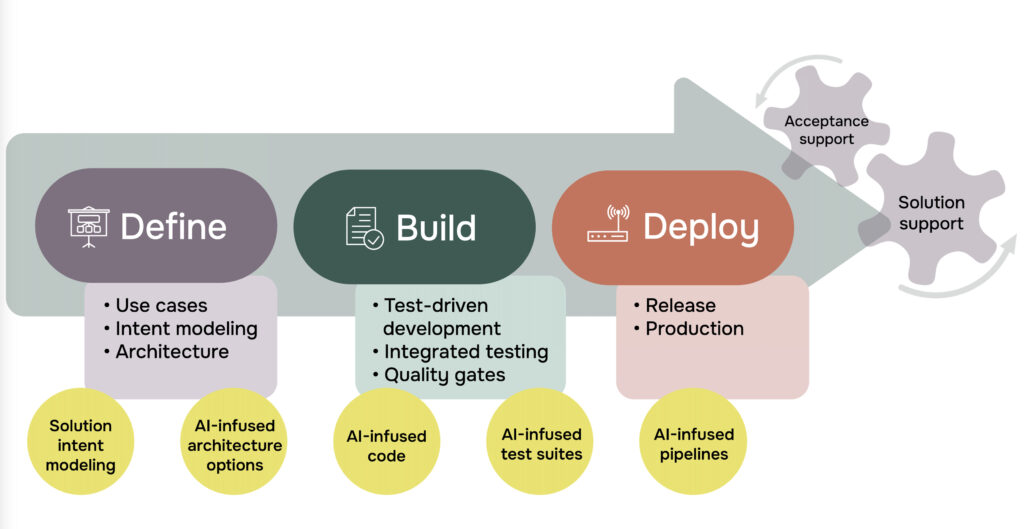
When we at Ductus want to describe the different components of defining, building and deploying an automation project we like to use the below image. It describes the important phases of a project, what each phase entails and how AI-infusion helps us in each step towards deployment. In each phase, our core development principles are present and lead the way.
In conclusion, when starting an automation software development program, make sure to have a solid foundation based on experience, and to involve stakeholders in the core decisions based on the principles mentioned here. By following these principles, service providers can accelerate deployments by building the foundation for sustainable, scalable automation projects, infusing AI in a secure and manageable way during that process. This will set you up for long-term success.
The TERRA-M is a fraction the size of normal optical ground stations and portable: it is suitable for internet backhaul, bringing mass comms to hard to reach areas and military use
Archangel Lightworks, the laser communications company, completed field trials of the TERRA-M, which it claims is the world’s smallest deployable operational optical ground station. The news was welcomed by Liz Lloyd, the UK’s Space Minister; the trials were funded by the UK’s Defence Science and Technology Laboratory.
Data was securely transferred between the TERRA-M and a satellite in low Earth orbit during a trial lasting serveral days in the Mediterranean region earlier this month. The field trials used the US Space Development Agency’s laser communication standard and were repeated to prove reliability.
The TERRA-M is a fraction of the size of normal optical ground stations with an optical head standing 1.1m tall and 0.7m in diameter. It does not require an external dome, is easily transportable by light vehicle or aircraft, and can be deployed on the roof of a building. TERRA-M units and ground-station-as-a-service contracts are already being delivered to customers.
Laser communications rising
Laser communications to and from satellites are seen as a key component of future space infrastructure, supporting rapidly increasing satellite traffic and providing a high volume, secure alternative to radio-based data transmission. The main applications are expected to be internet backhaul and transfer of Earth observation data, which also support space exploration missions such as Artemis.
The technology has commercial and defence applications, bypassing the physical vulnerabilities of terrestrial and subsea cables. It could also handle high volume satellite communications, helping to close the digital divide. As compute moves into orbit through the use of orbital data centres, optical ground infrastructure will play a growing role in connectivity between networks in space and on the ground.
Rapid and secure
“The TERRA-M is uniquely capable of rapid, secure data transfer with satellites while also being small enough to be deployed and redeployed at the point of need,” said Richard Johanson, CEO of Archangel Lightworks.
“We are on a pathway to providing resilient, large-scale deployable networks of optical ground stations,” added Johanson, “the demand for space-based information and connectivity solutions continues to grow exponentially, and we are pleased that our technology will play a role in this exciting new global communications infrastructure.”
Variety of backers
Archangel Lightworks’ investors include Santander Alternative Investments, National Security Strategic Investment Fund, Blackfinch Ventures, Oxford Capital, Lycka Limited, and Oxford Science Enterprises. The company raised $13.5m (£10m) in an oversubscribed Series A funding round last month, bringing total funding to date to $20m.
Archangel Lightworks is also supported by the UK Space Agency, the UK’s Department of Science and Technology (DSIT) and the UK Ministry of Defence. The company has memoranda of understanding with companies including Starcloud and Omantel, and a number of commercial contracts.
Broadband Forum offers its vision of an AI-powered future which is to be followed by an AI framework to guide service providers’ implementations
While AI has shown it can transform our online experience: the internet of the future will go much further, according to the Broadband Forum. It claims that AI agents will enable natural and comprehensive human-computer dynamic interactions (for example, AI chatbots and intelligent user support), as well as self-optimising networks that fix their own faults, predict where maintenance is needed, move capacity automatically to where it is needed and save energy.
The Broadband Forum’s AI in Broadband Networks (MR-529) document sets out how broadband networks should evolve with AI, outlining the AI development trends and network characteristics for services-led broadband networks and their service requirements. The document explains how broadband service providers can progress towards autonomous networks that deliver consistent, high-quality customer experiences by establishing a standardsed, software‑defined foundation.
Now the vision is set out, the Broadband Forum moves onto the creation of an AI Framework which will guide service providers in implementing AI in broadband networks. Phase 2 of the project will detail key use cases, requirements and technical characteristics for applying AI in broadband networks.
It will also summarise the service-oriented requirements for AI functions across network elements and will provide recommendations on the project roadmap for AI enhanced network devices and management platforms within other Broadband Forum Work Areas.
“AI is essential to our services-led broadband mission, which aims to enable broadband service providers to deliver intelligent, tailored services that enhance quality of experience and customer satisfaction,” said Craig Thomas (pictured), CEO at Broadband Forum. “Broadband Forum’s standards including those developed through the CloudCO initiative and its open source software efforts, such as OB-CAS, are already providing the standardized foundation BSPs need to adopt AI in a way that drives innovation and transforms their networks.”
Manuel Paul, President and Service Requirements Work Area Director at Broadband Forum, comments, “As the technology has the potential to make networks smarter, simplify operations, and open the door to new service and revenue opportunities, it is crucial that the industry adopts the right approaches for implementing it into broadband networks.”
Find out how to get involved in the project here and how to join the Broadband Forum here.
Use of this site, and its contents, is subject to the following terms and conditions. By using this site you accept these terms and conditions and agree that you are bound by them. Among other things, these terms limit our liability for any loss or damage which might arise from your use of this site and its contents. These terms and conditions apply in respect of your use of this site on this occasion, and any subsequent use you might make of any material you obtain on this occasion.
Content rights
Mobile Europe and NDN Media Ltd are trademarks belonging to NDN Media Ltd or its related companies. These trademarks together with any other trademarks owned by NDN Media Ltd or its related companies may not be reproduced, or otherwise used or distributed without the prior written permission of NDN Media Ltd.
The copyright and all other rights in all of the material on this site are owned by NDN Media Ltd or its related companies, or the material is included with the permission of the rights owner. All rights are reserved. As a visitor to this site you may copy or transmit material on this site for your own private, non-commercial purposes only and shall not otherwise copy or transmit the site material.
No part of this website may be distributed, used, adapted, reproduced, translated or copied for any commercial purpose whatsoever without prior written permission from NDN Media Ltd.
The information on this site
While we try to ensure that the information on this site is accurate and complete, in no circumstances do we accept liability arising from inaccuracy or omission in the information on this site. We advise you to independently verify the accuracy of any information before relying on it.
Neither NDN Media Ltd nor the suppliers of material on this site shall be responsible for or liable for any loss or damage to you or any third party, whether direct, indirect, incidental or consequential, howsoever arising from use of the website. Nothing in these terms and conditions shall exclude liability for personal injury or death resulting from NDN Media Ltd’s fraud, negligence or wilful default.
Parts of the material may express the personal opinions of their author. We wish to make it clear that these opinions are not necessarily ours. While our editorial staff will take reasonable care and skill in formulating and expressing their opinions, they are intended to stimulate thought and discussion. We are not liable for any loss or damage you suffer as a result of relying on them.
Links to other sites
On this site you will be offered automatic links to other sites that we hope you will be interested in. NDN Media Ltd does not accept any responsibility for the content of those sites, the owners of which do not necessarily have any connection, commercial or otherwise, with NDN Media Ltd. Nor can we accept any liability for transactions between NDN Media Ltd readers and third parties that are conducted through websites linked to this website.
Indemnity
You agree to indemnify NDN Media Ltd, its employees and representatives from any and all claims and liabilities (including legal fees) that arise from your unauthorised use of material obtained via this website or otherwise from your breach of these site terms and conditions.
Governing law
These terms and conditions and your use of this site shall be governed by and construed in accordance with the laws of England and Wales.
General
These Terms and Conditions are subject to change.
These Terms and Conditions are governed by English law. You hereby irrevocably submit to the exclusive jurisdiction of the English courts notwithstanding the jurisdiction where you are based.
These Terms and Conditions override any contrary terms or conditions published by us in relation to any order placed by you with us.