

Home Blog

Beware the seven deadliest customer experiences – Foundever

Repetition, ratings and rude robots

You can tell a CEO who’s spent too much time ‘in the cloud’. They believe their own customer satisfaction surveys. Either that or they are deliberately gas-lighting us. To improve customer experience, Mobile Europe sought simple ‘people pleasing’ advice for telcos from people who really know the customer. In the first of an occasional series, Maria Harju, Foundever’s Chief Revenue Officer for Europe, the Middle East and Africa, describes The Seven Deadliest Customer Experiences and how mobile network operators can avoid them.

Repetition.

Repeating your story to multiple people is enough to make 57% of Europeans hang up. Yes, some problems demand escalation, but if you’re moving your customer across an omnichannel platform it’s omni stupid not to move the information from channel to channel too. A CX should systematically do that. This averts another massive frustration, disregard for the customer’s history. How can you pretend to care about the customer experience when you show you are demonstrably oblivious to it? All the information across all channels is captured and should be correctly stored and retrieved so that your agents can do their best jobs.

Rate your experience.

OK, we need performance feedback, but customers are suffering from survey overload. Every trip to the toilet now involves an invitation to rate the experience. There are better ways to learn how customers feel about service and how they perceive your brand. Speech and text analytics are instant, less obtrusive and more accurate.

Chatnots.

If you don’t acknowledge your chatbot’s limitations, you’re setting your brand up for a CX failure. If your customer knows it’s an automated system, they’ll treat it as such and adjust their expectations accordingly. But when the bot goes beyond its domain intelligence it must hand off to a live representative and pass on the information shared up to that point.

Chats …. with delayed response. 
Chat’s rationale is about immediacy and accuracy but long wait times and vague unfocused responses will demolish that advantage. Immediate contextual support can help a customer take action or make a decision. Avoid the temptation to set high chat concurrency targets for agents. The more conversations they handle the less likely they are to resolve complex issues or satisfy each customer. Use your best pre-scripted responses in early conversational stages so that agents have more time to find a resolution. Cross train your CX staff so that they can work across channels based on peaks in demand.

Undervaluing CX

If each interaction doesn’t meet expectations it will damage your brand. So stress its value in your proposition. A superior customer experience should be reflected in the price of a product or service. If you’re cheap very hard to hold on to customers, especially in the current economic environment. Here is the value of CX. Three in four consumers will walk after a single disappointing customer experience, yet 42% would pay more for an identical product or service if it were supported by a superior CX. Being in the latter camp starts with understanding who your customers are, their wants, needs and expectations.

Treating vocal interaction like a necessary evil.

Test yourself before you test their patience. Voice is about people not managing processes, so IVR should solve customers’ problems, not stress test their patience and short-term memory on the altar of your management processes, said Harju. Most consumers are frustrated by complicated menus then agitated by the agent that takes over. A happy resolution is an uphill battle. An IVR should minimise menu options, as part of the identification or authentication process so that more of the conversation is focused on the customer and their issue, and use it to coach the customer. Rather than playing a message saying the call is important, a message asking if a person has the reference number or other relevant information to hand is going to make everyone’s life easier.


Network resilience is fundamental to Ukraine’s fight for survival

Kyivstar’s CEO and CTO talk about the power of grit and operators pulling together

In a small, quiet meeting room on the sidelines of Mobile World Congress with executives from Ukraine’s largest operator Kyivstar, the discussion was in stark contrast to what was going on at the show. While other European operators talked about fair-share politics and future immersive experiences, Kyivstar provided an update on how it has kept people safe and its network up and running after one year of war. 

Oleksandr Komarov, Chief Executive of Kyivstar, acknowledged having a somewhat “alien” feeling here as the operator has “very different challenges and priorities” compared to the rest of the industry.

In an interview with Mobile Europe, Komarov and Volodymyr Lutchenko, Chief Technology Officer at Kyivstar, shared how network resilience challenges have changed dramatically over the last year and how people have pulled together to preserve communications services. (Also see Telecoms in time of war)

National roaming

Cooperation among the country’s three operators – Kyivstar, Vodafone Ukraine, and Lifecell – has been “essential” for overall network resilience, and they have been “exchanging capacity and providing equipment to one another,” said Komarov.

Indeed, one of the first and most important steps the operators took after Russia invaded a year ago was to implement national roaming, so that if network services are down on one network, users are automatically switched to another. National roaming is unusual and difficult, but the Ukrainian operators were able to launch it in about three weeks with support from the national regulator.

The service is “working well to keep services going,” said Lutchenko. When the country suffered power blackouts in November last year, he said more than 2 million people per day used the national roaming service.

When the war started, the government also issued additional frequencies free of charge to the operators to give them extra network capacity. Meanwhile, equipment suppliers and local businesses have also rallied to help keep the networks going.

Komarov cited an example where Ericsson stepped up to support a “very big ambitious project to roll out a national core site in the western part of Ukraine … to mitigate the risks related to the potential loss” of other sites, he said. In peace time, such a project would take 12 to 18 months. But with everyone cooperating, he said they started the project at the start of 2022 and it was completed in early May, taking less than five months for a major deployment.

Moving targets for resilience

As the months of war have dragged on, the network resilience challenges have changed. In the first few months, Lutchenko said Kyivstar was engaged in “urgent activities” to keep the network going when the infrastructure was physically damaged by rockets, bombs, mines, and tanks, because the biggest problem is that it is often too dangerous to get to the sites to repair damages.

“[The sites] could be in occupied territory or on the front line. The area could be under fire or the fields can be mined so that without supervision from the military, you cannot get there … That’s why your network should be very reliable and still work with multiple damages like ours,” said Lutchenko.

Later in the summer, the resiliency work shifted to “stabilisation” projects. By September, Kyivstar’s network performance KPIs remarkably were “almost on a pre-war level.” Apart from occupied areas where Kyivstar had no access to sites, “the network was really good,” he said. 

Attacks on energy pose new threats

The communications resiliency landscape changed in October when Russia started attacking the country’s energy infrastructure. Lutchenko said the challenge is now “really huge” and the “new reality.” In late October, about 20% of Kyivstar’s base stations were affected by power outages. Lutchenko said the worst day was November 24, 2022, when 65% of Kyivstar’s network was without electricity.

In response, Kyivstar has strengthened energy resilience by adding longer-life backup batteries and diesel-powered generators.

Here again, cooperation has been vital. In Kyivstar has “crowd-sourced” access to power generators from local businesses, such as a petrol station located near one of the operator’s cell sites. “We asked businesses and invited people to help us with keeping the network up and running,” said Lutchenko, and now more than 600 sites are connected to diesel generators.

But this is one area where Komarov feels help from the government has been “limited”. Of Kyivstar’s 1500 generators, he said about 40 were provided by the government and the rest were either procured by the operator or acquired from third parties that have “extra power capacity on hand located nearby our sites.” Kyivstar said it has invested around US$5 million just on generators and diesel fuel. 

Fighting on two fronts

Kyivstar’s network is under threat from cyberattacks as well as physical attacks. “The Russians want to destroy us not only physically, but virtually as well, so that means we have to fight on two front lines,” said Lutchenko.

The operator took measures to protect its network by relocating certain equipment away from areas that were likely to come under Russian control. Komarov explained that in occupied territories there was a cyber defense effort underway to ensure that despite not having control of all its network, the operator was not “vulnerable to extra threats.”

“We streamlined the architecture of our core infrastructure to minimise the number of potential vulnerabilities,” he said. In Kherson, for example, Kyivstar had “just a media gateway and RAN network” and this “decreased the risk of penetration,” he said.

Restoring liberated areas

As territories are liberated, Kyivstar works on repairing the destruction to its network. Lutchenko said that about 18% to 20% of the telecom infrastructure in formerly occupied regions is “totally destroyed,” meaning “there is nothing from an equipment or infrastructure point of view.” About 30% to 35% is “heavily damaged” and about 40% has “minor damages.” Kyivstar says it can repair nearly 90% of the network in those areas.

“We’re waiting for our military to liberate more territory and we are ready to restore everything,” said Lutchenko.

Losing more than infrastructure

Kyvistar is worried about losing more county’s critical communications infrastructure: it is also working to keep its 3,800 employees and their families safe. In the initial months of the war, the operator provided instructions for where people could go for safety and converted regional offices into temporary homes with showers and washing machines for displaced families.   

Around 140 Kyivstar employees have been drafted into the army and thousands volunteer to help the army in various roles. The operator has lost three of its employees in the war and two are missing.

Kyivstar relies on maintenance and construction suppliers, but their situation is “very much worse” because they cannot protect employees “with the same efficiency as Kyivstar” due to its critical infrastructure status, explained Komarov.

Lutchenko joined Kyivstar in November 2021 and has been in the telecom industry in Ukraine for more than 25 years. “I don’t think anyone can plan for stuff like this. The most important thing is we have the greatest team in the world.”

Asked how the war has affected the operator’s business, Komarov said the operator was “in the green” and there is “extremely high pressure on our networks.”

“But let’s face it, it’s less about business and much more about survival,” he said.

More techcos step up to support Ukraine

Microsoft, VMware, Intel, AMD and OneWeb are the latest to stop trading with Russia – and some with Belarus too

Last week Google blocked Russians’ access to Google Pay and Apple did likewise with its wallet product and product sales in Russia.

Some have criticised Apple’s move, pointing out it could push people towards using Android phones made in China that are more susceptible to hacking and surveillance.

However, Apple made the moves after a direct appeal to its CEO, Tim Cook, by the Vice Prime Minister of Ukraine Vice

Now more big tech firms are following their lead.

Microsoft has suspended all new sales of Microsoft products and services in Russia.

The chips are down

Chip giant Intel said in a statement that it, “condemns the invasion of Ukraine by Russia and we have suspended all shipments to customers in both Russia and Belarus.

“Our thoughts are with everyone who has been impacted by this war, including the people of Ukraine and the surrounding countries and all those around the world with family, friends and loved ones in the region.”

Another chip giant, AMD has also stopped shipments to Russia and Belarus.

VMWare is suspending all its business activities in Russia and Belarus due to the unprovoked attack by Russia. It published a statement that read, “We stand with Ukraine, and we commend the bravery of the Ukrainian people. The human toll is devastating and like other global businesses, we are committed to supporting our Ukrainian team members, customers and partners.”

It added, “We are also seeking to support non-Ukraine-based employees with family members located in Ukraine with information to access available resources. We continue to support our employees in Russia, as they are adversely impacted by the consequences of their government’s actions.

“The suspension of operations includes suspension of all sales, support, and professional services in both countries in line with VMware’s commitment to comply with sanctions and restrictions.”

The board of directors at satellite operator OneWeb has voted to suspend all launches from Baikonur, the Russian cosmodrome in Kazakhstan.

Social media battles

Meanwhile social media sites are continuing their battle with Russian authorities, which are keen to control the flow of information and the narrative surrounding the war.

Facebook, Twitter and YouTube have acted to prevent Russia’s state media making money from ads on their sites. In response, Moscow has said will restrict access to Facebook after its parent company Meta refused to stop fact-checking some Russian media companies’ output.

TikTok has limited access to Russian state-controlled media accounts in the EU and Reddit has stopped users posting links to Russian state-sponsored media.

Expect yet more big techcos to act soon.

Vodafone looks to expand fibre footprint in Greece and the UK

It has entered a preliminary agreement with PPC Group in Greece to form a 50:50 JV of their fibre assets and businesses, and is reportedly bidding for TalkTalk’s consumer broadband unit

Vodafone Greece and Public Power Corporation, better known as PPC Group, have entered into a preliminary agreement to form a 50:50 joint venture for FTTH. Under the proposed deal, the two will merge their networks and wholesale fibre businesses into a single entity.

Collectively, Vodafone Greece and PPC Group’s fibre businesses cover more than 1.6 million premises. The JV would offer wholesale open access to internet service providers in Greece.

The formation of the JV is subject to due diligence and subject to customary conditions including regulatory approvals. Vodafone says it “expects to provide a further update in due course”. Last month Vodafone announced it would take full control of VodafoneThree – which was allowed for in the conditions of the merger – sooner rather than later.

Vodafone bids for TalkTalk assets in UK

Earlier this week, VodafoneThree reportedly bid for the consumer operations of UK rival TalkTalk. A Financial Times article [subscription needed] said the rationale is for VodafoneThree, now the UK’s biggest operator, to accelerate its progress into providing broadband. VodafoneThree said it wants to double its UK broadband base to 4 million premises passed by the 2030s.

TalkTalk has about 1.75 million customers and is auctioning its consumer division. After an inititial decision not to engage, VodafoneThree took part in the second round of bidding last week, according to unnamed sources cited by the FT. The value of the consumer business is not precise – valued at between £200 million and £300 million.

TalkTalk is also seeking a buyer for its wholesale division, PXC.

TalkTalk group was bought for £1.1 billion by London-based hedge fund Toscafund in 2021, which added £527 million debt to its balance sheet in a time of rising interest rates. Last year Openreach reportedly threatened not to connect any more TalkTalk customers to its network because of late payments by the service provider. That was also reported in the FT.

Ericsson’s monetisation plan for AI in RAN without GPUs

“With a software upgrade, operators can squeeze more capacity, better observability, and more accurate location-based services out of the 5G network they bought years ago,” Mobile Experts

Ericsson’s AI in RAN offers an alternative to Nokia’s tie-up with NVIDIA in the shape of a software subscription. Nokia’s approach relies on GPUs to act as a general-purpose compute fabric.

The vendor says the tech has been proven in more than 15 commercial network deployments and trials around the globe – see the quotations from operators below. Ericsson states it delivers up to 20% higher downlink throughput and up to 10% better spectral efficiency. It also supports up to twice as many high-volume users and offers coverage predictions that are 90–95% accurate, and is to up to 5x more precise about users’ positioning.

Joe Madden, Principal Analyst at Mobile Experts, says: “This could be the best ROI for mobile operators in years. With a software upgrade, operators can squeeze more capacity, better observability, and more accurate location-based services out of the 5G network they bought years ago.”

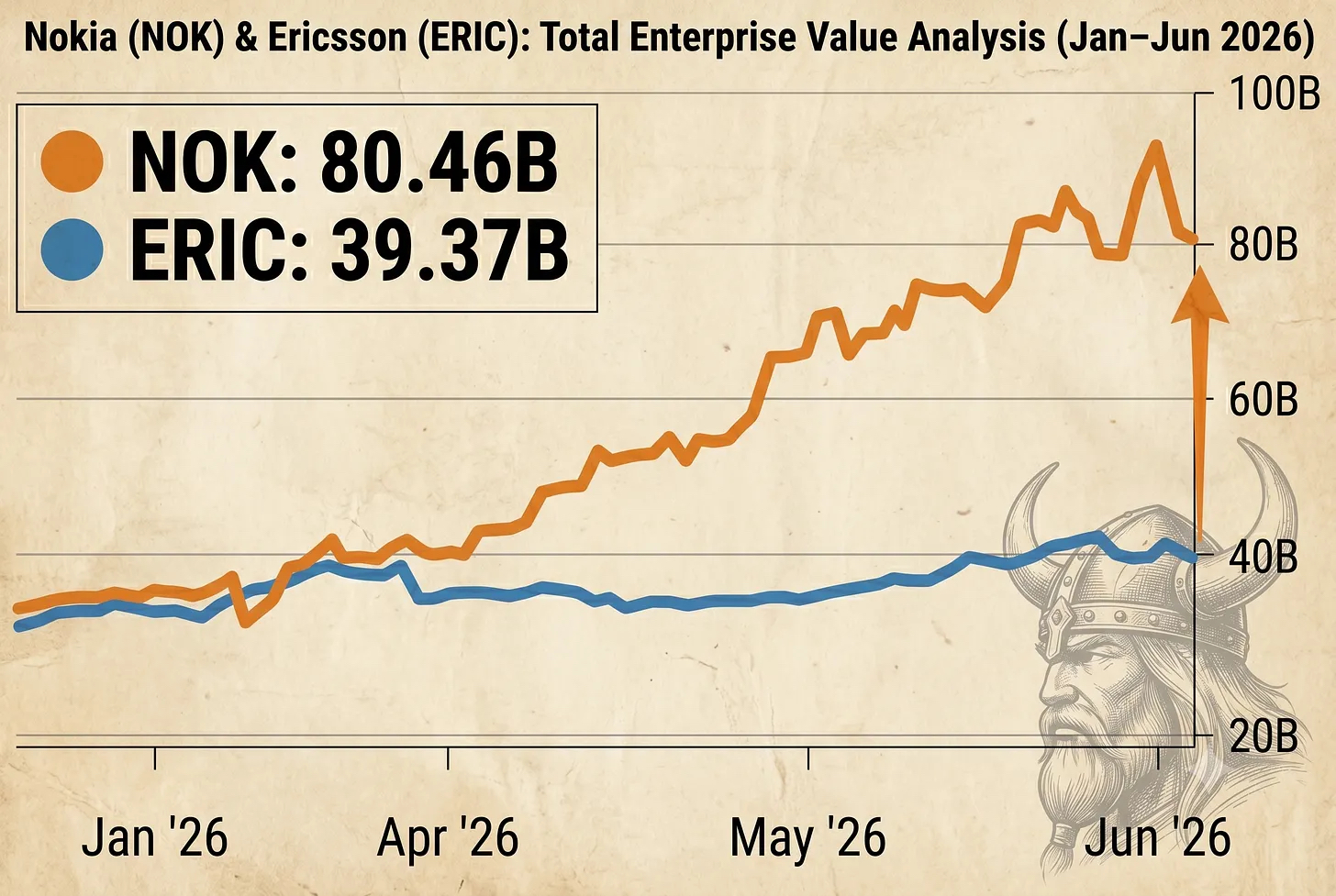
Since announcing its tie-up with NVIDIA last October and pivoting to reposition itself as an AI infrastructure company, Nokia’s share price has doubled, leaving Ericsson’s share price trailing – see below. So can Ericsson’s counter to NVIDIA/Nokia’s physical AI monetisation story succeed (not that there are any guarantees operators will buy into the GPU-in-the-RAN model)?

Source: Sebastian Barros, What in Valhalla is Going on With Nokia? 2X Value to 80B in 6 Months!, published 9 June 2026

Before we get going on the new AI in RAN part, Ericsson is keen to point out it has introduced AI functionality across its products since 4G, and in 2021 added AI‑ready acceleration in RAN Compute. More to the point, in February, it unveiled Neural Network Accelerators in its Massive MIMO radios, increasing AI inference capability by 10 times.

What is AI in RAN?

Ericsson’s new AI in RAN is a software subscription that “brings telco-grade AI models into basebands and radios to boost efficiency, performance, and energy savings. This commercially scalable offering gives communications service providers (CSPs) immediate benefits for 5G networks and supports the shift to AI-native RAN without requiring additional hardware.”

Ericsson AI in RAN introduces:

• Telco-grade AI models designed to run in real time within the RAN

• Continuous learning software powered by scalable, ‘high-quality’ data

• Agentic AI support for advanced RAN automation and network operations.

It works with Ericsson 5G Advanced across both purpose-built and Cloud RAN platforms to enable new AI-driven services. Some of the software features include AI-native Scheduler for Link Adaptation (see info on trial with T-Mobile US here), AI-powered Macro Positioning, AI-managed Beamforming, AI-powered Multi-layer Coordination, Performance Management Event Schema Files, and Augmented Observability for AI in RAN.

The first AI in RAN features are available in Q2 2026, with enhancements scheduled for later in the year.

What the operators say

Teruyuki Oya, Senior Vice President & CNO at SoftBank Corp, comments, “Ericsson’s AI in RAN software marks an important step in bringing AI deeper into the radio access network. By enabling realtime optimization of radio performance, spectrum efficiency and user experience, it helps us turn AI innovation into practical value on live networks. We also see strong potential in how this foundation can support emerging AI-driven services, including Physical AI scenarios that depend on low-latency, highly reliable connectivity, and intelligent coordination between network and compute resources.”

Bruce Dean, Senior Vice President, Network Technology & Operations at Bell, is also in favour, “At Bell, we’re continuously evolving our network to meet growing demand for high-performance, AI-driven services. Integrating AI directly into the RAN is an important step in making networks more intelligent and efficient. Working with partners like Ericsson, we’re bringing these capabilities into our network to enhance performance, improve energy efficiency and deliver a better experience for our customers.”

Yu Takki, Head of Network Technology Office at SK Telecom, adds, “Through our collaboration with Ericsson, SK Telecom is advancing AI-RAN to enhance network performance and energy efficiency while supporting more intelligent and automated operations. By combining research, real-world validation and software innovation, we aim to strengthen our leadership in AI-powered network evolution and help lay the foundation for AI-native 6G.”

Mark Kennedy, CTO at Rogers, says, “As Canada’s best 5G+ network, we’re proud to work with Ericsson and bring the latest 5G technology to Canadians. AI in RAN will help optimize network performance for customers in real-time and reduce energy consumption.”

Last word to Ericsson

“Ericsson is redefining what’s possible in mobile networks by bringing powerful AI capabilities to service providers,” says Mårten Lerner, Head of Networks Strategy & Product Management at Ericsson. “With AI in RAN software, we are taking a major step toward AI-native networks, alongside the AI-ready radios we unveiled in February.”

He adds, “With AI in RAN, Ericsson is bringing AI into networks to elevate 5G performance and efficiency through energy-efficient AI inference at scale”.

Colt, Ciena set benchmark with quantum-safe transatlantic transmission

0

New York-London trial shows ultra‑high‑speed data can remain protected from future quantum threats – when criminals gain access to the tech – across 6,900km of digital infrastructure

Colt Technology Services and Ciena completed what they say is one of the fastest quantum‑safe data transmissions ever demonstrated and the fastest across a transatlantic route.

The trial protected live data running across 6,900km of Colt’s subsea and terrestrial network between New York and London with Ciena’s WaveLogic 6 Extreme (WL6e) encryption solution. The solution uses post-quantum cryptography (PQC) algorithms that are compliant with the US’ National Institute of Standards and Technology (NIST) and approved for commercial use.

The trial proved that data can be securely transmitted at an 800Gb Ethernet (GbE) service rate which is fast enough to move data centre‑scale volumes across the Atlantic in seconds, that are protected against “growing quantum threats”.

Colt says businesses are moving to protect their data from “harvest now, decrypt later” attacks, in which bad actors intercept and store data in transit until they can access quantum computing capabilities at some time in the future. Some pundits this could be by 2030.

The trial is the latest in a series of quantum-safe encryption trials led by Colt across transatlantic subsea networks but stands out due to its:

  • Speed at 800GbE which is still at the early adoption stage – most long‑haul and subsea systems today run at 100GbE or 400GbE
  • Security as Ciena’s WL6e 1.6T quantum-safe encryption solution on the Waveserver platform offers PQC algorithms enabling high‑capacity secure connectivity that can function at extreme bandwidths over any distance. The solution uses a new type of encryption, Module-Lattice-Based Key-Encapsulation Mechanism (ML-KEM) is one of the first PQC methods to be officially standardised and approved by the National Institute of Standards and Technology (NIST) as FIPS 203.
  • Performance during the trial demonstrated outstanding optical performance, stability over subsea infrastructure and readiness to secure AI traffic demands 

Buddy Bayer, Chief Operating Officer, Colt Technology Services said, “Quantum computing is redefining the security challenge for global connectivity. This trial marks a significant step forward in protecting the world’s data as it moves across continents. It proves that quantum‑safe protection can be delivered at real‑world scale. Colt’s infrastructure combines global reach, sustained investment and robust security, giving businesses, hyperscalers and neoscalers the confidence to grow.

“At the same time, Ciena’s quantum‑safe solutions show how next‑generation security can be embedded into high‑speed networks, ensuring protection keeps pace with performance. Together, we’re helping customers protect critical data today while preparing for the quantum era, building future‑ready networks that simply work, and are secure, scalable and ready to power the AI economy.”

BT joins Anthropic’s Project Glasswing, as membership reaches 200

The project launched in April and allows trusted organisations to use Anthropic’s AI systems to identify vulnerabilities and fix them before criminals take advantage

BT has become the first UK company to confirm its membership of Anthropic’s Project Glasswing. It will have access to Claude Mythos Preview, Anthropic’s frontier AI model. BT claims this strengthens its protection against cyber security threats for its networks and customers.

Anthropic’s Claude Mythos can autonomously sequence multi-stage attacks and identify dormant bugs in decades-old codebases. It finds vulnerabilities then compiles and runs code to test and prove exploitability. Consequently, access to it is tightly restricted.

Anthropic launched Project Glasswing in April with about 50 founding partners and extended testers, including Amazon Web Services, Microsoft, Apple, Google, Nvidia, CrowdStrike and Palo Alto Networks. Its purpose is to bring together together critical infrastructure providers to secure data and systems which underpin services that millions of people rely on.

It allows trusted organisations to use Anthropic’s safe AI systems to identify vulnerabilities quickly – and help fix them before criminals can take advantage.

Telco joins the fray

Verizon was the first telco to join the project in May, followed by SK Telekom and AT&T. Earlier this month, Anthropic announced it is expanding the initiative, giving access to another 150 organisations across 15 countries, including from healthcare, water and power utilities, communications and hardware vendors. The current total of participants is about 200.

Each new organisation must pass rigorous security tests before gaining access to the unreleased Claude Mythos model to scan software for vulnerabilities.

BT’s Chief Executive, Allison Kirkby, announced the news as she opened the UK Government’s AI Adoption Summit yesterday. She said, “AI only works at scale when it is underpinned by future-ready networks that are secure, resilient, safe”.

She also emphasised BT’s commitment “to working with Government to support the further development and deployment of sovereign British AI capability, so that the UK can be an AI maker and not just a taker”, and to acting as an “enabler of responsible adoption and a responsible adopter ourselves” in AI.

Jon James, Chief Executive Officer, BT Business said: “AI is changing cyber security fast, and businesses need trusted partners who can help them stay one step ahead. By joining Project Glasswing, BT will strengthen its own cyber security capability to protect our networks, our customers and the wider UK.”

BT Business provides AI-powered cybersecurity solutions to customers of all sizes, including new products for small businesses – and it recently announced a collaboration with Accenture to develop advanced AI-powered cyber operations, responding to cyber threats at machine speed.

Proximus ran 3 slices at Red Devil’s final int’l before the World Cup

The operator’s slices simulataneously supported broadcast, medical teams and e-payments in and around the King Baudouin Stadium in Brussels in a first for Belgium

On Saturday, the Belgian men’s national football team, known as the Red Devils, played a final international friendly, against Tunisia, before the FIFA World Cup kicks off in the US. The Belgians won 5-0.

During the match, Proximus ran three 5G network slices at the King Baudouin Stadium in Brussels (pictured) to support on-site medical assistance, media coverage of the match and electronic payments. This is the first time that multiple slices ran simultaneously at a live event with tens of thousands of attendees in Belgium.

The UZ Brussels medical team on site was in constant contact with the medical staff at the hospital. The slice was secure and uninterrupted despite heavy network traffic in and around the stadium.

The slice dedicated to media coverage was in collaboration with DPG Media, which broadcast the match, and was a backup connection for the live broadcast.

A third slice supported mobile payments in an environment where hundreds of transactions take place simultaneously.

Renaud Tilmans, Chief Enterprise Officer at Proximus, said, “When the Red Devils play, everything has to run smoothly, both on and off the pitch. With this first, we are demonstrating…how our 5G network can support and guarantee multiple critical applications, from medical assistance and live broadcasting to payments, all simultaneously and within a packed King Baudouin Stadium.

“As a proud partner of the Royal Belgian Football Association and sponsor of the Red Devils, we are strengthening Belgian football by providing technology and innovation that make a real difference for fans, players, and the organisation alike.”

The men’s FIFA World Cup 2026 tournament will run from Thursday, June 11 to Sunday to July 19, with matches played in various locations in Canada, Mexico and the US.

Altice finally accepts €20.35bn offer from SFR’s rivals

Altice agreed to sell SFR to Bouygues, Orange and Free (Iliad) – assuming it wins regulatory approvals, it will be the biggest shake-up in French telecoms since Iliad joined the fray in 2012

After months of negotations, Altice France has finally agreed to French telecoms groups Bouygues Telecom, Orange and ‌Free (a brand owned by Iliad Group) jointly acquiring France’s fourth operator, SFR. The deal values SFR at €20.35 billion.

Altice Group is controlled by the French-Israeli billionaire Patrick Drahi and acquired SFR in 2014. Drahi’s empire was largely built on debt which now amount to about €60 billion. It has opcos across Europe and assets in the US.

Altice has struggled since the cost of servicing debt rose sharply post COVID due to inflation and other adverse factors. In 2025 Drahi renegotiated Altice France’s debt down from about €24 billion to €15.5 billion.

Back where they started?

Negotiations with SFR’s rivals began in April 2025 when the three offered Altice France a similar amount to that which has been accepted a year later. It was originally rejected as being too low. The three went on to offer Altice France €17 billion in October, which was also rejected.

Now the three buyers face regulatory hurdles to get one of the biggest telecoms deals in France over the line since cut-price Iliad group burst onto the scene in 2012.

Under the proposed deal, the companies will ​share out SFR’s assets. Bouygues is expected to take the the largest portion – assets that deliver about 52% of the revenue – followed by ⁠Iliad with 27% and Orange at 21%.

Orange and Bouygues ​are to file their proposed acquisition in France, where they generate more than two-thirds of their turnover within the EU. This exempts them from an obligation to notify the European Commission under EU merger rules, according to Reuters’ report.

However, this is not the case for Iliad which must file in Brussels with the European Commission.

After that, the French and EU regulators ​will agree who is to lead the merger review.

Regulatory attitudes might have shifted

Orange group’s CEO, Christel Heydemann (pictured), reportedly told analysts on a call, “What’s important for us is to have one authority in the driving seat ​to make sure the process is efficient”. She also said the company had strong relationships with ‌both.

Kester Mann, Director, Consumer and Connectivity, FDM CSS Insight, noted, “The agreement appears a successful outcome for all parties. Bouygues, Orange and Iliad each gain important new assets in their pursuit of greater scale, while eliminating a major rival [which] will reduce the competitive intensity of the market. For Altice, it ends months of speculation surrounding its heavy debt burden.”

He added, “The biggest challenge now is to convince competition authorities that the deal will bring positive outcomes to the French market. Several years ago, this would have felt like a Herculean task. But the regulatory tide has steadily been turning favour of consolidation in Europe following recent deals approved in the UK [the merger of Vodafone and Three UK] and Spain [which as seen a wave of consolidations in the last 3 years including Vodafone selling out and merging with regional service providers, and Orange merging with then buying out MasMovil]. Although a lengthy probe is likely, it is surely odds-on to get the green light.”

Mann is referring to the merger of Vodafone and Three UK last year to create the biggest operator group in that country. Spain has seen a wave of consolidations in the last three years including Vodafone being bought out and merging with several regional service providers, and Orange merging with then buying out MasMovil.

If the the deal is approved by regulators, Bouygues, Orange and Free/Iliad said they expect signing of the definitive legal documents in the second half of this year with completion in the second half of 2027.

Hospitals opt for Orange GenAI platform to support 15,000 professionals

Orange Business’ Live Intelligence was chosen by Rouen University Hospital which supports a network of public hospitals in Normandy

Rouen University Hospital (CHU de Rouen) selected Live Intelligence from Orange Business to provide its 15,000 professional staff with access to the secure GenAI platform. CHU de Rouen supports a network of public hospitals in the Normandy region of France (GHT Rouen Cœur de Seine).

Orange Business’ Live Intelligence platform is hosted in France, meaning it provides sovereignty, and connects to the hospital group’s information systems.

Stéphanie Decoopman, CEO of the Rouen University Hospital, said, “We chose Live Intelligence to provide the GHT Rouen Cœur de Seine public hospital group with an accessible, secure, and tailored GenAI solution across our network. Our goal is to leverage a trusted framework to develop use cases that benefit all job roles, from doctors and care teams to administrative and technical staff, in their daily work.”

Already in research

Already the GenAI platform streamlines grant application processes for researchers, reducing the time required from three weeks to two days. For sourcing, a request process that involves drafting specifications and evaluation criteria, the time could reduce from two weeks to one day. The ambition is to develop a long-term, co-innovation programme with other university hospitals to co-develop use cases that will be valuable for the entire healthcare industry.

A long-term partnership

Orange Business describes itself as Rouen University Hospital’s long-term trusted partner, calling on its tech and healthcare expertise for infrastructure, strategy and operational support. The goal is to deploy practical, robust solutions that keep pace with AI developments while remaining grounded in the realities of hospital operations and flexible enough to adapt to evolving needs over time, including the transition to agentic AI.

Claire Scotton, Vice President of Healthcare & Life Sciences at Orange Business, notes, “Some hospital staff today can feel they have become ‘data managers’ as much as healthcare professionals, spending significant time on documentation, administrative tasks, and coordination.

“The decision by Rouen Seine Valley Hospital Group to choose Live Intelligence as its trusted GenAI platform aims to empower staff with agentic AI capabilities, enabling them to reclaim time to focus on what truly matters: patient care, meaningful work, and collaboration. GenAI can improve working conditions and support all healthcare workers, support functions, and technical personnel to deliver better patient care.”

The rise of the Intelligence Live platform

Intelligence Live began as an internal AI platform built by Orange which about 100,000 of its 124,000 employees choose to use. This is “an incredible and an industry benchmark for adoption,” said Hriday Ravindranath, Chief Digital and Information Officer at Orange Business, in a recent interview.

The AI stack which underpins Live Intelligence, is shared with Orange Business. In 2024, the B2B unit productised the platform and took it to market.

At the Orange Business Summit 2026 in March, Orange Business announced its extended capabilities with Live Intelligence Studio. This is a new a plug-and-play generative AI platform that customers can use to develop, deploy and manage intelligent AI agents “securely in a trusted infrastructure to automate tasks and analyse data with a human touch,”. the firm says.

Telefonica’s CEO: sovereignty means Europe building its own assets

Marc Murtra argued for simpler regulation that prioritises what drives innovation, competitiveness and strategic autonomy – and accepting the risk of failure

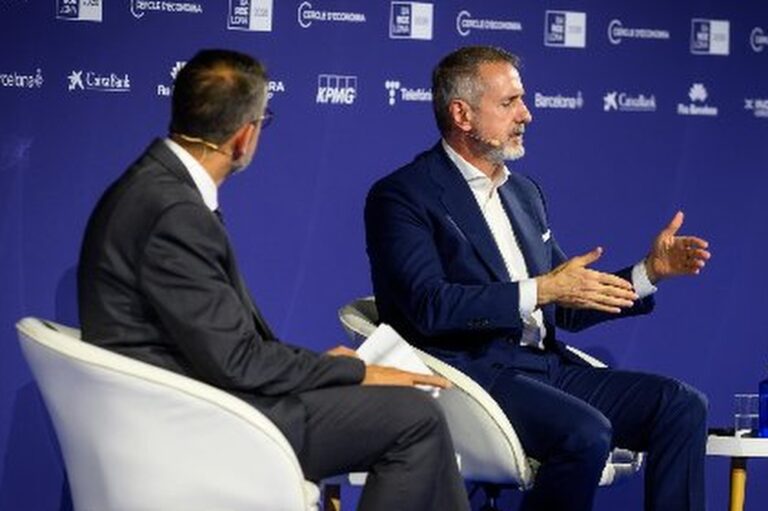
Telefónica’s Executive Chairman and CEO, Marc Murtra, said Europe must accelerate the development of its own technological capabilities to strengthen its strategic autonomy. He believes it is the only way to ensure the continent’s competitiveness in an era shaped by AI, quantum computing and new autonomous systems. He was speaking at the 2026 Cercle d’Economia event in Barcelona (pictured above, right, with Cristian Canton, Associate Director of the Barcelona Supercomputing Center, moderating).

He also stated that technological development has become a determining factor for countries’ economic competitiveness, productivity, resilience and decision-making capacity. He argued that strategic autonomy does not mean isolation, but rather the ability to develop and control critical capabilities in areas such as energy, digital infrastructure, semiconductors and AI.

“Strategic autonomy is the relevant concept. No economy is completely independent, but Europe must strengthen its capabilities to reduce excessive dependencies in key technologies,” he said.

He highlighted the role played by European telecoms companies as key platforms for the region’s technological development. “We are in an era of scale. If we want to develop technology in Europe, we need to build scale,” he noted.

Murtra stressed that Europe needs, and is strengthening, the technological layers that underpin AI, from energy and infrastructure to specialised models and applications. He also pointed out that Telefónica is contributing to this goal through its networks, digital infrastructure and strategic next-generation projects.

In his view, European strategic autonomy requires combining investment, industrial capacity, innovation, talent and a shared long-term vision. He argued that “building our own technology is the path to defending European values”, while also stressing that “technological development not only strengthens the continent’s competitiveness and autonomy, but also helps preserve very important values linked to democracy, human dignity and the ability to say what we think”.

“Europe has the GDP, the talent, the engineers, the companies and the institutions”, Murtra stated and argued for simplified regulation and to focus efforts on generating technology and industrial capabilities. “Simplifying does not mean eliminating regulation, but rather prioritising what drives innovation, competitiveness and strategic autonomy,” he explained.

Murtra acknowledged that it also means “accepting the risk of failure”, but, “Generating technology not only gives us autonomy; it can also represent very important values linked to democracy, human dignity and freedom.”

Lwazi Bam joins MTN as Group Chief Risk Officer from Standard Bank

He joins as MTN accelerates its Ambition 2030 strategy which focuses on fintech growth, digital infrastructure and financial inclusion across more than 20 markets

Via an Instagram post, MTN announced that Standard Bank’s former governance heavyweight has joined it ranks. Lwazi Bam’s new role is at MTN Group is Group Chief Risk Officer, effective from the start of June. The post said this is “marking strategic leadership shift as Africa’s largest telecom operator sharpens its risk framework amid rapid digital expansion”.

Bam joins the MTN Group as the company “accelerates its Ambition 2030 strategy focused on fintech growth, digital infrastructure and financial inclusion across 20+ markets”. His appointment reflects a broader shift toward governance-led leadership in African corporates navigating complex multi-market growth.

He has experience of other sectors including Deloitte, banking governance and corporate board. Apparently this positions him at the centre of growing convergence between telecoms and financial services, where risk management, compliance and capital discipline are critical.

For MTN Group, expanding mobile money, enterprise solutions, and digital ecosystems, the move signals a stronger push toward banking-grade oversight as cybersecurity and regulatory pressures intensify.

- Advertisement -
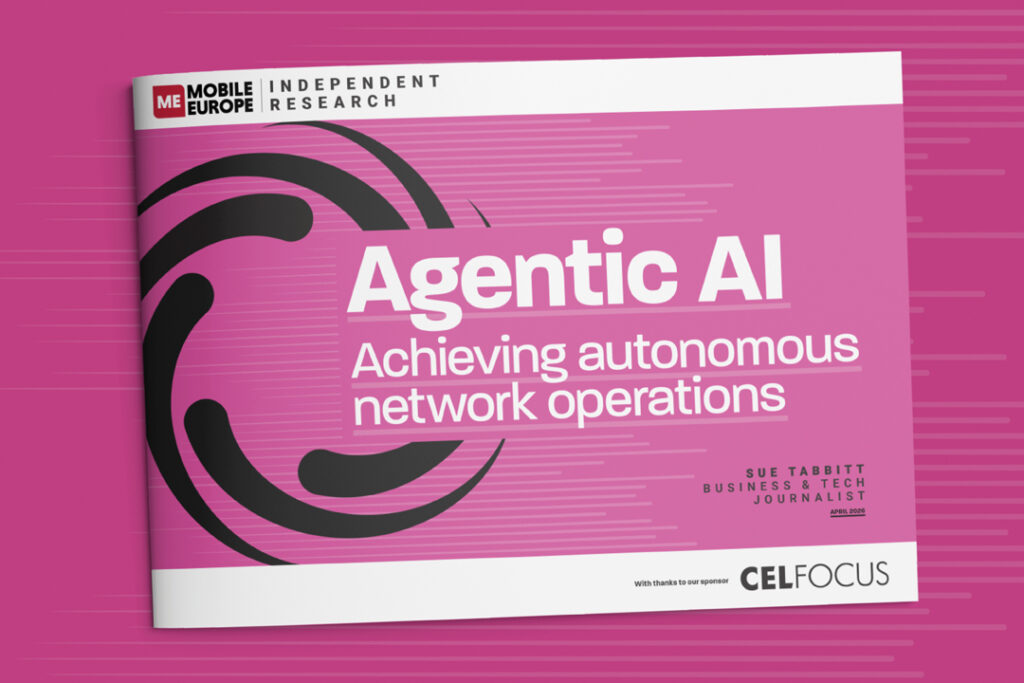
Latest independent research

Achieving autonomous network operations

Find out more in our new report