
Home Blog Page 3

AI is not why telcos keep shedding staff – cuts don’t always improve margin

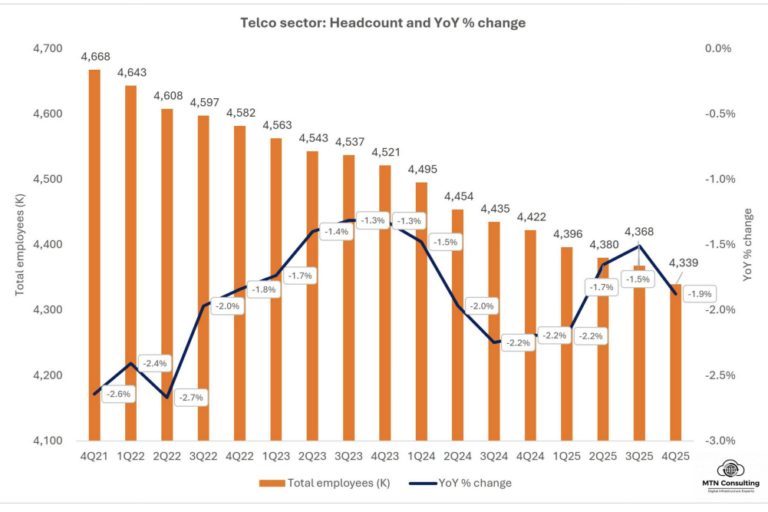
MTN Consulting: in 1Q 2011 telcos globally employed nearly 4x more than the webscale sector but since 4Q 2025, hyperscalers’ headcount is 3.5% higher. What’s going on?

With global telecom revenues flat, the industry’s strongest players are shifting from unrealistic growth targets to aggressive cost control. Central to that shift are automation, autonomous networks, and, more recently, AI. MTN Consulting’s Telecom AI & Automation (TAIA) module examines this transition.

The telco workforce has been shrinking for years due to layoffs, retirement and attrition, while the employee profile is also changing. Telcos increasingly value skills in software, cloud, AI and quantum computing.

Operators have long automated incrementally, but many now frame their strategy explicitly around AI as AI has become a major theme in the telco C-suite. Verizon said on its 4Q25 earnings call that it aims to be the industry’s “most efficient telecom company” [an ambition shared by the Vodafone Group, see this FutureNet World article] and an AI-first company deploying AI at scale.

At Orange, Chief AI Officer Steve Jarrett said the company is still at the crawling stage of managing AI systems at scale, while CEO Christel Heydemann predicts that by 2030, nearly two-thirds of network traffic could be AI-related.

Despite this rhetoric, telcos still need to make better use of their existing workforce. Training and upskilling remain essential. Swisscom’s CEO said on its recent 4Q25 earnings call that the company is “constantly upskilling” to improve employee performance as digital and AI transformation accelerates.

Other examples include:

Vodafone Spain – in May 2026, it said it had trained more than 2,300 employees in AI and cybersecurity through 22,000 hours of instruction, including masterclasses on AI and automation tools.
China Unicom (Chongqing) – in December 2025, it said it had built an “AI talent army” around “Research-Maintenance-Operations” integration, training staff in AI applications and “digital employees.”
Telus (Canada)– the company is rolling out an “AI co-pilot” for retention calls, saying it is meant to augment staff with real-time information despite employee concerns about job security.
VNPT – in late 2025, the Vietnamese state-run operator launched specialised AI training through VNPT Academy and VNPT AI, focused on enterprise solutions and workforce upskilling.

Success now depends on balancing retraining with selective hiring to meet digital-first needs.

The layoff paradox

Large layoff announcements often grab headlines. Verizon’s late-2025 plan to cut 15% of its workforce remains the biggest recent example. Over the past year, other major cuts came from AT&T, BCE, T-Mobile US, and Charter/Cox in the Americas; BT, Telefonica, and Vodafone in Europe; and Telstra in Asia-Pacific.

Operators often justify cuts as necessary for competitiveness and profit. BCE, for example, said its November 2025 plan to cut 700 jobs would help deliver C$1.5 billion (US$1.1B) in savings by 2028. But our data shows no direct link between headcount reductions and margin expansion, even with a multi-quarter lag, whether measured by EBIT or EBITDA.

This matters for telecom CFOs and labour unions alike: headcount cuts do not reliably raise EBIT margins. Savings on labour are often offset by higher costs elsewhere, especially depreciation and amortisation.

A telco that cuts staff by 20% while maintaining heavy capex should not expect a consistent EBIT benefit. Some operators, including KPN, Telenor and Deutsche Telekom, did improve EBIT while reducing headcount, but those gains also reflected asset restructuring or revenue stabilisation. The cuts alone were not the cause.

Analysts should stop accepting claims that layoffs are needed to protect margins without clear evidence afterward.

By contrast, MTN Consulting’s TAIA research suggests that financially strong telcos, those with high EBIT margins and high EBIT per employee, reinvest in workforce upskilling across automation, autonomous networks and AI.

Indiscriminate cuts can erode morale, institutional knowledge, service quality, and brand equity, hurting long-term profitability. Telcos that rush to cut staff in response to AI may also create talent gaps that increase cybersecurity risk, churn, and lost innovation.

Key findings: 4Q25 analysis: the following insights are based on MTN Consulting’s quarterly review through to the end of December 2025.

Employment and labour costs

Total headcount: The sector employed 4.339 million people in 4Q25, a 1.9% year-over-year decline (roughly 82,900 positions). This aligns with long-term trends of steady contraction. On a quarter-over-quarter basis, headcount has fallen steadily for 8 years, with only one interruption: after a dramatic dip in 1Q20 when COVID hit, employment levels rose slightly in 2Q20.

Global labour costs: Annualised labour costs were $263.2 billion in 4Q25. To put this in perspective, this compares to $295.7 billion in capex and $340.4 billion in depreciation opex for the same period. Some telcos spend much more on labour costs than capital, including Telus (labour costs 2.3 times capex in 2025), Chunghwa and stc (both 1.8x), KT (1.6x), and NTT (1.4x).

Cost efficiency: As a percentage of opex (excluding D&A), labour costs were 21.6% in 4Q25, down a bit from 21.8% in 3Q25 or 21.9% in 4Q24. Many telcos spend well over 30% of opex (ex-D&A) on the workforce, though, such as Swisscom (36%), Turk Telekom (35%), Telecom Argentina (34%), BT (32%), and Orange (31%).

Revenues mapped to costs: Another view is to map revenue to its primary uses. In 4Q25, annualised telco revenues broke down as follows: 14.2% to labour costs; 18.4% to depreciation and amortisation; 51.7% to all other opex; and 15.6% “leftover” as operating profit (EBIT). The EBIT portion is the second highest since the 3Q14 period, when EBIT/revenues was 16.8%; the highest since 3Q14 was the 3Q25 result of 16.1%.

Top workforce movers (4Q24–4Q25) – the cutters

Biggest 1-year declines: The largest headcount drops in number of employees between 4Q 2024 and 4Q 2025 were at Telefonica (down 18.7K employees), Verizon (-9.7K), AT&T (-8.0K), BT (-7.7K), and Etisalat (-5.0K). These are all large national operators with strategic programmes aimed at streamlining operations. Automation has been a central part of headcount cuts at these and similar companies for many years; AI is only an after-thought. Some even may call it a convenient excuse.

Of the five top decliners, BT and Verizon have been most explicit in claiming that AI is a (or the) primary driver in motivating workforce cuts. BT’s current CEO Allison Kirby, who is already planning 55K job cuts by 2030, has said that this plan does “not reflect the full potential of AI”, and that “depending on what we learn from AI…there may be an opportunity to be even smaller by the end of the decade.”

Verizon’s CEO Dan Schulman has been vocal about ambitious job cutting plans since taking his post late last year. Now he is making big claims about the benefits of AI in company operations, pointing to energy savings and better network troubleshooting. However, most telcos cutting headcount have been shrinking for many years, or have other reasons such as weak revenue growth or low margins which explain the cutting better than do early AI deployments.

Biggest gainers

Biggest 1-year gains: The largest headcount increases between 4Q 2024 and 4Q 2025 were at China Mobile (+5.9K, AI/data center expansion), Telus (+4.7K, growth at non-telecom divisions, Digital and Health), Swisscom (+3.4K, acquisition of Vodafone Italia), NTT (+3.2K, AI/hyperscale expansion), and Digi Communications (+2.4K, growth in Spain & Italy, new launch in Portugal).

When headcount growth occurs, the causes are usually acquisition or consolidation, short-term network rollout needs related to 5G or FTTH, and occasionally expansion into new market areas. Quite a few telcos are investing in AI and data centres, or diversifying away from telecom in other ways; China Mobile, Telus, and NTT are examples.

Biggest percentage changes in employment since 4Q 2024

These often result from spinoffs, asset sales, and M&A activity. Swisscom, for instance, grew headcount by 17% between 4Q 2024 and 4Q 2025 due to acquisition of Vodafone Italia. Digi grew headcount by 10% in 2025 due to expansion within Spain and Italy, and its newly launched greenfield mobile network operations in Portugal.

Turkcell’s headcount rose by 9.3% in 2025 due to both a ramp-up in 5G and expansion in cloud and data centre areas. The biggest percentage declines from 4Q 2024 to 4Q 2025 were at TDS Telecom (-40.5%, sale of affiliated wireless business to T-Mobile), CK Hutchison (-25.9%, Three UK and Vodafone merger), and Spark New Zealand (-20.2%).

Spark’s case is unusual, as the company reported poor results for the year ended June 2025, triggering a move to more outsourcing via Infosys and Nokia.

Profitability and performance

Labour costs/opex: Telcos spending the most on workforce, measured by labour costs as a percentage of opex (ex-D&A), include: BSNL (45%), Telus (43%), Rostelecom (43%), Bezeq (37%), and Grupo Televisa (37%). Those spending the least include Softbank (6%), Taiwan Mobile (8%), Airtel (9%), Zain KSA (9%), and True Corp of Thailand (9%).

Companies with low labour costs tend to have high external costs, such as interconnection, roaming, facility leasing or outsourced sales and marketing to partners or franchises. Those with high labour costs often have complicated histories as incumbent providers, high pension costs, high unionisation rates, and may own substantial infrastructure leased to others. Some also conduct their own R&D and design, such as Chunghwa, BT, Orange, and NTT.

Labour cost per employee: The global average rose to $60.2K in 4Q25, up from $51.4K 6 years prior in 4Q19. This growth is largely driven by rising salaries in emerging markets. For instance, China Mobile’s average per-employee cost rose from $30.4K to $47.1K in that period. Labour costs per head are also rising in the US; for AT&T, as an example, its average employee cost $115.K in 2019 but that grew to $183.1K in 2025.

EBIT per employee: This KPI is on a strong upward trajectory, growing from $51.1K in 4Q19 to $66.1K in 4Q25. On average, telco employees are generating 29% more profit per person than they were six years ago.

The hyperscale crossover

In 1Q11, the telco sector employed nearly four times as many people as the webscale sector. After years of rapid hyperscale growth and telco consolidation, the two sectors reached parity in 2Q24. As of 4Q25, hyperscale headcount is now 3.5% higher than that of the global telco sector.

Telcos tend to hire lots of people in two groups: network/IT engineers, and sales & customer support staff. Telcos will continue to need people in these areas for many years to come, but the needs are declining. Geographic and scale efficiencies, automation, autonomous networking, and now AI all are allowing the telco workforce to do more with less. AI may facilitate some of these changes, but it is not the main driver. Telcos have been using automation to do more with less (staff) since well before the first Lucent 5ESS digital switch was deployed in 1982 in Seneca, Illinois.

By contrast, hyperscalers continue to branch out and have more diverse hiring needs. They do hire plenty of software engineers, but that’s not all. Some hire lots of logistics and fulfillment staff; some hire retail specialists. All key hyperscalers spend heavily on R&D, and in a number of different areas: robotics, drones, aerospace, quantum computing, gaming. Nowadays there is high demand in areas like chip and DC infrastructure design, cloud platform development, AI model training, etc.

At the same time, the hyperscalers have always aspired to downsize their workforce when possible. That’s why, for instance, Amazon has been investing in robotics since its 2012 acquisition of Kiva. Now there is more of a push to downsize, for two reasons. First, hyperscalers are spending so much on capex, that they need to cut operational expenses. Second, they need to show that they can “take their own medicine”.

After all, they are all pushing the world to adopt AI as fast as possible, and they need to show that this approach can work. Meta’s big May 2026 layoff announcement is an example. There is a chance that Meta’s aggressive layoff strategy will be as successful as its rebranding to Meta in 2021.

Contact me, Matt Walker, Chief Analyst, MTN Consulting, via matt@mtn-c.com

Privacy Policy

0

Privacy Policy
1. Introduction

1.1 We are committed to respecting and protecting your privacy. This policy sets out our approach and how we collect and process data received from you on our site. “We” in this context are NDN Media Ltd. We are the Publishers of Mobile Europe and act as the administrators of the policy. In the policy we’re referred to as “The Administrator”.
1.2 We are committed to protecting the privacy of visitors to the website in accordance with the EU General Data Protection Regulation ( EU 2016/679) (GDPR) (the “Regulation”).
1.3 Here are the details that the Regulation says we have to give you as a ’data controller’:
· Our site address is www.mobileeurope.co.uk
· Our company name is NDN Media Ltd.
· Our registered address is 37 Lombard Street, London EC3V 9BQ
· Our nominated representative is James Pearson and they can be contacted at jamesp@sjpbusinessmedia.co.uk.

1.4 This privacy policy explains how we may collect personal data and how we use the information we may collect about you.If you have any comments or questions regarding this policy, please email them to dataprotection@sjpbusinessmedia.com.

2. Information collected and retained by the Administrators

2.1 We collect personal information about you from personal details provided by yourself in relation to the Services we offer to Users. We do not collect any sensitive personal information such as information on your racial or ethnic origins, political opinions, religious beliefs, trade union affiliations, sexual life, health or criminal history.

3. Use of information by the Administrators

3.1 We collect information which is necessary to:
3.1.1 provide the Services to you;
3.1.2 notify you of your Service order status; and
3.1.3 carry out internal administration and analysis.

3.2 We can also use that information to enhance your visit to our website by:
3.2.1 (with your consent) telling you about new products, new services and special offers;
3.2.2 tailoring your experience to your preferred choice of activities; and
3.2.3 informing you of changes in our website.

3.3 By providing us with your personal information, you consent to us (and where relevant, our subsidiaries, affiliates and trusted partners) using (including collecting, storing and processing) your personal information.

3.4 Under the Regulation we will ensure that your personal data is processed lawfully, fairly, and transparently, without adversely affecting your rights. We will only process your personal data if at least one of the following basis applies:

3.4.1 you have given consent to the processing of your personal data for one or more specific purposes;

3.4.2 processing is necessary for the performance of a contract to which you are a party or in order to take steps at the request of you prior to entering into a contract;

3.4.3 processing is necessary for compliance with a legal obligation to which we are subject;

3.4.4 processing is necessary to protect the vital interests of you or of another natural person;

3.4.5 processing is necessary for the performance of a task carried out in the public interest or in the exercise of official authority vested in the controller; and/or

3.4.6 processing is necessary for the purposes of the legitimate interests pursued by us or by a third party such as our credit card payment processing, except where such interests are overridden by the fundamental rights and freedoms of the data subject which require protection of personal data, in particular where the data subject is a child

3.5 If you do not want us to use your personal data for any of the reasons detailed in 3.1 and 3.2 above, you can let us know at any time by contacting dataprotection@sjpbusinessmedia.com and we will delete your data from our systems. However, you acknowledge that this will limit our ability to provide the best possible services to you. In some cases, the collection of personal data may be a statutory requirement and we will be limited in the services we can provide you if you don’t provide your personal data in these cases.

4. Accessing and amending your personal information

We will process your personal data for the purposes set out in clause 3 above. If, however, you have any queries or requests in relation to Data Protection/GDPR please notify our Data Protection Compliance Officer at: NDN Media Ltd, 37 Lombard Street, London EC3V 9BQ or dataprotection@sjpbusinessmedia.com.

5. Disclosure to Third Parties

5.1 We are allowed to disclose your information in the following cases:
5.1.1 If we want to sell our business, or our company, we can disclose it to the potential buyer.
5.1.2 We can disclose it to other businesses in our group.
5.1.3 We can disclose it if we have a legal obligation to do so, or in order to protect other people’s property, safety or rights.
5.1.4 We can exchange information with others to protect against fraud or credit risks.

5.2 We may disclose your information to necessary third parties to enable us to provide you with the Services. These are the third parties that have access to your information:
Oracle+Bronto [Email Service Provider]
AgileCRM [Customer Relationship Management tool]

5.3 We also reserve the right to access and disclose to third parties your information to comply with applicable laws including but not limited to disclosure in accordance with the GDPR Regulation, the Regulation of Investigatory Powers Act 2000 and lawful authority requests, to safeguard the proper operation of our systems and to protect ourselves and our clients.

5.4 Where any of your data is required for such a purpose, we will take all reasonable steps to ensure that your data will be handled safely, securely, and in accordance with your rights, our obligations, and the obligations of the third party under the Regulation and the law.

6. Protection of personal information

We use our reasonable endeavours, to ensure proper storage and careful disclosure of your personal information in order that nothing improper happens to your private information. These security measures mean that we may occasionally have to ask you for proof of identity before we are able to disclose personal information to you.

7. External Websites

This Privacy Policy only applies to this website. The website may contain links to external websites. Please note that we are not responsible for the privacy practices of other websites. We recommend that you check the privacy policy of any other websites you may visit through the website. The inclusion of links to such websites does not imply any endorsement of the material on such sites nor any association with their owners or operators. If you have any complaints relating to such sites, please contact them directly.

8. Storage of your Data

8.1 We may transfer your collected data to storage outside the European Economic Area (EEA). It may be processed outside the EEA to fulfil your order and deal with payment.

8.2 By giving us your personal data, you agree to this arrangement. We will do what we reasonably can to keep your data secure.

8.3 Payment will be encrypted. If we give you a password, you must keep it confidential. Please don’t share it. Although we try to provide protection, we cannot guarantee complete security for your data, and you take the risk that any sending of that data turns out to be not secure despite our efforts.

8.4 We only keep your personal data for as long as we need to in order to use it as described above in section 3, and/or for as long as we have your permission to keep it. In any event, we will conduct an annual review to ascertain whether we need to keep your personal data. Your personal data will be deleted if we no longer need it.

9. Opt-Out

9.1. Upon registering, there are several communication lists you can opt-out of. These lists are operated on an opt-out basis due to the legitimate interest there is in providing you with the service, information and business intelligence you’re registered for

9.1.1. To update your communication preferences, either select to manage your communication preferences at the bottom of any email from Mobile Europe, or visit the “My Preferences” section of the website whilst logged in to your account.

10. Your rights

10.1 You can ask us not to use your data for marketing. You can do this by indicating your preferences on our forms, or by contacting us at any time at dataprotection@sjpbusinessmedia.com.

10.2 Under the Regulation, you have the right to:
10.2.1 request access to, deletion of or correction of, your personal data held by us at no cost to you;
10.2.2 request that your personal data be transferred to another person (data portability);
10.2.3 be informed of what data processing is taking place;
10.2.4 restrict processing;
10.2.5 to object to processing of your personal data; and
10.2.6 complain to a supervisory authority.

10.3 You also have rights with respect to automated decision-making and profiling as set out in section 11 below.

10.4 To enforce any of the foregoing rights or if you have any other questions about our site or this Privacy Policy, please contact us at dataprotection@sjpbusinessmedia.com.

11. Automated Decision Making and Profiling

11.1 In the event that we use personal data for the purposes of automated decision-making and those decisions have a legal (or similarly significant effect) on you, you have the right to challenge to such decisions under the Regulation, requesting human intervention, expressing their own point of view, and obtaining an explanation of the decision from us.

11.2 The right described in section 11.1 does not apply in the following circumstances:
11.2.1 the decision is necessary for the entry into, or performance of, a contract between the you and us;
11.2.2 the decision is authorised by law; or
11.2.3 you have given your explicit consent.

11.3 Where we use your personal data for profiling purposes, the following shall apply:
11.3.1 Clear information explaining the profiling will be provided, including its significance and the likely consequences;
11.3.2 Appropriate mathematical or statistical procedures will be used;
11.3.3 Technical and organisational measures necessary to minimise the risk of errors and to enable such errors to be easily corrected shall be implemented; and
11.3.4 All personal data processed for profiling purposes shall be secured in order to prevent discriminatory effects arising out of profiling.

12. Sponsored Content

12.1. Upon downloading sponsored content, we will provide your contact information (Name, Email, Job Title, Company, Phone Number) to the sponsor of that content. They may contact you via email or telephone thereafter.
12.1.1. This is performed under legitimate interest, for which we have undertaken assessments to confirm the balance therein, specifically, it is the sponsorship of our partners that make the content possible, and we believe our users will find hearing of their products & services – relevant to the subject of the aforementioned content – to be useful and their right to privacy does not override our legitimate interest..
12.1.2. You may unsubscribe from receiving communications from any third party at any time by clicking the unsubscribe link at the bottom of any of their email communications.
12.1.3. SJP Business Media cannot be held liable for any failure of a third party affiliate to reasonably process a request to unsubscribe or for data, once data has been passed over.
12.1.4. We will not pass your personal information on to any third party other than those who are sponsors of the content which you have downloaded
12.1.5. This clause does not extend to NDN Media Ltd “Sponsors & Partners” mailing list, which is considered as a part of the NDN Media Ltd provision. You may unsubscribe from this list at any time.
12.2. We share with you a list of our sponsors and partners with whom we may share your data when you download content for which they are a sponsor and/or contributor.

13. Changes

13.1 If we change our Privacy Policy, we will post the changes on this page. If we decide to, we may also email you.

Hopes for telecoms are high as Ireland prepares to assume the Irish Presidency

An open letter from Connect Europe and Telecoms Industry Ireland argues this is real chance for “a more ambitious, more coherent and more investment-friendly connectivity agenda”

Here is a joint statement by Connect Europe (formerly ETNO) and the Telecommunications Industry Ireland, issued today. Ireland’s stint is from the beginning of July to the end of December this year. The following open letter is arguably a triumph of hope over experience, given how slow the EU is to act and that the Presidency of the Council of the EU only lasts six months.

We reproduced it here in reverse order, starting with the specific requests before moving to the general observations. Note that the EU has been accused of weakening the Digital Networks Act (DNA) under pressure from US Big Techcos and the draft DNA was not enthusiastically received when it was published in January.

Ireland is well placed to bring focus, pragmatism and momentum to this agenda. 

On the Digital Networks Act, we call on the Irish Presidency to help drive a framework that:

  • Delivers simplification and harmonisation, cutting duplicative and outdated rules, reducing fragmentation, and ensuring a genuine level playing field across the digital ecosystem. 
  • Strengthens long-term spectrum certainty, with predictable and proportionate rules that support investment, scale and innovation, including early clarity on future bands and next-generation networks. 
  • Modernises open internet rules, preserving core principles while adapting them to technological evolution, enabling innovation in advanced networks and supporting Europe’s industrial digitalisation. 
  • Ensures proportionate and coherent end-user rules, maintaining strong consumer protection while avoiding unnecessary duplication, reducing complexity, and supporting a more investment-friendly telecom framework. 

On the Cybersecurity Act, we call on the Irish Presidency to help promote an approach that:

  • Ensures supply chain security measures are strictly risk-based and proportionate, while fully respecting Member States’ competence in national security matters. 
  • Provides predictability for long-term network investment, by carefully taking into account the impact on resilience, service continuity, competition, legal certainty as well as Europe’s overall investment capacity.

Europe’s digital future will be built on the strength of its networks. If Europe wants to compete, innovate and remain resilient, policy must now match that ambition. The Irish Presidency has a real opportunity to help shape that next chapter.”

“Europe is entering a decisive phase in shaping its digital future. As Ireland prepares to assume the Presidency of the Council of the European Union, it has a timely opportunity to help steer a more ambitious, more coherent and more investment-friendly connectivity agenda for Europe. This will require improving the current draft of the Digital Networks Act and correcting the course on investment-depressing measures in the Cybersecurity Act.”

[Note that the proposed update to the Cybersecurity Act was also published in January.]

The letter’s general observations

Telecommunications is no longer a sectoral issue. It is a strategic enabler of Europe’s competitiveness, resilience, innovation and security. As highlighted by the reports of Enrico Letta and Mario Draghi, Europe’s ability to lead in AI, cloud, advanced manufacturing, digital public services and the green transition will depend on the strength, scale and sustainability of its digital infrastructure. 

Yet Europe still operates within a fragmented and outdated regulatory environment that too often discourages long-term investment, limits scale and slows innovation. At a time of rising geopolitical tensions and intensifying global competition, Europe cannot afford to remain stuck in a cycle of underinvestment and regulatory complexity. The next phase of EU telecom policy must help create the right conditions for a stronger, more unified and future-ready European telecom market

In this context, the proposed Digital Networks Act represents a strategic opportunity to reset Europe’s connectivity framework. If ambitiously strengthened during the legislative process, it can support faster network deployment, greater regulatory coherence, stronger investment capacity and a more competitive and sovereign digital Europe. The DNA should not be a technical codification exercise. It should be a competitiveness instrument, one that restores investment confidence, enables scale, simplifies rules and helps secure Europe’s technological future. 

At the same time, the review of the Cybersecurity Act must reinforce Europe’s network resilience and security in a way that is proportionate, risk-based and operationally workable. Europe needs a cybersecurity approach that strengthens trust and preparedness without creating unnecessary duplication, unintended market disruption or barriers to investment. Security and competitiveness must advance together. 

Hyperscalers to shift AI financing off their balance sheet onto private equity backers?

Big Tech’s AI infra spend is expected to clear $700bn in 2026: Juniper Research distils possible implications of the Google, Blackstone JV to build AI infra in the US, at scale

On 18 May, Google and Blackstone announced a joint venture to create a new US-based company, reports Juniper Research. The new company will offer data centre capacity, operations, networking and Google Cloud’s Tensor Processing Units (TPUs) as a Compute-as-a-Service (CaaS) offering. 

Blackstone will contribute an initial $5 billion in equity capital; Google will provide the hardware, including its TPUs, which are custom chips purpose-built for AI. The joint venture expects to bring the first 500 megawatts (MW) of capacity online in 2027, with plans to scale – significantly – over time.

This is Juniper Research’s summary of why this could prove a highly significant development:

• The Google-Blackstone joint venture externalises hyperscaler capital expenditure (CapEx) to private capital for the first time at this scale, with Blackstone taking majority equity while Google retains the TPU supply relationship. Big Tech AI infrastructure spend is set to clear $700 billion in 2026; marking a structural shift where financing the physical layer of AI moves off hyperscaler balance sheets and into private equity-backed operating companies. It is likely that more hyperscalers will follow the same game plan. 

• TPU CaaS to rival NVIDIA’s graphics processing unit (GPU) dominance for the first time, as CoreWeave – a specialised cloud provider of high-performance GPU infrastructure – fell more than 10% on the announcement of the joint venture. The broader neocloud category could face margin pressure as a non-NVIDIA accelerator alternative becomes commercially available outside Google Cloud itself.

• NVIDIA’s export controls are squeezing GPU access across Southeast Asia and the Gulf. As a result, a commercially available TPU platform could become a meaningful alternative for markets that are hungry for AI compute but locked out of the supply chain. A TPU-native CaaS offering, backed by Blackstone’s capital and Google’s silicon stack, could represent a credible alternative procurement pathway. However, the current US-only framing could limit this opportunity for the joint venture in the near term. The question is whether Google is willing to internationalise TPU access. 

Mobile Europe wonders why it wouldn’t?

Sparkle expands Quantum Safe Interconnect to 20 locations

0

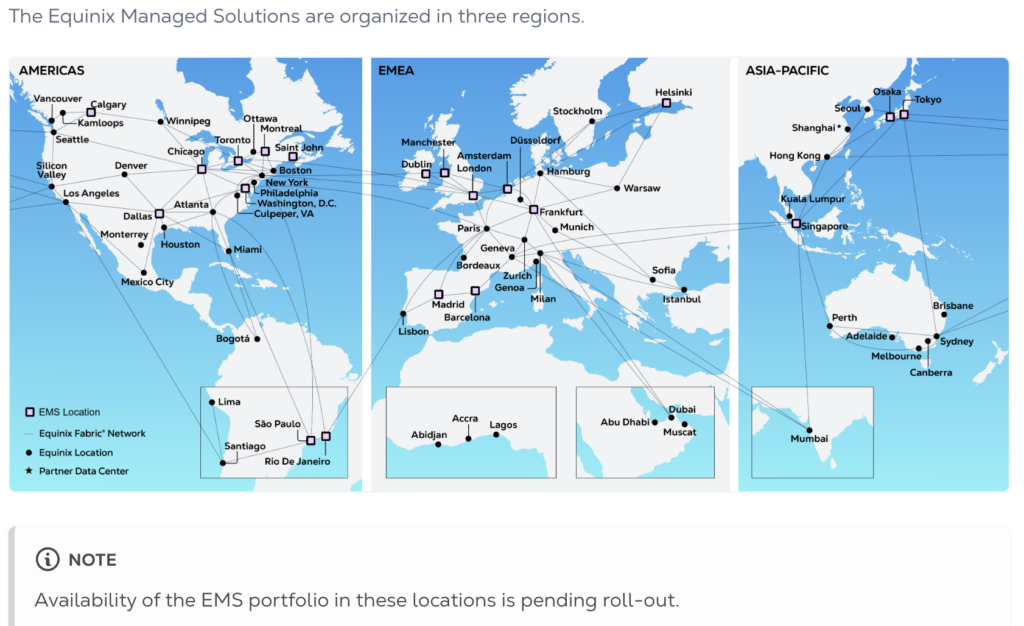
After validation over an IPsec tunnel between Frankfurt and Singapore, QSI is now available in 20 Equinix locations across Europe, the Americas and Asia

Sparkle, Italy’s leading international service provider, announced its Quantum Safe Interconnect (QSI) is commercially available at 20 Equinix International Business Exchange (IBX) data centre locations. They span Europe, the Americas and Asia where Equinix Managed Solutions (EMS) are offered (see graphic and note below).

The QSI was validated through a proof of concept over a secure Internet Protocol (IPsec) tunnel between Frankfurt and Singapore. It is available to enterprises, carriers and hyperscalers seeking quantum-safe protection for their cross-site VPNs, hybrid infrastructures and distributed multi-cloud environments.

QSI is a software-based overlay which can be deployed on existing network and security infrastructures. Sparkle says this is unlike approaches based on dedicated transmission paths, specialised hardware chains or rigid point-to-point architectures.

QSI can integrate with virtual firewalls, cloud environments and interconnection platforms, and can be delivered through Network-as-a-Service (NaaS) so organisations can secure traffic across regions without redesigning their networks. It is intended to enable rapid adoption, scalable multi-site deployments over long distances and a gradual transition to quantum-resilient connectivity.

Commercial availability

“The commercial availability of Quantum Safe Interconnect across Equinix locations marks a major milestone in Sparkle’s strategy to extend QSI into leading interconnection environments worldwide”, said Antonella Sanguineti, Head of Networking, Cloud, Security & Identity Solutions at Sparkle

“QSI stands out for its ability to deliver quantum-safe protection in real operational contexts as a scalable software-based service. This achievement reflects a shared vision with Equinix to develop secure, interoperable and future-ready solutions across a global digital ecosystem.”

“Sparkle is innovating in the integration of next-generation security directly into the environments where dense ecosystems of customers build and scale their digital infrastructure at Equinix,” said Joe Crawford, Vice President, Equinix Managed Solutions. “They have demonstrated an approach that can be integrated into real world IPsec, data center and interconnection environments, helping customers strengthen cyber resilience across globally distributed infrastructures.”

Sparkle says it will continue to industrialize and expand the solution across the broader Equinix ecosystem, including Equinix Fabric, accelerating the adoption of quantum-resilient connectivity worldwide.

Vodafone Deutschland pumps up the volume for DOCSIS customers

0

Can the operator finally leverage its massive investment in the German market, which is its largest in Europe but has often been a drag on growth?

Earlier this week, Vodafone Deutschland said it is to halve latency on its cable internet infrastructure to improve users’ experience of apps like video conferencing, cloud-based services and online gaming.

The rollout is already underway and Vodafone expects around 45% of its cable network to be equipped with the technology by October. At that point, firmware updates will also be pushed to compatible cable routers, enabling customers to benefit from the improvements in everyday use without needing to replace hardware.

Vodafone aims to have a phased deployment to its total base of 24 million homes within about two years.

Vodafone acquired the cable infrastructure in Germany as part of an €18.4 billion deal in 2019 with Liberty Global. However, Vodafone has struggled in Germany, its biggest market in Europe although that might be rivalled after the merger of Vodafone and Three in the UK.

In particular, it suffered when tenants in multi-dwelling buildings were allowed to choose their own internet and TV service provider rather than the landlords’ choice – Vodafone was the incumbent provider and experienced heavy churn. Clearly, this is has launched a counterattack instead of the rearguard action it engaged in for so long.

Vodafone says live testing was carried out in Stuttgart, in a network segment covering around 100 household connections over several months. The pilot used the company’s Ultra Hub 7 router [its first own brand home device, launched earlier this month] and measured thousands of parameters. Vodafone said the results showed latency reductions of more than 50% for selected real-time applications during peak traffic compared with the previous setup.

DOCSIS fit for the future

The technology is based on the DOCSIS cable standard, according to Vodafone, which combines fibre optics up to local distribution points with coaxial cable for the last leg into homes. The new system prioritises time-sensitive data streams, giving them a ‘fast channel’ within the network.

Applications like video calls, online gaming and cloud services experience less buffering and prioritised routing, even if large background data transfers are in train, such as downloads or software updates. The changes are all within the network and do not require customers to act to benefit from the changes.

“Today marks the starting signal,” said Marcel de Groot, CEO of Vodafone Deutschland yesterday (pictured above) “We are making our cable network fit for the future and significantly improve response times technically. Every millisecond can make a difference in video calls or gaming. The latency booster delivers noticeable improvements, especially during peak hours.”

More on the home device front

But that’s not all. Today Vodafone Deutschland announced that external speakers will be available from mid-June as an add-on to the GigaTV Home Sound TV box. In parallel, Vodafone launched a hardware exchange programme for its customers: the operator will gradually replace about 400,000 older TV receivers (such as GigaTV.Net, Giga Cable Box 1 and Horizon) with new GigaTV Home receivers.

Matthias Lorenz, Head of Consumer Business at Vodafone Germany, said, “To ensure our customers benefit from the full range of features, we will be replacing around 400,000 older TV boxes with new ones by the end of 2027.”

More info here, in German.

Orange partners global initiative to map and disrupt cybercrime

The operator’s Cyberdefense unit joins forces with the Cybercrime Atlas initiative, hosted by the World Economic Forum, to launch open source Cosmos

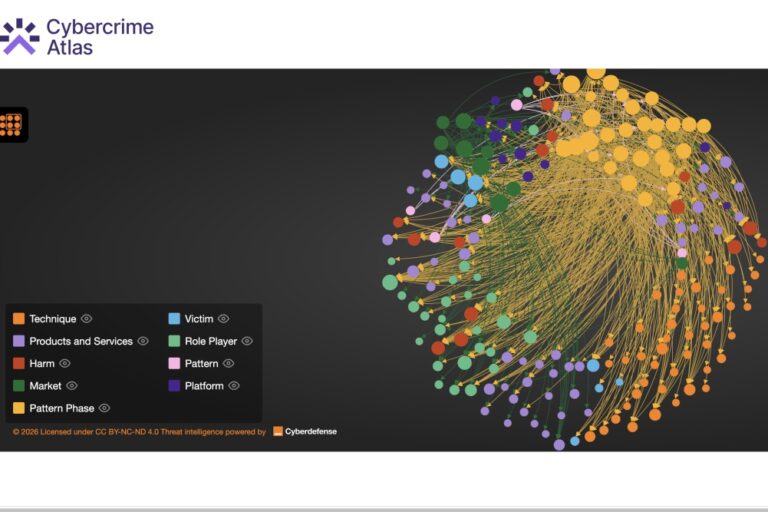
The World Economic Forum is hosting the Cybercrime Atlas initiative, Cosmos, to create a universal ontology that maps, classifies and connects the components of the cybercriminal ecosystem. It wants to equip law enforcement agencies, institutions, researchers and private sector experts to understand and disrupt global cybercriminal ecosystems collaboratively.

Orange Cyberdefense is to contribute intelligence about cyber threats, research expertise on open source and technology know-how via an interactive knowledge-graph platform (see screenshot above) to support this global effort.

Orange claims this is “a bold step-change in the way organizations collaborate against cybercrime, enabling greater intelligence sharing, co-ordinated analysis, and collective action across the global cybersecurity community”.

It notes cybercrime is an industrialised, borderless societal threat, that operates through a complex ecosystem involving specialised actors, criminal marketplaces and sophisticated monetization channels.

Orange Cyberdefense is contributing to the Cybercrime Atlas on a pro bono basis, working alongside private-sector and academic experts to support research, data collection and intelligence structuring.

The company is also providing the World Economic Forum with a bespoke visualisation application, built on the technology behind its Cybercrime Now platform which reveals connections between threat actors, infrastructure, criminal services, marketplaces, intermediaries and monetisation chains.

Seán Doyle, Lead of the Cybercrime Atlas at the World Economic Forum’s Centre for Cybersecurity, comments, “The Cybercrime Atlas capitalizes on open-source research and the extensive knowledge of leading companies and experts to map cybercrime networks. “The insights generated are supporting greater cooperation between the private sector and public sector to combat cybercrime.”

More details on The Cybercrime Atlas’ Cosmos initiative can be found here.

Ex-Chief of Joint Ops to advise Voda Business on defence, security and industry

Sir David Capewell KCB OBE FRSA is to help build “robust links” with the UK Ministry of Defence and security bodies, including NATO, the EU and critical infrastructure organisations

Former Chief of Joint Operations Sir David Capewell KCB OBE FRSA has an advisory position at Vodafone Business. He will support the company’s strategic engagement across the defence, security and government sectors, in the UK and internationally.

This includes establishing connections with UK Ministry of Defence and related security agencies, including NATO, the European Union, and the international aspects of critical national infrastructure.

He is also tasked with fostering collaborative relationships with partners, industry stakeholders and the wider science and technology community.

Vodafone Business supports public sector and critical national infrastructure organisations across the UK with secure connectivity, cloud, IoT and cybersecurity services. The company says Sir David’s appointment reflects its continued investment in specialist leadership to support customers operating in mission-critical environments.

A long, distinguished career

Sir David served in the UK military for more than 37 years, holding several senior operational and leadership roles. In his final appointment, he served as Chief of Joint Operations, overseeing UK global and allied operations.

Prior to that, he was Assistant Chief of Defence Staff (Operations) at the Ministry of Defence, where he helped shape national operational policy and strategy, including security operations for the London 2012 Olympics.

Sir David said, “Secure, resilient and trusted communications are fundamental to modern defence operations. Vodafone Business has a unique combination of global scale, technological capability and deep security expertise. I am looking forward to working with the team to help defence organisations harness digital connectivity in a way that enhances operational effectiveness and resilience.”

Nick Gliddon, Business Director, VodafoneThree, added: “Sir David[‘s]…understanding of defence priorities, combined with Vodafone Business’s global networks and security capabilities, will help us better support defence organisations as they modernise and operate in an increasingly complex digital landscape.”

du offers cloud for Chinese enterprises expanding into the UAE

Sovereign cloud solution offers Chinese SMEs and electric vehicle makers “seamless” market entry with integrated local hosting, regulatory compliance and secure connectivity

du, the biggest telecom and digital services provider in the United Arab Emirates (UAE), has launched the National Hypercloud – Huawei Edition. This is a UAE-based cloud platform designed to support Chinese enterprises and SMEs seeking to establish and grow their presence in the UAE.

Chinese businesses increasingly look to the UAE as a strategic gateway to Middle Eastern and global markets. The new platform “addresses a critical gap in the market by providing Chinese companies, particularly those in the rapidly expanding electric vehicle sector and ambitious SMEs, with a comprehensive, sovereign cloud solution tailored to their unique operational requirements,” the statement says.

The platform combines local data hosting and regulatory alignment with UAE compliance standards. Beyond hosting, it provides connectivity infrastructure and data exchange protocols, accessible through a single integrated partner.

For Chinese electric vehical (EV) manufacturers, the platform offers strategic value as the UAE continues to position itself as a hub for sustainable mobility and clean technology investment. The sovereign cloud architecture ensures that sensitive proprietary data, including vehicle software, customer information, and manufacturing specifications, remains protected within UAE borders while maintaining the performance standards required for modern automotive operations.

Colt’s second PoP in Turkey supports demand for AI and digitalisation

Instanbul offers alternative east-west and north-south routes, plus direct connectivity in central and Eastern Europe, the Middle East, central Asia and the Caucasus and parts of North Africa

Colt Technology Services (Colt) has added a second point of presence (PoP) to its network in Istanbul, Türkiye. It was built to meet the growing demand for infrastructure capacity to support businesses’ AI and digital transformation plans. Colt’s infrastructure now connects to two established data centres in the city – one on both the European and Asian side of Istanbul which are separated by the Bosphorous Strait (pictured).

Colt has also upgraded its network capabilities in the city to improve resilience and reach, so local and international customers can access a broader portfolio of scalable networking solutions. They include optical, Packet Ethernet and enterprise IP services at speeds of up to 100 Gbps.

Istanbul is Türkiye’s leading financial and commercial hub and one of the very few cities in the world that physically spans two continents and is a natural interconnection point between Europe, Asia, the Middle East and parts of Africa.

Colt’s digital infrastructure in the region creates alternative east-west and north-south routes, providing direct connectivity in central and Eastern Europe, the Middle East, central Asia and the Caucasus and parts of North Africa.

This reduces reliance on a small number of traditional Western European hubs and improves redundancy and failover for global customers. It also provides shorter, more direct data paths between regions and fewer network hops compared with routing traffic via Western Europe alone.

‍Joe Scattareggia, EVP –Infrastructure and Connectivity Sales, Colt Technology Services said, “Demand for high-capacity, low-latency infrastructure in Türkiye and its surrounding regions is rising fast, driven by factors such as AI workloads, cloud adoption and digital transformation.

“Deepening our loca presence in Istanbul means we can serve enterprise customers in‑country, meet data-residency, performance and resilience requirements, and support hyperscalers and neoscalers expanding into the region. It’s an exciting part of our continued investment in building exceptional infrastructure that powers the global AI economy.”

- Advertisement -
Latest independent research

Achieving autonomous network operations

Find out more in our new report