

This is according to Juniper Research but is physical AI just Round 2 of MEC or could we follow Softbank and Yaskawa’s lead to turn the network into the brain for less specialist tasks?
A new study* by global tech strategist firm Juniper Research predicts deployments of physical AI systems in manufacturing and logistics will reach 400,000 by 2030. This would reflect a growth rate of 3,500% from 2026, driven by advances in real-time processing and AI models, which promise to improve the capabilities and safety of physical AI operating in real-world environments.
Physical AI systems can perceive, reason and act in the real world. In manufacturing and logistics, they are expected to play a critical role in improving warehouses and factory efficiency to reduce costs for businesses.
“Multiple technological advancements are converging to accelerate physical AI adoption,” says Molly Gatford, Senior Research Analyst at Juniper Research. “Reduced latency from improved real-time processing is enabling more reliable real-world operation, while more advanced models allow systems to respond to a broader range of inputs, including tactile data; improving how physical AI interacts with its environment.”

Is physical AI just the new edge?
Is physical AI simply a renamed, second attempt at Multi-access Edge Computing (MEC) which promised us autonomous vehicles and remote surgery a decade ago? And a whole new money-making opportunity for telcos providing ultra-low latency connectivity to underping it all, delivered via their networks which make them local almost everywhere MEC might be required.
Instead cloud hyperscalers – AWS, Azure and Google Cloud – extended their centralised clouds to the edge where necessary, capturing the value in the enterprise market. They maintained their extraordinary grip on developers in part because telcos didn’t offer universal APIs for them to use in application development. Telcos new revenues from the edge are very scarce indeed.
Industry veteran and commentator Sebastian Barros sums up: [subscription needed], “The financial lesson to learn in the AI-Edge era is that owning localized physical real estate is worthless unless you control the software platform developers use to build applications.”
Will round two to play out in the telcos’ favour? Juniper’s Gatford reckons major technical barriers are being addressed, so vendors “must prioritise connectivity partners that offer edge-enabled connectivity architectures; allowing physical AI systems to process data locally and reduce latency constraints. This becomes essential with advanced physical AI models now requiring processing of data from multiple different sensor inputs,” Gatford concludes.
But telcos get maybe a 5% share of the revenues for providing infrastructure, as they mostly do in private 5G networks, and telcos are not the only option for that connectivity in many instances either.
A giant leap for robotic kind
Maybe it doesn’t have to this way: last December, the partnership between Japan’s Softbank and Yaskawa Electric demo’d physical AI in action, at the 2025 International Robot Exhibition (iREX 2025), held at Tokyo Big Sight. Softbank, a commercial operator, provided the distributed computing that acted as a multi-tasking robot’s brain.
Why is this such a big deal? Conventional robots are designed to perform specific tasks and cannot handle multiple tasks simultaneously – I’m still not sure they can in this demo either, any more than humans can. The point is the ability to switch between tasks extremely rapidly. By leveraging AI on MEC, various types of information can be integrated and analysed in real time to assess situations accurately then provide optimal instructions to robots. As the press release says, their “multi-skilled functionality” means a single unit can take on multiple roles.
Necessity is the mother of invention
The second reason this is such a big deal: I could never understand, looking at manufacturing and other ‘verticals’, where anybody in their right mind thought all those extra multimillions were going to come from for telcos via 5G. I mean, how many sectors were or are there when super-low millisecond latency is needed?
Appledore Research found that about 95% of ‘edge’ use cases can be dealt with by hyperscaler data centres, even to the level of regional data centres within a country. The remaining 5% that do need lower latency are for applications like factory automation and [conventional] robots.
But I’ve finally grasped that looking at ‘industries’ was the wrong way to look at it and the ‘everyday’ market is massive. Like peeking at the world through a keyhole.
Turning Japanese
Japan is an extreme example of a declining birthrate and an aging population, common in many developed economies, at a time when business operations are becoming more complex. Hence there is an urgent and growing need for automation and labour-saving solutions in many scenarios. Softbank and Yaskawa point to the lack of automation in social environments “where there are many unspecified people, and where various tasks need to be implemented in unspecified orders”.
Such environments include office buildings, hospitals, schools and department stores, where robots would need to operate in the same space as humans. To succeed they would need to respond to changing situations – adjust work procedures and accommodate interruptions – which requires complex decision-making on the fly.
There are challenges. Barros notes that, “A typical human user produces tens of megabits per day. The robot produces hundreds of megabits per second”. Telecoms networks are not architected to deal with that volume of uplink traffic – even the the explosion of social media content being uploaded every minute of every day by users has done little to shift the balance away from the majority of traffic being on the downlink.
To manage the ‘reverse’ load, Softbank’s AI RAN uses GPU acceleration to run Massive MIMO in software to optimise real-time scheduling using info from environmental sensing. “This is how the network becomes a sensor-aware compute mesh rather than a static radio grid,” he says. Which also looks like a real opportunity to earn more revenues and genuine needs looking for a solution rather than a technology looking for a purpose. That is, a purpose beyond being essential to carry rising volumes of data at an affordable rate.
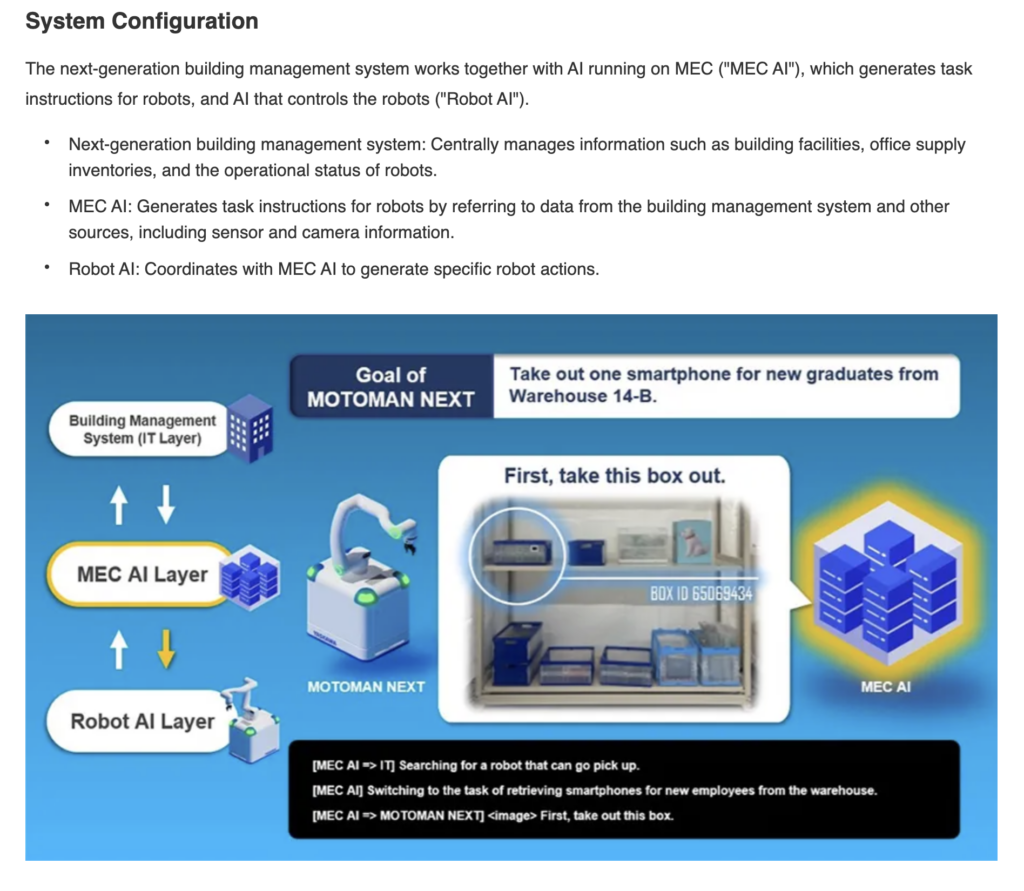
Source: https://www.softbank.jp/en/corp/news/press/sbkk/2025/20251201_02/
* An extract from Juniper Research’s report, Physical AI in Manufacturing & Logistics 2026-2030, is available as a free download.

