

Marc Murtra argued for simpler regulation that prioritises what drives innovation, competitiveness and strategic autonomy – and accepting the risk of failure
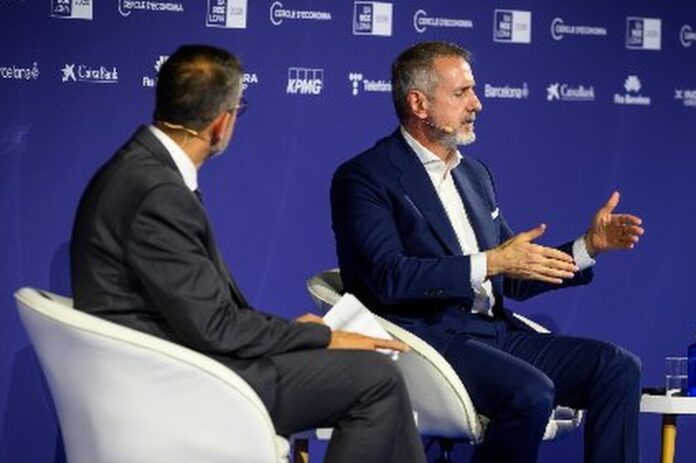
Telefónica’s Executive Chairman and CEO, Marc Murtra, said Europe must accelerate the development of its own technological capabilities to strengthen its strategic autonomy. He believes it is the only way to ensure the continent’s competitiveness in an era shaped by AI, quantum computing and new autonomous systems. He was speaking at the 2026 Cercle d’Economia event in Barcelona (pictured above, right, with Cristian Canton, Associate Director of the Barcelona Supercomputing Center, moderating).
He also stated that technological development has become a determining factor for countries’ economic competitiveness, productivity, resilience and decision-making capacity. He argued that strategic autonomy does not mean isolation, but rather the ability to develop and control critical capabilities in areas such as energy, digital infrastructure, semiconductors and AI.
“Strategic autonomy is the relevant concept. No economy is completely independent, but Europe must strengthen its capabilities to reduce excessive dependencies in key technologies,” he said.

He highlighted the role played by European telecoms companies as key platforms for the region’s technological development. “We are in an era of scale. If we want to develop technology in Europe, we need to build scale,” he noted.
Murtra stressed that Europe needs, and is strengthening, the technological layers that underpin AI, from energy and infrastructure to specialised models and applications. He also pointed out that Telefónica is contributing to this goal through its networks, digital infrastructure and strategic next-generation projects.
In his view, European strategic autonomy requires combining investment, industrial capacity, innovation, talent and a shared long-term vision. He argued that “building our own technology is the path to defending European values”, while also stressing that “technological development not only strengthens the continent’s competitiveness and autonomy, but also helps preserve very important values linked to democracy, human dignity and the ability to say what we think”.
“Europe has the GDP, the talent, the engineers, the companies and the institutions”, Murtra stated and argued for simplified regulation and to focus efforts on generating technology and industrial capabilities. “Simplifying does not mean eliminating regulation, but rather prioritising what drives innovation, competitiveness and strategic autonomy,” he explained.
Murtra acknowledged that it also means “accepting the risk of failure”, but, “Generating technology not only gives us autonomy; it can also represent very important values linked to democracy, human dignity and freedom.”

