

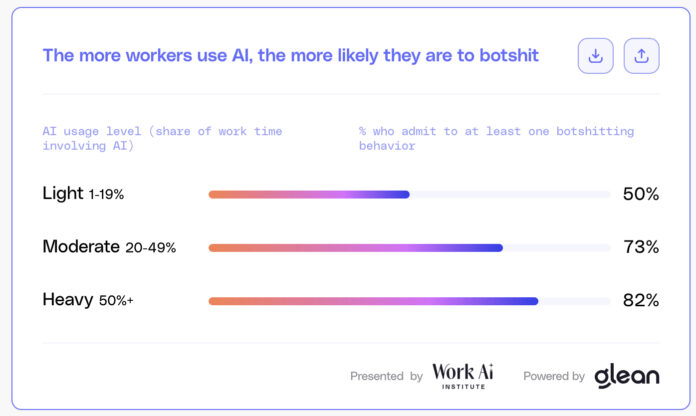
New research found this is closely related to “botshitting” which is admitted to by up to 70% of users, that is, shipping AI-generated work that is not verified or fully understood
Seventy percent of UK AI users admit to at least one form of botshitting, meaningfully higher than the 64% reported in the US.
Workers in the workers are adopting AI faster than their US peers but most organisations are still not seeing the business gains AI was expected to deliver. This is according to new research from the Work AI Institute in what it says is a first-of-its-kind research collaborative from enterprise AI specialist Glean.
The Work AI Index is based on a survey of 6,000 full-time digital workers across the US, UK and Australia, including 1,500 in the UK. Digital workers are defined as full-time workers who perform most of their work on a computer or digital tools. The report incorporates insights from AI leaders and analysis of millions of anonymised, aggregated workplace AI interactions from the Glean Work AI platform.

It finds that 90% of UK digital workers use AI at work, compared with 84% in the US. Most, 77%, reckon AI makes them more productive, saving roughly 12 hours a week through AI automation alone, but only 18% say it has significantly improved their organisation’s performance.
The cost of botsitting…
The report points to what is calls “a distinctly British version of the AI productivity paradox”. The UK has moved quickly on adoption, workplace policies and guidance concerning AI’s use, but that institutional readiness is “not yet translating into stronger verification, better context, or measurable business impact”. [Editor’s note: The use of “yet” assumes it will which she would argue in at least some scenarios is not a foregone conclusion.]
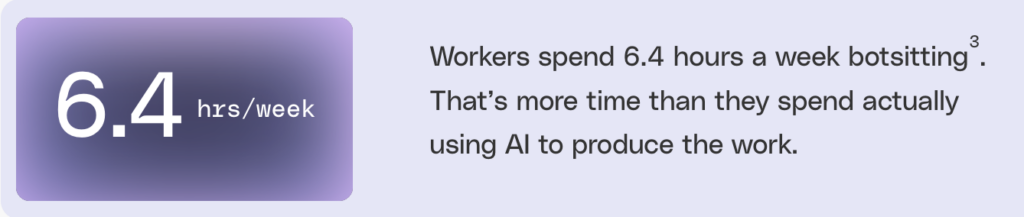
Instead, the research found, workers are absorbing a growing layer of hidden labour to make AI usable: feeding it missing context, checking outputs, rerunning prompts and cleaning up errors downstream. The report calls this “botsitting” and finds UK workers spend 6.3 hours a week doing it. More worryingly from their employers’ point of view, frequent botsitters are 73% more likely to be actively hunting for another job.
…and botshitting
The Work AI Index also identifies a related behaviour it calls “botshitting”: shipping AI-generated work that employees have not verified, do not fully understand or cannot confidently stand behind. In the UK, 70% of AI users admit to at least one form of botshitting – considerably higher than the 64% reported in the US.
Key UK findings from the Work AI Index:
● The UK is ahead in AI adoption, but not yet converting usage into business impact. Ninety percent (90%) of UK digital workers use AI at work, 78% say it makes them more productive, and 42% say their workplace is either AI-integrated or AI-first. Only 18% say AI has significantly improved organisational performance.
● UK workers are spending more than a third of the work week in AI, but much of that time is hidden labour. UK workers save roughly 12 hours per week with AI automation, but 6.3 hours of the saved time is spent botsitting. Despite higher AI adoption and reported productivity gains than in the US, UK workers spend a larger share of their AI time botsitting (38% vs. 36%), which is also more than the 36% spent actually using AI to do the work.
● The cleanup bill is growing. More than a third of AI sessions fail outright, requiring a full restart or substantial rework. Some 77% of UK workers say they have corrected or redone AI-assisted work in the past month and 26% say they do that at least weekly.
● The hidden labour is becoming a quality-control problem. Most (70%) of UK AI users admit to at least one botshitting behaviour, meaningfully higher than the 64% reported in the US. Further, 40% say they sometimes deliver AI-assisted work they could not explain if asked.
● UK workers are more comfortable with AI in high-stakes workplace decisions. For example, 54% of UK workers are comfortable with AI playing a role in performance evaluation, compared with 42% in the US. In the UK 40% are comfortable with AI in hiring decisions, 40% in promotion and compensation decisions, and 31% in sacking decisions.
● AI has already moved beyond content generation into the operating rhythms of work. More than half of UK workers have sent an AI digital twin to a meeting on their behalf, compared with 50% in the US. 62% of UK respondents say AI helps them more with their day-to-day work than their manager does, and 52% say it is easier to collaborate with AI than human coworkers.
● Tool sprawl is turning employees into the integration layer. Some 80% of UK AI users juggle multiple AI tools each week, and 39% use four or more. In addition, 60%, rerun the same prompt across multiple tools because the first output was not good enough.
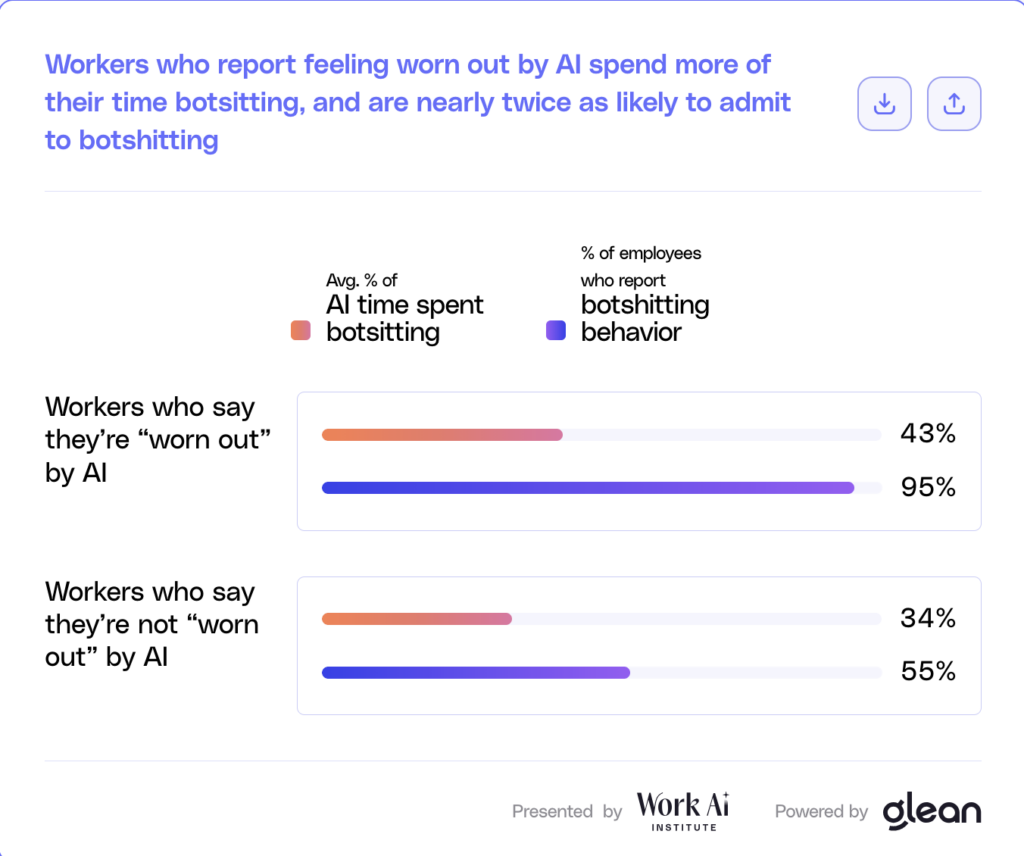
● Context remains the missing layer. Half of UK workers say important information they need to do their job is not accessible through their AI tools. In context-poor AI environments, workers are 3.3x more likely to feel worn out by AI – 46% versus 14%. They are also more likely to ship work they cannot explain, use unapproved tools and hide their AI use from the organisation.
Vanity metrics do not make good business
“Too many companies are treating AI adoption like a vanity metric: more seats, more prompts, more usage,” said Dr. Rebecca Hinds, Head of the Work AI Institute at Glean. “But the UK data shows why that is not enough. British organisations have moved quickly to put structure around AI, and that is a real advantage. The next step is making sure AI is grounded in the right enterprise context, governed in the flow of work, and measured by whether it actually improves outcomes.”
The report suggests the next gap in enterprise AI is not adoption, but the human infrastructure around it. The UK is ahead of many peers on institutional readiness: more workers have read their organisation’s AI policy in full, more describe their workplace as AI-integrated or AI-first, and more are comfortable with AI in high-stakes decisions. But the next phase will require more operational discipline at the desk, on the team, and across the organisation.
“The UK data shows a workforce that is not hesitant about AI – in many ways, workers are already ahead of their organisations,” added Jen Rhymer, Professor of Business Strategy, University College London.
“The issue now is whether companies can build an organisational infrastructure around AI fast enough: redesigning workflows around genuine human-AI collaboration, better access to organisational context, and judgement about AI’s role in supporting work, verification norms, and when human expertise needs to lead. Without that, adoption can create the appearance of progress while quietly increasing the amount of cleanup work employees have to do.”
The full Work AI Index is available here.
The U.K. Work AI Index is available here.

