

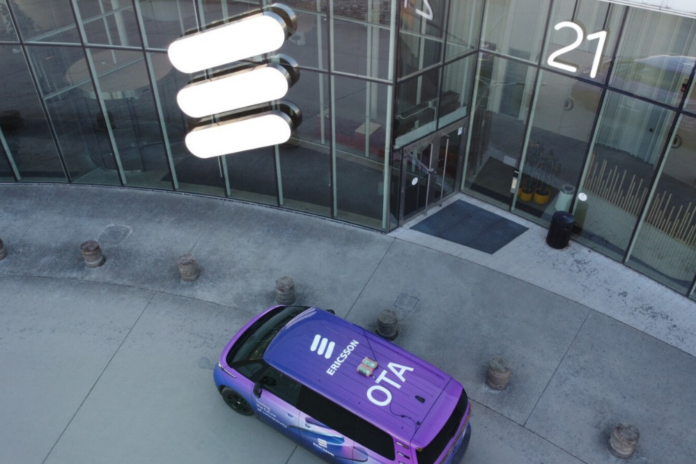
Ericsson has partnered with MediaTek in what it claims is a world-first end-to-end test of high-precision outdoor positioning over a commercial 5G network.
The test used standardised 3GPP technology for Global Navigation Satellite System (GNSS) Real-Time Kinematic (RTK), achieving positioning accuracy of less than 30 centimetres using a handset’s built-in antenna.
According to the telecom giant, the technology will support applications such as autonomous vehicles, drones and industrial robots, where accurate location data is essential.

The test delivered RTK correction data through the 5G network using the LTE Positioning Protocol (LPP), resulting in high-precision positioning being provided without the need for proprietary systems or additional specialist hardware.
The company added the technology is also based on 3GPP Release 16 standards and supports both unicast and broadcast delivery.
With unicast, correction data is sent directly to individual devices, whereas with broadcast, the same data can be sent to all compatible devices within a network cell at the same time.
Ericsson provided the 5G Core, Ericsson Network Location and radio network technology for the test, while MediaTek used its latest 5G modem technology to process the GNSS corrections in real time.a
Ericsson Head of Product RAN Software, Johan Hultell, said: “This is a milestone for the 5G ecosystem. Together with MediaTek, we make high-precision location more accessible to device makers and enterprises, accelerating use in manufacturing, transport and beyond.”
MediaTek, General Manager of Wireless Communication Systems and Partnerships, Dr. HC Hwang, added: “The collaboration with Ericsson demonstrates how 5G Advanced technology can unlock new value for consumers and enterprises alike.
“Our modems with integrated-GNSS are ready to support these advanced positioning services, paving the way for the next generation of intelligent devices.”
IN RELATED NEWS

