Home Blog Page 31

BNetzA to revisit Germany’s 2019 5G spectrum auction after court loss

The German telecoms regulator must remedy bowing to political pressure on licensing terms the first time round

The German telecom regulator, Bundesnetzagentur, known as BNetzA, must redefine the regulatory framework that underpinned its 5G frequency auction of 2019. This is after the Federal Administrative Court in Leipzig dismissed the appeal launched by BNetzA after it lost the court case brought by network operators Freenet and EWE Tel at the Cologne Administrative Court last year.

The Cologne court had ruled that the conditions for the frequency auction were established unlawfully. The judges found that the Federal Ministry of Transport had brought influenced the terms and conditions of the licences, thereby undermining the independence of the federal authority in Bonn. At time, the Ministry for Transport has headed by the Andreas Franz Scheuer of the Christian Social Union (CSU) party.

Now that the appeal has been dismissed, the Cologne Court’s ruling is legally binding. The head of BNetzA has been quoted saying, “We will promptly restart the 5G frequency process to ensure legal certainty and planning reliability for companies as quickly as possible”.

Why was the court case brought?

Germany ran one of the most expensive spectrum auctions for 5G back in 2019 and was also later to hold the auction than many European countries. Deutsche Telekom, Vodafone, O2 Telefónica, and 1&1 committed to paying a a combined total of about €6.6 billion for spectrum licences.

The licences did not include a ‘service provider obligation’; that is, they did not have to sell mobile contracts and lease network access to MVNO competitors, such as EWE Tel and Freenet. The court found this had weakened their negotiating position.

Freenet has accused BNetzA of delaying tactics by launching the appeal against the Cologne court’s judgement. Its CEO, Rickmann von Platen, was reported saying, “The reallocation must include measures to protect competition,” said Freenet CEO .

What next?

The court case has not cast BNetzA in a good light and it must now consider its options. According to Market Screener, could be drawing up a new set of terms and conditions along similar lines, but with its decisions reached independently this time. This would result in a similar regulatory framework as was used for the auction in 2019 and avoid rerunning the auction.

Alternatively BNetzA could put different rules in place which would necessitate redoing the auction which could raise less for the German exchequer. This option seems less likely.

Driving operational efficiency with private networks

Partner content: Visit Druid Software Demo Day, which focuses on mining, on 16 December at the Mermaid Theatre, Dublin, in the heart of the Irish private network ecosystem

Druid’s Software Demo Days have become a defining feature of how Druid engages with our ecosystem, where technology meets practical business outcomes. This December, our focus turns to one of the most demanding and dynamic industrial environments, mining.

Across the world, mining operators are under growing pressure to improve safety, productivity, and sustainability while reducing operational costs. Digital transformation has become essential, and at its core lies reliable, high-performance connectivity. That’s where private cellular networks come in.

A platform built for industrial reality

At Druid, our Raemis™ platform has been deployed across some of the toughest operational settings imaginable, from ports and railways to utilities, energy corridors, healthcare facilities, and remote industrial sites. Each of these environments shares a common challenge: connectivity is mission critical, yet traditional public mobile networks or Wi Fi alone cannot deliver the control, reliability, or coverage required.

Private networks bridge that gap. They give enterprises ownership of their connectivity, offering secure, low latency, and deterministic communication channels that support automation, remote operations, and data driven decision making.

In mining, the stakes are particularly high. A single minute of downtime can cost thousands of euros. Communication breakdowns can risk worker safety. And as mines become increasingly automated with autonomous trucks, drones, and real time monitoring, the need for dependable wireless performance becomes absolute.

Our Demo Day will explore how private 4G and 5G networks are transforming operational efficiency across the mining sector, featuring live demonstrations of seamless roaming between public and private networks, high-availability network resilience, and 5G LAN connectivity alongside showcases and use cases from ecosystem partners and keynote speakers.

The mining business case: from concept to cost savings

Mining operations typically span vast areas, both open pit and underground, where conditions are harsh and unpredictable. Equipment moves constantly, and connectivity must follow. Legacy systems like leaky feeder cables or Wi Fi mesh networks often struggle to maintain stable performance over distance or under load.

Private cellular networks, however, can deliver:

  • Wide area coverage and mobility across the full site, ensuring workers, sensors, and autonomous vehicles remain connected at all times.
  • Low latency and high throughput to support automation and mission critical control applications.
  • Security and resilience, with fully isolated local cores and data sovereignty.
  • Scalability as operations expand or shift into new pits, tunnels, or exploration zones.

These are not theoretical advantages. Mining customers are already seeing measurable business impact. Reductions in unplanned downtime, faster incident response, and improved utilisation of assets are translating directly into lower operating costs and improved safety metrics.

We will be showcasing examples of this at the Demo Day, highlighting how Druid’s Raemis platform integrates seamlessly with both ruggedised RAN solutions and the wider ecosystem of IoT, automation, and analytics platforms used by modern mining operators.

Collaboration drives innovation

One of the most exciting aspects of our journey at Druid, has been the strength of our global partner ecosystem. Through collaborations with system integrators, base station vendors, device providers and application specialists, we’ve built a network of innovators who share our vision for truly intelligent private mobile connectivity.

At the Mermaid Theatre, near Druid HQ, attendees will hear directly from these partners, each bringing a unique perspective on how private networks can deliver real business outcomes.

From edge computing integration that brings data processing closer to where it’s generated, to MEC enabled applications that enable ultra reliable automation, and AI driven analytics that enhance predictive maintenance, the demonstrations will show how these technologies combine to drive tangible operational efficiencies.

From proof of concept to production

For many enterprises, the private network journey begins with a single use case, often safety or tracking. But once deployed, the network quickly becomes a platform for innovation.

In the mining context, a single private 5G deployment might begin by connecting worker communications underground. Then, over time, it extends to:

  • Autonomous haulage and drilling systems
  • Condition monitoring for predictive maintenance
  • Environmental and air quality sensors
  • Connected PPE and real time location systems (RTLS)
  • Drone based surveying and inspection

    Each new use case adds value and justifies the investment further, creating a compounding return.

Our December Demo Day will walk through this evolution step by step, showing not only the technology but the business logic behind each stage. It’s about demonstrating that private networks are not a cost centre; they are an enabler of efficiency, safety, and sustainability.

Why this matters now

The global mining industry stands at a turning point. Commodity demand is rising again, driven by the energy transition as lithium, nickel, copper, and rare earth elements are in greater demand than ever. Yet operations are becoming more complex, labour markets are tighter, and environmental scrutiny is increasing.

Connectivity is now as vital to mining as energy or water. Without it, autonomous systems, advanced analytics, and digital twins simply cannot function.

Druid’s mission is to make this connectivity intelligent, resilient, and accessible, not only for tier one multinationals but for every operator who wants to digitise their operations.

The December Demo Day is therefore more than a product showcase. It’s a conversation about how enterprises can take control of their communications future.

An invitation to explore the art of the possible

If you’ve attended a Druid Demo Day before, you’ll know they’re not ordinary corporate events. We design them as immersive experiences, a mix of live demonstrations, interactive discussions, and open dialogue between engineers, business leaders, and customers.

On December 16th, the Mermaid Theatre will be transformed into a living example of what’s possible with private networks. Visitors will see firsthand how Druid’s Raemis platform operates, how easily it can integrate with existing systems, and how flexible and cost efficient it can be when scaled for industrial use.

We’ll explore not just mining, but broader operational efficiency themes, from ports to utilities, energy, and transportation, showing how each vertical benefits from similar principles of deterministic performance, security, and control.

It’s also an opportunity to listen, to hear what challenges our customers are facing as they navigate digital transformation, and how our ecosystem can evolve to meet them.

Looking ahead, Private networks have moved from pilot to mainstream adoption. In 2025 and beyond, we’ll see a continued acceleration of deployments across industrial verticals, fuelled by advances in spectrum availability, RAN flexibility, and device maturity.

At Druid, we’re proud to be at the centre of that movement, helping enterprises and operators alike harness the full power of 4G and 5G technology to drive measurable operational gains.

As we prepare for December 16th, my message to our partners and guests is simple:
Join us to experience how private networks can transform efficiency, safety, and competitiveness in mining and beyond.

This Demo Day is about showing that digital transformation isn’t a future goal, it’s happening now, and it’s delivering results.


Druid Demo Day 2025 — December 16th, Mermaid Theatre, Dublin
To reserve your place or learn more, visit our landing page for this Demo Dayor email enquiries@druidsoftware.com. Spaces are limited, so register early to secure your seat and be part of the future of connected mining.


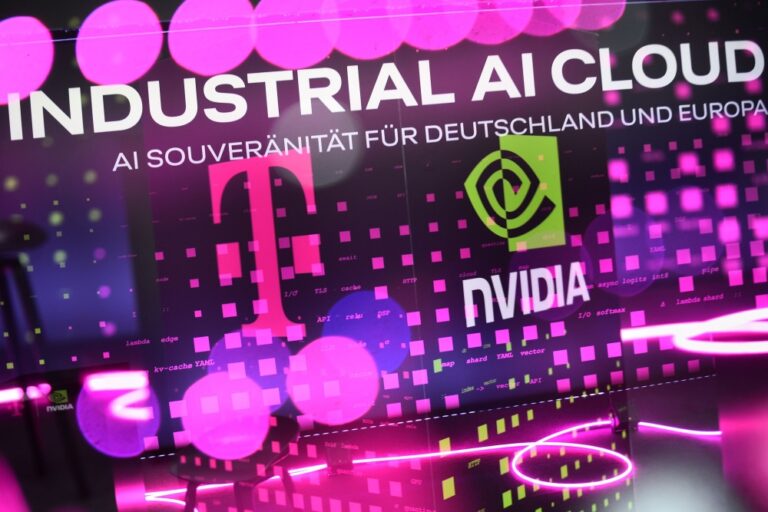
DT wins ‘multi-million euro’ contract for its Industrial AI Cloud

0

T-Systems will provide its new AI factory to six leading research institutes, funded by the German government, to develop sovereign LLM models via the SOOFI initiative

Deutsche Telekom (DT) has won a contract worth tens of millions of euros for its Industrial AI Cloud from Leibniz University Hannover. Deutsche Telekom and NVIDIA announced they have jointly built the world’s first Industrial AI Cloud in a €1 billion partnership earlier this month. The contract is to provide the technical infrastructure for the Sovereign Open Source Foundation Models (SOOFI) research project in the AI factory.

SOOFI’s purpose is to develop a new, sovereign large language model (LLM) with around 100 billion parameters, operated and trained in Europe to replace Teuken7B, which has 7 billion parameters.

Scientists from six leading German research institutions and two start-ups are collaborating on the project to provide sovereign European alternatives to AI technologies from the US and China.

SOOFI “is one of the most important European AI initiatives”, according to the press statement and funded by the German Federal Ministry for Economic Affairs and Energy. It is also supported by the Fraunhofer Society, the German AI Association and the Center for Sovereign AI (CESAI).

The project aims to lay the foundation for a trustworthy and technologically independent European AI infrastructure. The focus is on European languages and to develop models that advance the industrial use of AI.

T-Systems in play

The Industrial AI Cloud for training the LLM is provided by DT’s subsidiary, T-Systems. It is one of Europe’s largest AI factories with more than 10,000 GPUs and total computing power of 0.5 exa floating point operations per second or exaFLOPS plus storage capacity of around 20 petabytes.

The data centre is connected to four 400 Gbps fibre connections and, DT says, “meets the highest standards of data protection, security, and reliability. A network of around 130 NVIDIA DGX B200 systems with a total of over 1,000 GPUs will be operated exclusively for the European language model SOOFI from March 2026,

“Digital sovereignty is critical to Europe as a business location. We are proud to be working with Leibniz University, the Fraunhofer Institute, and the German AI Association on a project that is crucial to Europe’s future viability and independence in the field of artificial intelligence,” says Dr Ferri Abolhassan, Member of the Board of Management of Deutsche Telekom and CEO of T-Systems.

Dr. Nicolas Flores-Herr, Fraunhofer IAIS, noted, “SOOFI brings together leading research teams from Germany to train large open-source LLMs, which represent an important area of a sovereign AI value chain. These are to be used, for example, in industry, SMEs, and the public sector to strengthen the development of an independent European AI infrastructure.”

Nokia announces strategy, restructures and makes changes at the top

The changes were announced at the company’s Capital Markets Day, to better align with customers and capitalise on the boom in AI infrastructure

At Nokia’s Capital Markets Day 2025 it is announcing a new strategy and strategic business KPIs, an evolution of its operating model and changes to the group leadership team. It new financial goals are to grow its annual comparable operating profit to a range of €2.7 to €3.2 billion by 2028, an increase from the €2.0 billion generated between Q4 2024 and Q3 2025. This is separate from earnings guidance figures.

It seems off to a good start: yesterday Nokia announced it has won a three-year contract with Telecom Italia to expand 5G coverage and add capacity. Currently, Nokia kit is thought to account for a little over 20% of TIM’s RAN, according to Lightreading, citing “a reliable source”. The new contract will increase that by about 40%, making it the largest 5G supplier in the network, entirely at Ericsson’s expense. The contract includes supply of solutions from Nokia’s AirScale RAN portfolio, including Habrok 32 Massive MIMO radios and its Pandion FDD multi-band remote radio heads (RRH).

In October, the company’s share hit a 10-year high when NVIDIA announced it would invest $1 billion in Nokia to accelerate AI-RAN innovation and lead the transition from 5G to 6G…although its slumped somewhat since…

Back to now

According to the announcements at Capital Markets Day, from 1 January 2026, the company will have two primary operating segments – Network Infrastructure and Mobile Infrastructure. The rationale is this structure is better aligned to customers’ needs and to “accelerate innovation as the AI supercycle increases demand for advanced connectivity”.

The new strategy has five priorities: 

  1. Accelerate growth in AI & Cloud
  2. Lead the next era of mobile connectivity with AI-native networks and 6G 
  3. Grow by co-innovating with customers and partners
  4. Focus capital where Nokia can differentiate
  5. Unlock sustainable returns.

Two new segments

Nokia sees Network Infrastructure as a growth area that can capitalise on the global AI and data center build-out while continuing to serve its telecoms customer base. This segment will continue to be led by David Heard and consists of three business units Optical Networks, IP Networks and Fixed Networks.

The new Mobile Infrastructure segment will bring together the Core Networks and Radio Networks portfolios, and Technology Standards, formerly Nokia Technologies. Its ambitions are leadership in core and radio network technology and services to deliver AI-native networks and 6G. It will be led by the group CEO and President, Justin Hotard, on an interim basis and will comprise three business units Core Software, Radio Networks and Technology Standards. Hotard took up the reins at Nokia in April, joining from Intel.

Changes at the top

Also from 1 January, Raghav Sahgal will become Nokia’s Chief Customer Officer and continue in the Group Leadership Team. Patrik Hammarén will also continue in the Group Leadership Team as President, Technology Standards (formerly Nokia Technologies) while Tommi Uitto will step down from the Group Leadership Team at the end of this year.

According to a local Finnish newspaper, local newspaper Helsingin Sanomat (HS), Nokia has appointed Timo Ihamuotila as the new chair of its Board of Directors. He will succeed Sari Baldauf, who has held that role since 2020 at the company’s Annual General Meeting (AGM) in the spring, unnamed sources say. It is thought Baldauf is retiring. Ihamuotila was appointed to the board at the previous AGM and he has also served as CFO of ABB Group.

Portfolio Businesses segment

As part of devising the new strategy, Nokia reviewed its business portfolio and identified several units are not seen as core to the future of the company’s strategy, although some have “compelling growth opportunities”. They will be shunted into an operating segment called Portfolio Businesses while the company assesses the best way to extract value from them in 2026.

The businesses that will be moving under the Portfolio Businesses segment are

  • Fixed Wireless Access CPE (currently in Fixed Networks in Network Infrastructure)
  • Site Implementation and Outside Plant (currently in Fixed Networks in Network Infrastructure)
  • Enterprise Campus Edge (currently in Cloud and Network Services) 
  • Microwave Radio (currently in Mobile Networks).

Nokia stresses its priority will be to ensure continuity for customers and employees during the transition. Over the last year, the units collecitvely generated net sales of about €900 million at an operating loss of EUR 100 million.

Moving defence into incubation 

Nokia Defense is being launched as an incubation unit to serve as the central go-to-market and R&D hub for Nokia’s defence portfolio. It will bulld on the foundation of Nokia Federal Solutions in the US. The company sees opportunities to deliver defence-grade solutions, based on Nokia’s core technologies in Network and Mobile infrastructure, in the US, Finland and other allied countries.

Long-term financial target, strategic KPIs

Nokia’s new long-term financial target (to achieve comparable operating profit of €2.7 billion to €3.2 billion by 2028 is not part of the group level financial outlook. It replaces Nokia’s former long-term targets which were: to grow faster than the market; achieve a comparable operating margin of at least 13%; and free cash flow conversion from comparable operating profit of 55% to 85%. 

Nokia says it is exposed to different trends across its primary segments and will use different strategic levers across the company maximise shareholder value, based on the greatest opportunities. To this end, it is introducing a series of strategic KPIs which illustrate the expected outcomes of Nokia’s strategy. These KPIs are not part of the group level financial outlook.

  • Net sales growth in Network Infrastructure: Nokia targets 6-8% net sales CAGR during 2025-2028. This includes a 10-12% target for the combined Optical Networks and IP Networks. 
  • Network Infrastructure operating margin: 13% to 17% by 2028
  • Mobile Infrastructure gross margin: 48-50% by 2028
  • Mobile Infrastructure operating profit: Grow from a base of EUR 1.5 billion
  • Group Common and Other operating expenses: EUR 150 million operating expenses down from the current EUR 350 million run-rate by 2028. 
  • Free cash flow conversion: Nokia targets to deliver free cash flow conversion from comparable operating profit of between 65% and 75%.

Provisional financial information

Nokia will begin reporting its financial results under the new segment structure in its first quarter 2026 financial results. The company intends to publish recast financials for both 2024 and 2025 under the new reporting structure during the first quarter of 2026. The table below shows the estimated provisional breakdown of the business within the new reporting framework. The figures are also provided proforma for the Infinera acquisition. 

Q4’24 – Q3’25 
(€ billion)
Net 
sales
Gross 
margin
Operating profitOperating 
margin
Network Infrastructure*7.843%0.810%
Mobile Infrastructure11.648%1.513%
Portfolio businesses0.922%-0.1N/A
Group Common and Other  -0.2N/A
Nokia comparable*20.345%2.010%

*This provisional financial information is also shown proforma for the Infinera acquisition. 

From the Q1 2026 financial results, Nokia will provide full segment reporting each quarter for the new segments (that is, net sales, gross profit, operating profit) and will also provide revenue disclosure for the business units within the primary operating segments.

“Nokia changed the world once by connecting people — and will again by connecting intelligence,” said Justin Hotard, President and CEO of Nokia. “As the trusted western provider of secure and advanced connectivity, our technology is powering the AI supercycle. From fixed to mobile infrastructure we are developing technology that accelerates value for our customers. I am proud of the work Team Nokia is doing to focus and lead this critical era in connectivity”.

Investigators raid 29 premises in French territories in ongoing Altice probe

Allegedly hundreds of millions of euros were defrauded by some employees and suppliers overbilling for goods and services then syphoning the money off into shell companies

According to Bloomberg, investigators raided multiple properties across France as part of their ongoing investigation into fraud at the Altice Group. It is suspected that some employees and suppliers were running a scheme to defraud the group on a vast scale.

Raids were carried out on 14 companies and 15 homes simultaneously in locations as far flung as the Isle-de-France, Vosges, Corsica and Var. The report said more than 70 investigators were involved from Eurojust, which is a cross-border agency, based in the Hague, that looks into serious crime within the EU.

They also seized about €14 million from bank accounts and assets like vehicles and luxury goods, but so far the investigators have not brought any formal charges.

Investigation into the alleged fraud began in 2023 when Armando Periera and others were arrested in Portugal. Periera co-founded the company with billionaire Patrick Drahi and has been described as Drahi’s “right-hand man”. Drahi delisted Altice Europe in 2021, and now controls the group.

Periera’s home in France was among those raided this week.

Denials of wrongdoing

Periera has denied any wrongdoing but is accused of involvement in a scheme by which suppliers overcharged Altice via procurement and other contracts for goods and services – to the tune of hundreds of millions of euros. The monies were diverted into a complex collection of shell companies which sat between the vendors involved and Altice. Money laundering was allegedly was carried out in France and elsewhere.

Altice maintains it is the victim and Drahi claims he was ignorant of the scheme and is deeply shocked. Pereira reportedly expressed support for the raids this saying he was pleased at progress by the investigation more than two years since it started.

The timing of the scandal could not have been worse. Drahi built the Altice Group leveraging debt when money was cheap but that debt has become more expensive to service as interest rates rose over recent years. He renegotiated Altice’s debt of €24 billion in Europe earlier this year in one of the largest debt restructuring exercises the continent has ever seen. It is expected he will have to repeat the process for holdings outside the EU in the near future.

In October, Orange, Bouygues and and Iliad jointly bid €17 billion to buy SFR, which is Altice’s opco in France, but their bid was rejected for being too low.

Italy mulls extending 5G licences, less cost in return for investment pledges

Italian operators have been lobbying for a free extension of the 10-year spectrum licences that cost them €6.5 billion in 2018, starving them of funds to invest in networks

Italy is considering extending 5G licences while limiting costs for operators in return for investment pledges, a cabinet undersecretary, Alessio Butti, was reported saying by Reuters.

In response to the telecom sector struggling with lower revenues and margins, operators are lobbying for a free extension of their 10-year licences after Italy raised €6.5 billion from auctioning 5G spectrum in 2018.

“The renewal cannot be automatic, but you know I’ve long been one of the strongest supporters of avoiding a cash-driven approach in favour of clear investment commitments,” Butti reportedly said at a business conference in Rome. He oversees innovation and digital transformation policies.

Italian telecoms operators will need to increase investment to upgrade 5G networks in the coming years to provide faster transmission speeds and to support a range of AI-driven applications for businesses and consumers.

Butti said that the government is working on several options which will be discussed with telecoms regulator AGCOM. 

“The 2018 auction was disastrous, with operators caught in a bidding spiral. As a result, they were left without resources to invest,” Butti was quoted saying.

Revenue at Italian telecoms operators has dropped by nearly a third since 2010 and cash generation after investment has collapsed to zero from €10.5 billion in that year, according to data from industry lobby Asstel, cited by Reuters.

EU to investigate if Amazon, Microsoft are gatekeepers for their cloud services

And if the Digital Markets Act effectively tackles fairness and competitiveness regarding cloud in Europe – talk about missing the starting gun…

The European Commission has opened three market investigations on cloud computing services under the Digital Markets Act (DMA). Two market investigations will assess whether Amazon and Microsoft should be designated as gatekeepers for their cloud computing services, Amazon Web Services and Microsoft Azure, under the DMA; in other words whether they act as important gateways between businesses and consumers, despite not meeting the DMA gatekeeper thresholds for size, user number and market position.

The import of gatekeepers

Organisations deemed to be gatekeepers by the Commission are subject to obligations and the banning certain practices is sees as unfair.

When conducting an investigation, the Commission assesses elements such as the provider’s size, the number of users, network effects, scale and scope effects, lock-in and switching costs, and the conglomerate corporate structure or vertical integration of that company.

In these investigations, the Commission is supported by the Authority for Consumers and Markets (ACM), the Dutch competition authority, in the form of a joint investigative team, as provided for in the cooperation rules under the DMA.

AWS and Azure

Analyses of cloud markets conducted in recent years seem to indicate that the cloud computing services Microsoft Azure and Amazon Web Services occupy very strong positions in relation to businesses and consumers. Editor’s note: We’re baffled by the ‘seem to’, but anyway.

The Commission is also to assess if certain features of the cloud sector may further reinforce the position of Microsoft Azure and Amazon Web Services.

If the Commission’s investigation finds that Microsoft Azure and Amazon Web Services qualify as important gateways under the DMA, the cloud computing services would be added to the list of core platform services for which Amazon and Microsoft are already designated as gatekeepers.

Investigation into DMA’s applicability

The third market investigation will assess if the DMA can effectively tackle practices that may limit competitiveness and fairness in the cloud computing sector in the European Union. 

Cloud computing is the backbone of many digital services, and it is crucial for AI development. To foster innovation, trust, and Europe’s strategic autonomy, cloud services must be provided in a fair, open and competitive environment, according to the Commission.

The Commission is gathering information from relevant market players to assess whether the current obligations under the DMA are effective in addressing practices that limit competitiveness or are unfair in the cloud sector.

The investigation will cover, for instance, obstacles to interoperability between cloud computing services, limited or conditioned access for business users to data, tying and bundling services, and potentially imbalanced contractual terms.

Next steps

The Commission aims to conclude the market investigations on Microsoft Azure and Amazon Web Services within 12 months – not exactly moving in alignment with the market.

Should the Commission conclude Microsoft and Amazon fulfil the criteria to be designated as gatekeepers for their cloud computing services under the DMA, Amazon and Microsoft would have six months to ensure full compliance of their designated cloud computing services with the DMA obligations.

The market investigation on the DMA’s application to cloud markets will result in a final report to be published within 18 months, which may propose the update of the DMA obligations in respect to cloud by way of a delegated act pursuant to Article 12 and 49 DMA.

Mobile core market reaches pivotal point, up 14% outside China in Q3

0

Dell’Oro says that China aside, revenues from mobile core network kit rose between 9% and 17% in other regions, with North America blazing the trail

Dell’Oro Group’s new research on the mobile core network market highlights a sharp divergence in different countries. They rose 14% year-on-year outside China, driven by accelerating 5G Standalone deployments, momentum behind network slicing, and early 5G-Advanced launches.

Research Director Dave Bolan reckons 3Q25 marks a pivotal turning point as operators begin shifting from rollout to monetisation. Mobile network operators {MNOs) investing in SA migrations, enterprise services and new 5G-Advanced capabilities are reshaping mobile core strategies worldwide: so far 12 mobile operators are moving forward with 5G-Advanced.

“The Chinese market experienced abnormally high growth in 3Q 2024. Consequently, its spending on mobile core declined 39% year on year for 3Q 2025,” stated Bolan. “The revenue for all the other regions increased, between 9% and 17% Y/Y, resulting in a worldwide revenue decline of 2% Y/Y [with China factored in].

“As noted, revenue worldwide excluding China rose 14% Y/Y, continuing the trend in subscribers migrating to 5G Standalone (5G SA), and revenue worldwide excluding North America declined 5% Y/Y.” 

Bolan continued, “MNOs are moving forward with 5G SA (72 in our last count) and moving forward to take advantage of monetization opportunities. Network slicing announcements continued. Of note is Reliance Jio (India), which announced 10 network slices with guaranteed service level agreements (SLAs) at scale. In October, T-Mobile launched Edge Control, providing enterprises with what Dell’Oro Group refers to as ‘an MNO-provided Mobile Private Network (MPN)’. This is in response to the challenges of implementing 5G SA Private Wireless networks in the shared CBRS spectrum in the US.

“We have identified 12 MNOs that have commercially launched 5G-Advanced networks (not all this quarter), to take 5G to the next level with new features and performance. MNOs include: China Mobile, China Telecom, China Unicom, CTM (Macau), Du (UAE), e& (UAE), HKT (Hong Kong), Singtel (Singapore), Telstra (Australia), T-Mobile (USA), YTL (Malaysia), and Zain (Kuwait),” added Bolan.

MTN’s revenues rise 26% in first 9 months

Nigeria and Ghana are the star performers among the group’s opcos, along with a surge in data traffic and financial transactions, but growth in South Africa slowed

South Africa’s MTN group announced its service revenue for the nine months to September rose by 25.9%, driven by strong performances in Nigeria and Ghana. MTN is Africa’s biggest telecom operator with operations in 16 markets. During the first nine months, its customer base has expanded by 5% to 301 million.

If the effect of currency fluctuations are removed from the equation, the group’s service revenue rose by 22.6%.

MTN Nigeria saw a rise of 57.1% in service revenue over the first nine months of the year, while MTN Ghana rose 35.9%, helped by lower inflation and more stable exchange rates.

MTN South Africa saw slower grow of 2%: gains from post-paid and enterprise were negated by ongoing pressure in a fiercely competitive prepaid market.

Data and fintech

The group’s data revenue increased by 40%, due to the rising number of active data subscribers and strong demand. Fintech’s revenue rose 35.7%.

MTN said 27.9 billion rand (€1.04 billion) its investment to expand its commercial business had been a major contributory factor in the growth of data traffic and the volume of fintech transactions.

MTN plans to expand its AI-powered digital inclusion initiative with Microsoft across Africa in early 2026.

MTN expands Microsoft partnership with AI tools for consumers 

The pan-African operator is ramping up its Microsoft collaboration, pairing AI-driven Microsoft 365 tools for consumers with an Azure rebuild of its analytics platform

Africa’s biggest mobile operator MTN Group plans to introduce Microsoft 365 with Copilot to its customers from early 2026, in a move the company claims will broaden access to AI-driven learning and productivity tools across the continent. 

However, MTN has not yet specified which markets will be included in the first wave of the rollout, nor has it detailed what governance measures will underpin what it describes as “responsible AI”. The announcement coincides with MTN passing 300 million customers and forms part of the operator’s push to shift from basic connectivity to wider digital participation.

“Africa’s growth will increasingly be shaped by how effectively its people can participate in the digital world,” said MTN Group president and CEO Ralph Mupita (above). “This new collaboration strengthens that trajectory. Working together, we will open new pathways for innovation and opportunity that will define the continent’s next phase of progress.”

The service will include Microsoft’s security features like phishing protection and continuous device-level monitoring. MTN argues that pairing its scale and local insight with Microsoft’s technology expertise will help bridge skills gaps across its markets.

Samer Abu-Ltaif, president for Microsoft Europe, Middle East and Africa, said: “Our collaboration with MTN reflects our shared goal to enable people to learn, create, and participate meaningfully in the digital economy. By bringing Copilot to millions of MTN customers, we are helping unlock new opportunities for learning and innovation across Africa.”

The announcement was light on detail around whether lucky customers would pay more to receive Microsoft’s AI tool. The Australian regulator recently commenced proceedings in that country’s Federal Court against Microsoft for allegedly misleading approximately 2.7 million Australian customers when communicating subscription options and price increases, after it integrated its AI assistant, Copilot, into Microsoft 365 plans. 

Enterprise analytics

The consumer-focused AI launch builds on another Microsoft development announced on 31 October: the full migration of MTN South Africa’s Enterprise Value Analytics platform to Microsoft Azure. Now operating as EVA 3.0, the cloud-based system processes around 22 billion records a day and supports more than 800 analytics workflows. MTN calls it the largest telco cloud implementation in the Middle East and Africa. 

The move also underpins MTN’s preparations for broader AI use across the organisation, linking internal real-time intelligence capabilities with future customer-facing AI services.

According to the operator, the shift to Azure Databricks and Microsoft Defender has delivered major improvements in processing speed and security. “With EVA 3.0, we’re expanding those capabilities – analysing information more quickly, applying intelligence more effectively, and safeguarding it through advanced cloud security,” said MTN Group CIO Nikos Angelopoulos.

At the time, Microsoft said the project shows how cloud-based analytics and AI can support network resilience, customer experience enhancements and new service development for telcos.

MTN’s Cloud Centre of Excellence and a group-wide engineering network have together achieved more than 1,350 Microsoft Azure certifications, which the company claims is the highest total of any organisation in Africa. The EVA 3.0 deployment is expected to serve as a template for further data-modernisation work across MTN’s markets.

- Advertisement -
Latest independent research

Achieving autonomous network operations

Find out more in our new report