


What you need to know, from LLM to RAG, the MCP and A2A protocol, knowledge maps, ontologies, curated documentation, why the agent itself is only 15% of the agentic effort and more
GenAI has had a big impact on handling content and knowledge but it cannot deliver autonomous operations. GenAI’s capabilities are drawn from large language models (LLMs) which by design are stateless, meaning each prompt is a new interaction, with no memory of previous messages. GenAI cannot initiate actions, are at risk of hallucinating and operate in isolation, away from live operational systems. Agentic AI addresses these limitations by combining reasoning and execution.
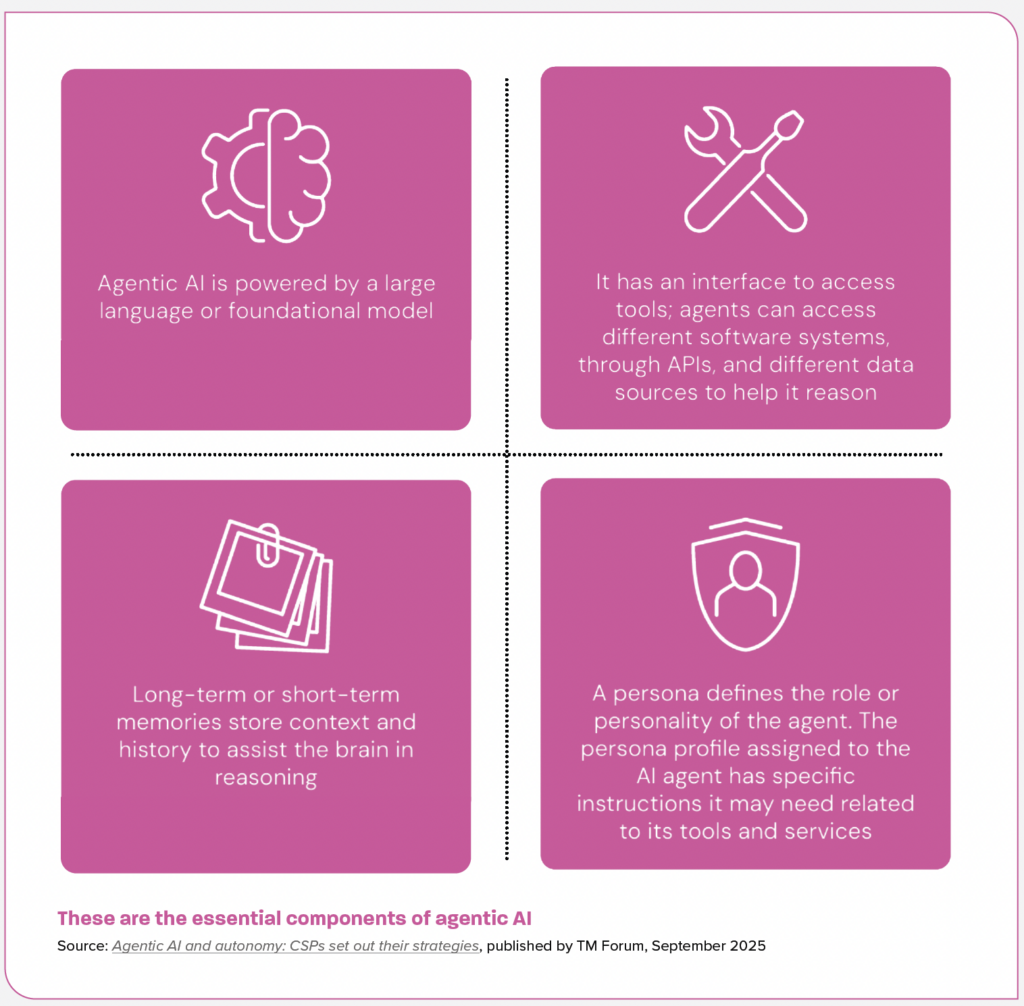
Gartner warns that much of what vendors describe as AI agents are in fact relabelled AI-enabled assistants, a practice it calls agent-washing. This could confuse the picture as operators strive to measure their progress against the market. The essential components of an agent are shown in the graphic below.
Leading edge evolution

Gartner positions agentic AI at the leading edge of the AI evolution: traditional (analytical) AI and LLM-based systems act when prompted by human inputs. They don’t initiate actions.
Agentic AI can: receive and act on high-level goals; decompose goals into steps; select appropriate tools; take action; and adapt based on outcomes. Agentic systems can learn from their environment, make decisions and perform tasks independently.
Across all sectors, not just telecoms, Gartner predicts that:
• By 2028, 33% of enterprise software applications will include agentic AI and that at least 15% of daily work decisions will be made autonomously
• By 2029, 70% of enterprises will deploy agentic AI as part of IT infrastructure operations, up from less than 5% in 2025
• By 2035, at best agentic AI could drive about 30% of software revenue for enterprise applications, surpassing $450 billion.
Gartner also predicts that more than 40% of agentic AI projects will be cancelled by end of 2027 due to escalating costs, unclear business value or inadequate risk controls.
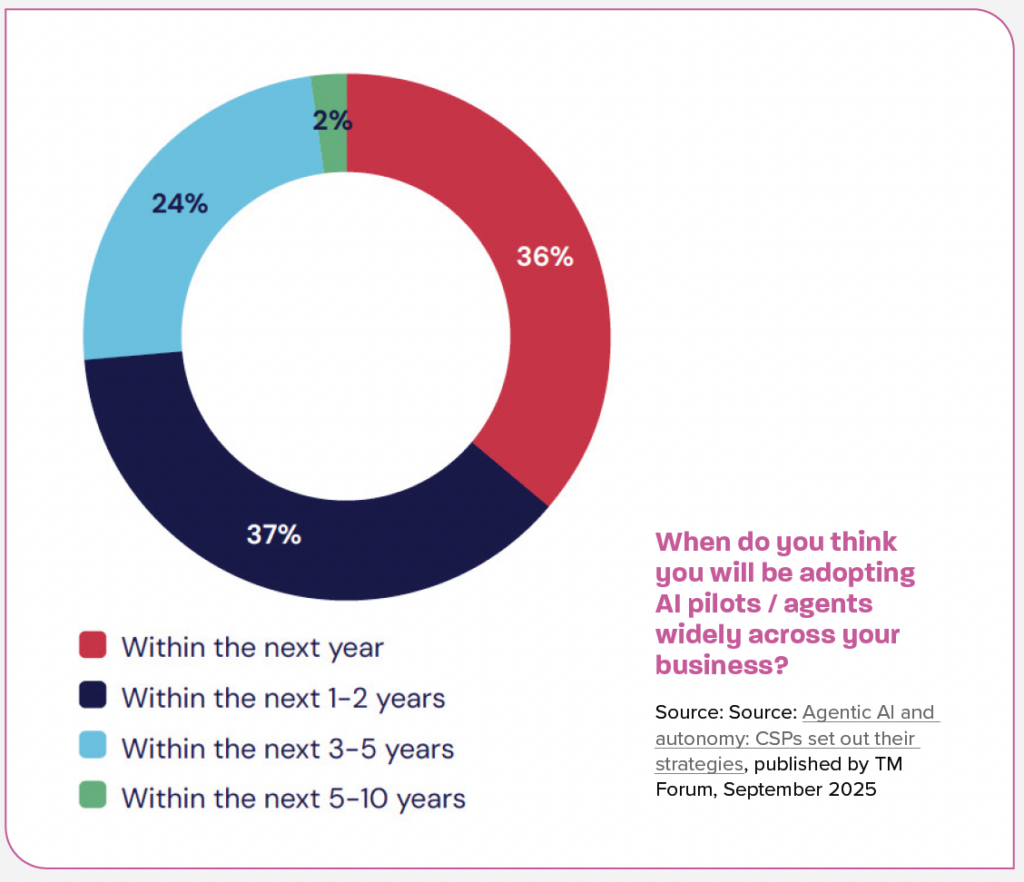
Agentic AI and autonomy: CSPs set out their strategies, published by TM Forum last autumn, found that 73% of operators are expecting to run pilots at least in the next two years (see pie chart below). It surveyed more than 100 respondents from 68 operators around the world.
Agency, reasoning and execution
Philippe Ensarguet, Orange’s VP of Software Engineering, describes agents as “autonomous, interactive, goal-oriented, reactive and proactive, task-specific.” Where “LLMs think” (provide reasoning), “RAG knows” (retrieval-augmented generation supplies context and knowledge), and “agents do” (execute actions autonomously), he explains in his keynote conversation for The Briefing on Becoming an AI-native telco (watch on playback).
Traditional automation executes predefined workflows: agentic capability reasons what workflow is needed. Agentic AI adapts its approach, based on context and can handle situations without being explicitly programmed to do so. This adaptability means agents can work across organisational silos, unlike all previous automation technologies.
Mapping where value will come
Analyst Charlotte Patrick tracks the evolution of agentic AI to develop a pragmatic framework for understanding where and when its value will come in telecoms. Rather than focusing on distant visions of full autonomy, her model maps realistic near-term progress across three stages (see graphic below). Her staging is designed to help operators set realistic expectations around autonomous operations enabled by agentic AI and discourage over-investment in approaches that lack solid foundations.
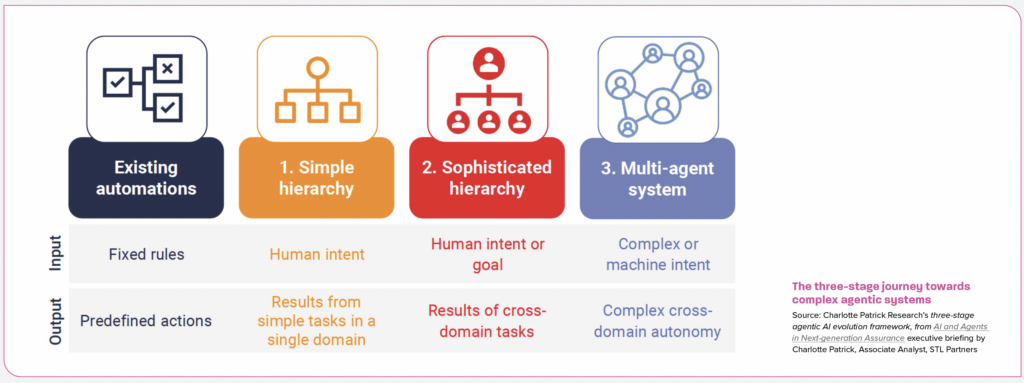
Most operators who are underway with agentic AI are making progress in Stage 1, deploying copilot agents supported by simple agent hierarchies. A copilot agent interprets natural language requests, delegates to specialised sub-agents and returns validated results. Patrick expects broad roll-out in relatively low-risk, data-rich domains like service assurance within one to two years, given that assurance allows humans to remain in the loop and mistakes carry manageable consequences.
Patrick projects Stage 2 will take two to three years to deploy at scale. It will see operators move to more sophisticated hierarchies as agents gain the ability to reason over structured knowledge graphs, making them more reliable and allowing them to expand into faster operational processes (see ‘Knowledge and context’ below).
A knowledge graph is a data structure that connects real-world entities – such as people, places or concepts – and their relationships in a network, typically using nodes (entities) and edges (relationships). As yet, no approach has been found to enabling an LLM to reason correctly and reliably over a knowledge graph at production scale.
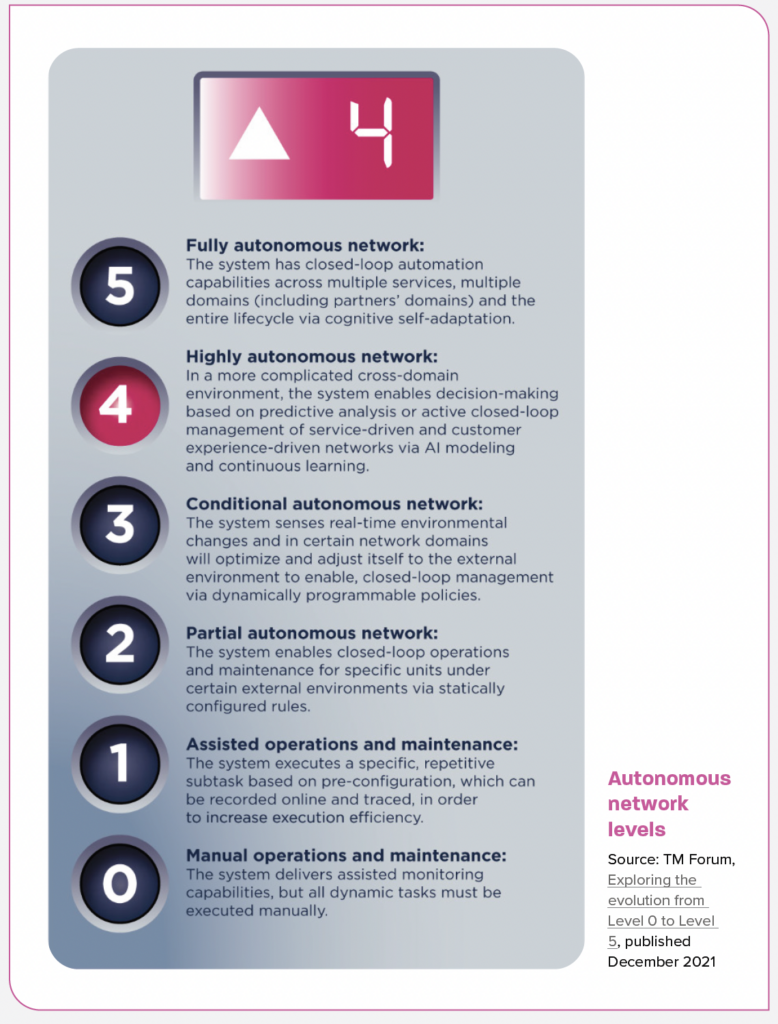
Stage 3 represents true multi-agent systems with distributed intelligence and is a much longer term prospect, at least five years away. In such scenarios, agents would become autonomous peers – negotiating with each other rather than following centralised orchestration – closer to TM Forum’s Level 5 network autonomy (see graphic below). As yet there is no resolution to conflicts between agents pursuing competing goals. Patrick notes that situations where fully distributed, multi-agent intelligence is genuinely required may be less common than hype suggests.
In the more immediate future, critical foundational work is necessary before agentic AI can be applied, especially given its promise of operational autonomy.
Emerging protocols
At this nascent stage, there are technical facilitators to help operators progress their agentic AI ambitions, including protocols, most notably the model context protocol (MCP) and agent-to-agent (A2A) protocol.
The MCP provides vertical integration between agents and tools, resources and prompts. Note that those designed for public contexts and consumer applications are unlikely to offer enterprise-grade security without reinforcement.

The A2A protocol enables agent-to-agent collaboration through synchronous and asynchronous communication patterns, meaning agents can request information or actions from other agents and coordinate responses.
Even with these facilities, Orange’s Ensarguet warns that considerable complexity remains around deployment, operation, validation and testing. TM Forum’s Project Foundation seeks to help with this. It is building the industry’s first AI-Native Open Digital Architecture (ODA) Canvas Sandbox which is a Kubernetes-orchestrated environment, that is, an open-source platform where telcos, hyperscalers and partners can co-develop, integrate and test interoperable AI agents aligned with TM Forum’s AI-Native Blueprint.
Infrastructure for building
Agent development kits (ADKs) are intended to act as foundational infrastructure for building, deploying and managing agents – typically covering orchestration, integrating tools, managing memory, guardrails and observability. In 2025, a number of agentic AI toolkits for telecoms came onto the market, with technology vendors releasing telco-specific frameworks, reference architectures and agent-building platforms.
They variously targeted network operations, OSS/BSS automation and customer service, but none provides quick fixes for data quality and integration challenges, highlighted succinctly by Swisscom’s CTIO, Mark Düsener in this recent interview for FutureNet World.
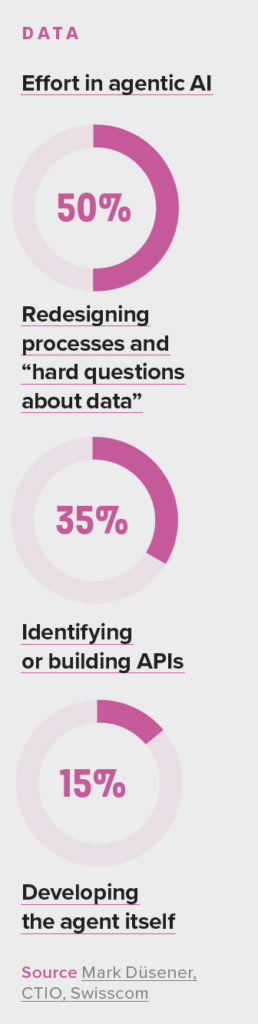
He says understanding the current state, identifying or creating the necessary APIs account for about 35% of the effort required; 50% goes into redesigning processes and asking “hard questions about data”. Only 15% of the work is developing the agent itself. “The last, small part is building the agent, yet that’s where the public focus mostly is,” he notes (see graphic left).
The critical importance of AgentOps
Patrick warns that operators risk repeating the mistakes of early robotic process automation (RPA) deployments if they do not get the foundations right before throwing everything at evolving AI options.
In those early automation scenarios, organisations often allowed teams to deploy the technology everywhere, creating fragmentation and management nightmares. They then had to retrofit governance, security and lifecycle management, which typically was neither efficient nor effective. The same risk exists with agents today, Patrick says, without proper AgentOps – that is, operational frameworks models.
AgentOps encompass governance which:
• determines who can create agents and what permissions they have
• lifecycle management, that is from design to deployment, monitoring, updating and retirement
• security covering access controls, audit logging and prevention of attacks
• coordination controls how agents discover and interact with each other.
Unless AgentOps are established from the start, the tactical proliferation of pilots could create technical debt, gaps in security and coordination failures that become exponentially harder to fix as deployments scale.
Knowledge and context
Agentic AI’s success relies on the range and value of the information it has to work with, which is where knowledge graphs, ontologies and curated documentation come into play.
Mark Sanders, Head of Network Transformation at Telstra argues that the industry needs “a shared language, an ontology of how we can model knowledge for a telco business” that goes far beyond network topology. “It needs to have business processes coded in, our engineering design limits, our policies and even regulatory frameworks,” he told TM Forum’s Inform in February 2026. “Those things need to be coded into the knowledge behind it.”
In the same interview, Dennis Sehalic, Senior Solution Architect at Telenor Sweden, links this to TM Forum’s AN framework (see graphic above), noting that achieving Level 4 means “orders of magnitude more automations and more meshed automations” which makes it essential to classify and control individual parts.
With contextual knowledge, an agent can reason holistically rather than treating a specific situation or incident. For example, when diagnosing service degradation, a system can immediately understand:
• which customers are affected
• what their contract terms are
• which network elements serve them
• what changes were recently made, similar past incidents and their resolutions – synthesising this context
• then recommend and autonomously execute appropriate action.
New operational discipline
Not surprisingly, progress with all of this has been slow: many telcos are yet to start building more than their first, small knowledge assets, according to Patrick. Creating and maintaining high-quality knowledge will require ongoing curation, validation and updates – essentially establishing a new operational discipline.
This is unglamorous, methodical work but without it agents would have to operate with incomplete understanding, limiting their effectiveness.
Despite these challenges and so much work in progress, ambitious if cautious operators are keen to seize advantage through agentic AI, as we see in the next chapter.
This text is slightly adapted from Mobile Europe’s new report, Agentic AI: Achieving autonomous network operations, written by the independent business and tech journalist Sue Tabbitt, with thanks to our sponsor Celfocus.