

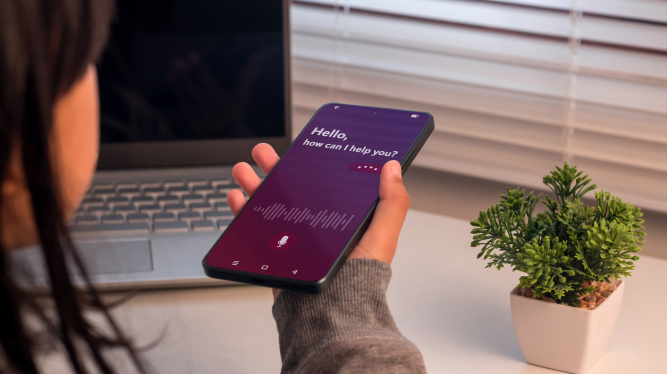
Partner content: Customers are already asking Siri and Gemini about their bills, their data and their contracts. The quickest route into that conversation is not another chatbot – it is the mobile assistant the OS already provides.
Every customer channel a company has built with care – the app, the portal, the IVR, and most recently the chatbot – is now competing with an assistant the customer already trusts more: the one built into their phone.
That competition is quiet, and it is not going well. Gartner’s 2024 State of the Customer survey found that only 14% of customer service journeys are fully resolved in self-service, even though nearly three-quarters of customers attempt self-service first. Gartner research published in July 2026 is sharper still: use of third-party GenAI tools during service interactions has nearly doubled in a year, while use of company-provided chatbots has remained statistically unchanged since 2022.
The conclusion is uncomfortable: customers have not given up on self-service. They have moved it somewhere your company does not control.
Self-service hit a ceiling, and cost to serve isn’t coming down
For a decade, the cost-to-serve model has rested on one assumption: build enough digital capability and contacts will deflect. Companies built well. Apps now carry billing detail, usage breakdowns, plan changes and troubleshooting. But the richer the app became, the harder it became to navigate, and customers who cannot find the answer in three taps do what they have always done. They ask someone.
What changed is who they ask. It used to be the contact centre. Increasingly it is Siri or Gemini, because the assistant is one gesture away and never asks where a setting lives. And when the assistant has no line into the company’s systems, it improvises: public information, third-party comparisons, or a competitor’s offer better optimised for AI visibility. Someone is answering these questions. It is simply not the company.
The conventional fix is to become AI-discoverable the traditional way: content strategy, generative engine optimisation, structured data. That work is worth doing, but it is a 12-to-18 month journey, and it buys influence over what an assistant says rather than the ability to do anything. “The assistant described my plan accurately” is a far weaker outcome than “the assistant changed my plan”.
The capability is already sitting inside the app
Both platforms have already solved the hard part. App Intents on iOS and App Functions on Android let an application declare what it can do, so the assistant can invoke those capabilities directly. The assistant handles the language. The app handles the work, using the same session, validation rules and backend it uses when a customer taps a button.
This is materially different from building another conversational agent. There is no model to ground, no knowledge base to maintain, no intent taxonomy to retrain. Functionality the company spent years building simply becomes reachable the moment the customer asks for it.
What we built, and what we deliberately did not
The customer conversations for mobile is a library that makes an app’s existing capabilities callable by Siri and Gemini: a controlled bridge between the mobile app and OS-level assistants. It combines a catalogue of pre-defined industry-specific intents built around journeys and an adapter layer that calls the app’s existing functions.
It is not a chatbot or an NLU engine – Siri and Gemini do the language understanding. It is not a new backend – no new endpoints, no duplicated logic. Nothing sensitive executes without confirmation, following a quote, confirm, execute pattern, and step-up authentication is handed back to the app, where strong customer authentication already lives.

The intents that need care
Not every journey belongs in an assistant, and pretending otherwise is how these programmes lose credibility with the business. Billing explanations, usage checks, plan fit and outage status are high volume, low complexity and carry no revenue risk. That is where to start.
Equally low-risk, but often overlooked, are navigational intents. A significant portion of self-care friction is simply customers unable to find a buried screen. Instead of forcing complex forms into conversational bubbles or leaving users to search manually, the assistant should act as a shortcut. It resolves the intent with an authenticated deep link straight to the target page in the app.
Others need deliberate design. A cancellation intent that simply executes what was asked hands the retention funnel to a voice assistant with no save attempt, so it should interject with an eligible offer before proceeding. Technical troubleshooting is strong at diagnosis and weak at remediation, so it belongs in the conversation as a triage layer, not a resolution engine. Complaint escalation needs contextual judgement a discrete-action model cannot provide, and is better left to a human.
Deflection numbers should be earned rather than modelled: pilot two or three intents, measure real contact reduction against a captured baseline, then decide what comes next on evidence.
In weeks, not in quarters
The work is one integration into an app the company already ships. It is also an easy review to pass: no new endpoints, no new credentials, no new data path, and authentication stays where it already is. The questions that usually gate a go decision have answers before the project starts.
The priority intents are aligned with the business, and mapped to existing journeys, leveraging an existing intent catalogue. This is just the beginning. Additional intents will be prioritised based on the metrics that matter most.
None of this depends on the wider agentic programme: the platform, the data foundation, the governance model, the orchestration layer. That programme is a multi-year commitment and it should continue. This initiative runs in parallel, operating on a different timeline and delivering value much sooner.
The conversation is already happening
Companies do not get to decide whether customers use OS-level assistants for service and sales. That decision has been made on hundreds of millions of devices, and Gartner expects 70% of customer service journeys to begin and be resolved in third-party assistants by 2028.
What companies still control is whether the assistant works from their systems or guesses on their behalf. The capabilities are already built. The question is how quickly they are made reachable – and who answers the customer in the meantime.
Meet Celfocus at CACES 2026
Want to learn more? Celfocus will be presenting the Customer Conversations for Mobile at the Conversational AI and Customer Experience Summit in Munich, on 28-29 October.
Session Details
Title: Customers have picked their assistant and it isn’t the one you built
Date: 28 October | Day 1 | 2:25 PM

