


Michael Majster, Partner at Arthur D. Little Strategy Consulting, talks about agent orchestration as a critical success factor, agentic for core capabilities and puzzling economics
Agentic AI has more potential than GenAI, but their intrinsic DNA is more or less the same, says Michael Majster, Partner at Arthur D. Little (ADL) Strategy Consulting (pictured), based in Brussels. This means agentic AI could fail to move the economic dial in the same sort of ways as GenAI and the previous generations of tech that were supposed to produce step changes in efficiency and better outcomes.
ADL found some large telco groups have most commonly deployed agentic AI in network operations. Majster says this is because there is plenty of data available and operations are “digital native and IT-heavy”, meaning they have the potential to be more highly automated compared with, say, product development (see graphic).
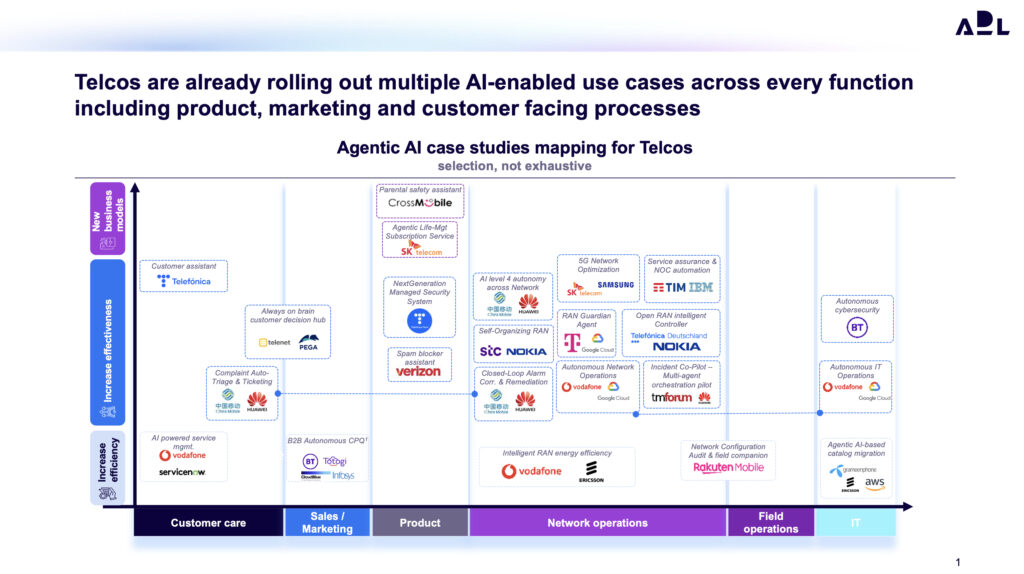
This is especially true in the RAN as deployments by Telefonica, stc, Vodafone, SK Telecom and Deutsche Telekom with Google Cloud (RAN Guardian Agent), as shown.
Deutsche Telekom’s RAN Guardian Agent has attracted much publicity because the operator has applied agentic AI to network operations which are fundamental to every telco and is one of the first instances an AI agent has been applied to the core business of any company. He comments, “I’d say telecoms has done the most interesting agent AI deployment over the last months although let me stress our research is not quantitative.”
Majster says “the low hanging fruit” for agentic AI are mostly related to enterprise resource planning (ERP) as the likes of SAP and Salesforce licences have agentic capabilities embedded in them, but for supporting functions like CRM, finance, accounting and HR, rather than the core capability. “And you could automate accounts receivable and payable with RPA [robotic process automation] 15 years ago,” he adds.
He also says agentic AI is building on GenAI in that “Everything that is related to a strong AI foundation – data governance, data quality and investment – remains more or less the same.” In some ways this is positive – telcos aren’t having to rip it up and start again – but on the other hand, there is a danger it could fail in the same way.
Lack of economic correlation
Majster reckons, “Positive figures around Gen AI are a bit of disappointing,” given that it’s coming up to four years since the tech hit the mainstream. He points out that few jobs – consultants, journalists and to some extent lawyers aside – have had their jobs disrupted.
The picture regarding agentic AI remains unclear, despite its deployment at scale in the US. “This is almost the first time in history where we see possible correlation between [a trend] and growth at national level – GDP – and no positive repercussion on the rate of employment at any level. Another element is that more people who have just graduated haven’t got a job, which is puzzling when we see positive figures in economic terms.
“The benefits are not cascading down into employment and jobs, and this is not related to the situation with Iran and the Middle East. Academics are trying to understand to what extent this is linked to the deployment at scale of agentic AI in large corporations over the last 15 months.”
He continues, “For agentic, we expect to see more and more direct links between use cases and positive business cases eventually…The hunch is that that real disruption, the step change in efficiency, will come not from Generative AI but it might come from agentic AI.…We need to correlate this somehow and come to a definite conclusion.”
Simply replacing humans will fail
What does the “might” depend on? The execution? What your goals are? He answers, “That’s the point – the reason for [potential] failure is the same as for Generative AI. I think increasingly that GenAI has less potential, apart from those jobs we’ve mentioned, but the reasons for agentic’s failure will probably be the same because…the foundations are the same, the operating model is the same.
“If you just try to replace a human with an agent, the gains will not be massive but eventually you will need to manage the agent as well. You will need to add an IT person behind it to maintain the agent, so that’s not the right bet.
“The right bet is how to change and rewire part of the business process or even the operating model to include agents as if there were a new sort of employee, a new kind of end user. The data quality is definitely the main barrier as an enabler of business cases when it comes to agents because it is not a robot like in RPA. An agent is not just to replace a piece of code that clicks on something 24/7 that replaced a human doing it for eight hours a day.”
Orchestration, orchestration, orchestration
Majster draws another parallel with another automation technology, APIs: “An API is a way to interface to OSS. You call the API of another application and get an answer without knowing how the request will be processed. It’s a client-server kind of principle.
“That got messy as modern companies have more than 100 applications and each one was developing its own API. It was hard to find which API was necessary for what without having a kind of inventory and being able to orchestrate different API calls in the right order,” he explains.
The solution to this was business process management (BPM) “as a top layer, to orchestrate APIs across different systems for end-to-end business processes making calls to underpinning applications through APIs. We are at the same stage now with agentic AI although the API example is a more static.”
Not how many but how well they are coordinated
Majster stresses that success with agentic AI “is not about how many agents you have within the company but to what extent are you capable of orchestrating multiple agents to contribute to the same coordinated goal. Otherwise. It’s just a mess of agents that are not correlated.”
He notes that McKinsey is proud of having 25,000 agents in play, “which is almost one agent per person [employee] but the real question is how to orchestrate 25,000 agents?”.
Majster himself is responsible for AI adoption within ADL in Western Europe and is monitoring the use of agents in his own company. “We have found a steep increase in the of use of consultants with the more junior people in our pyramid chatting with ChatGPT. If you double click to see the kind of use cases, it really is just like chatting. It’s not structured. It’s not bringing insight to a specific question. The prompts are exploding, for sure, but it’s not about getting smarter as such.” In other words, use does not automatically mean better outcomes.
Hidden costs of AI for unknown gain
As an aside, it seems Amazon recently reached the same conclusion. At the end of May, the Financial Times [subscription needed] reported, “Amazon has shut down an internal leaderboard that tracked employees’ use of AI tools after workers tried to boost their scores with unnecessary activity that increased the company’s computing costs.”
Other recent research from the AI Work Institute was scathing about the hidden costs of the amount of time employees spend “botsitting” and “botshitting”.
Interestingly, ADL’s research on telcos’ use of agentic AI found, “It’s more bottom-up than top-down,” suggesting an emphasis on specific approved goals rather than quotas imposed by management.
Andy Linham, Vodafone Business’ Principal Strategy Manager, explained in a recent interview with Mobile Europe [watch the playback here or read this article] that being such a heavily regulated industry is “an enabler” – the first step Vodafone took regarding AI was to build a platform, the AI Booster, that polices every AI request to ensure it complies with regulation and company policy.
40% cancel rate by 2027?
What does he make of the prediction by Gartner in June 2025 that more than 40% of agentic AI projects will be cancelled by end of 2027 due to escalating costs, unclear business value or inadequate risk controls?
He says, “I agree [in principle] although I’m not a technologist; that’s why I’m making the link with technologies like RPA and APIs – eventually the same kind of pattern will emerge, when we have more computing power and more data at hand. Agentic AI has more potential, but the intrinsic DNA is more or less the same.”
Majster offers, “My simple, plain advice to most of the companies is you have Salesforce and SAP; deploy agents you already pay for. That will be a good first step…it’s quite structured and a good playground to start deploying agents and to understand how it works. Then we come back to the Deutsche Telekom example – you move to process, which is more fuzzy, more complicated and has consequences if you fail.”
Perhaps it’s not surprising then, that at the recent meeting of Mobile Europe’s Editorial Advisory Board, a number of members – operators and vendors – said they could not stress enough the critical importance of being able to roll back an agentic AI deployment, fast, if something goes wrong to an established stable state. Interestingly, they also felt this is an area that is not receiving the attention it requires.
Further reading: ADL also published AI at the telco edge, where to play, how to win earlier this year.

